
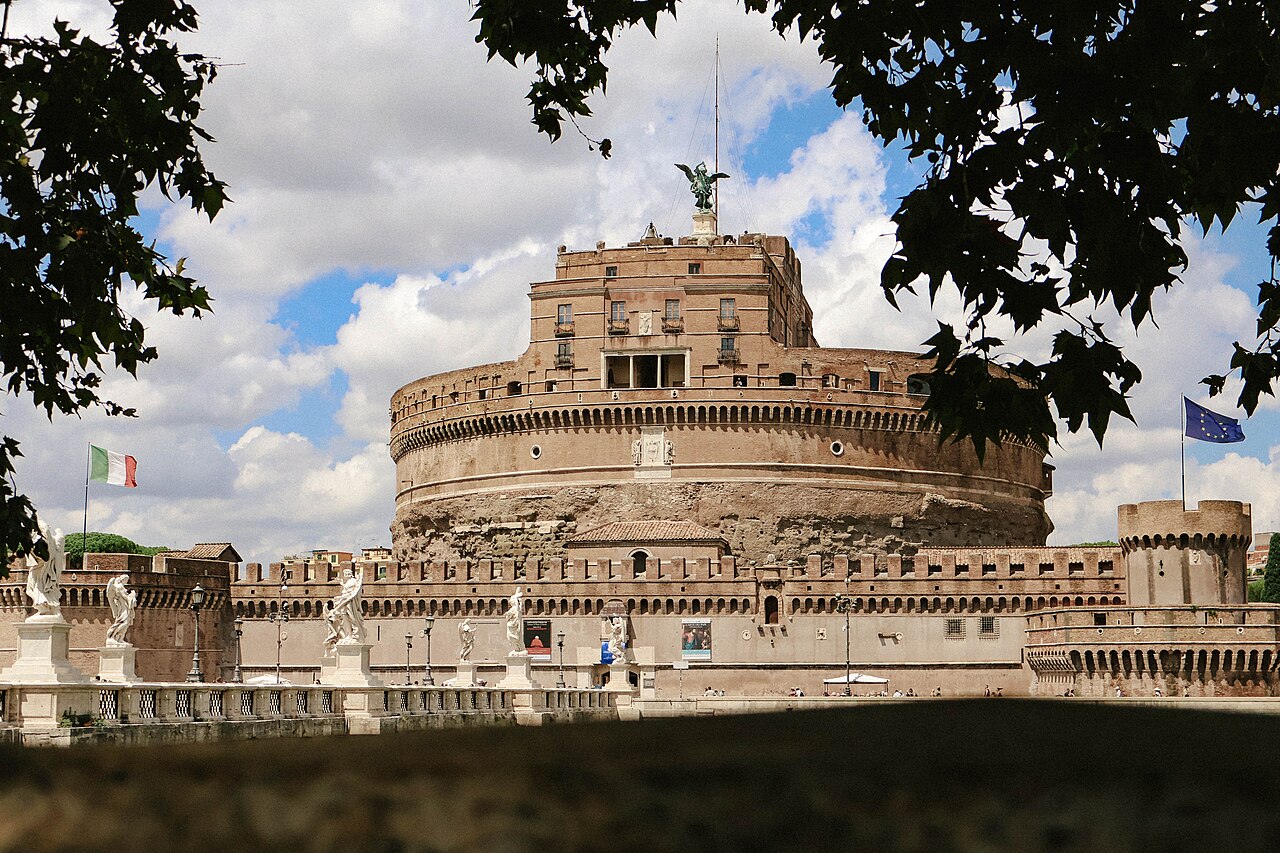
Photo: Labicanense · CC BY 4.0 · Wikimedia Commons
Santo Spirito in Sassia is a church in Rome. Sassia comes from the Saxon pilgrims' quarter, Schola Saxonum. The free Lokali audio guide runs 7 minutes.
✓ Published October 2026 · how we write these guides
Visitor facts
| Lokali audio guide | 7 min · free |
|---|---|
| Type | Church |
| Location | Rome, Italy |
| Coordinates | 41.9014, 12.4611 |
| Official website | divinamisericordia.it |
| Languages | 50+, in the Lokali app |
The story
Stand for a moment on the pavement and listen. Traffic hums along the riverside road behind you, and somewhere a scooter whines toward the Vatican. Yet the stone steps in front of you are cool, and the pale facade holds a calm that the street does not have. You are only a few minutes' walk from Saint Peter's Square, but most visitors rush past this church without a second look. That is a shame, because this corner of Rome carries more than a thousand years of stories.
Start with the name, because it surprises almost everyone. Santo Spirito means Holy Spirit. But Sassia? That word comes from the Saxons. In the early Middle Ages, pilgrims from Anglo-Saxon England travelled across Europe to pray at the tomb of Saint Peter. They settled here, in this quarter beside the Vatican, and the area became known as the Schola Saxonum, the school or community of the Saxons. So the English, in a sense, left their name on Rome.
Tradition links this Saxon settlement to King Ine of Wessex, who is said to have come to Rome and ended his days here in the early eighth century. The story is old and widely repeated, but treat its details with care... medieval sources and later legend blend together. What is certain is that this district held a hostel, a church, and a small world of English pilgrims, far from home. They needed shelter, food, and a place to be buried among friends.
Now turn your attention beside the church, to the long building next door. This is the Hospital of Santo Spirito, and it is one of the oldest hospitals in Europe. Pope Innocent the Third founded it at the end of the twelfth century, replacing the old Saxon hostel. He placed it in the care of a religious order dedicated to the Holy Spirit. For centuries, this complex looked after the sick, the poor, pilgrims, and abandoned children.
That last group brings us to a famous story. Legend has it that Innocent the Third had a troubling dream. In it, fishermen pulled the bodies of drowned infants from the Tiber in their nets. Babies, the tale says, had been abandoned by desperate mothers. Whether or not the dream ever happened, the hospital took in unwanted children for many centuries. The legend explains why the place mattered so much to ordinary Romans.
Here is a detail most visitors miss. Look along the hospital wall for a small opening with a turning wooden drum inside. This is the foundling wheel. A mother could place her baby in the drum, turn it, and ring a bell. Someone inside would take the child, and the mother could walk away unseen. It is a quiet, heavy object. It shows how a city tried to handle poverty and shame without asking questions.
The hospital building you see today owes much to Pope Sixtus the Fourth, who rebuilt it in the late fifteenth century. Inside lies a vast hall known as the Sistine Ward, named after him, like the more famous Sistine Chapel across the way. Long rows of beds once stood beneath its high ceiling. Frescoes along the walls show scenes from the hospital's own history. Parts of the complex are still used for medical and cultural purposes today.
Now look back at the church itself. The building in front of you is not medieval. It was rebuilt in the sixteenth century, during the Renaissance, after an earlier church on this site had suffered damage, including during the terrible Sack of Rome in 1527. The architect Antonio da Sangallo the Younger designed the new church. He was one of the leading builders of his age and also worked on Saint Peter's Basilica nearby.
The facade was finished a little later in the century. Notice how calm and orderly it is. Two storeys of flat pilasters, which are columns pressed into the wall, frame the doorway. A round window sits high in the upper section, and a triangular pediment crowns the top. There is no wild Baroque movement here. Instead, you see the measured balance of the late Renaissance, made from pale stone that turns warm and golden in the afternoon sun.
Step inside, if the doors are open, and let your eyes adjust. The church has a single wide nave, without the rows of columns you find in older basilicas. Chapels open along both sides, each one decorated with paintings and stucco. Much of the decoration comes from Mannerist artists, a style that followed the High Renaissance. Mannerist painters liked long, elegant figures, unusual colours, and crowded scenes. Take a slow walk along one side, then return along the other.
In recent decades, this church has gained a new and very different role. In 1994, Pope John Paul the Second made it a sanctuary of Divine Mercy. This devotion grew from the visions of Saint Faustina Kowalska, a Polish nun of the twentieth century. Her image of Christ, with rays of red and pale light coming from his heart, appears here. Pilgrims from Poland and across the world now come to pray in front of it.
So this small church has served three very different groups of travellers. First came the Saxon pilgrims of the early Middle Ages. Then came the sick and the abandoned, sheltered by the hospital next door. Today come the pilgrims of Divine Mercy, many of them carrying rosaries and quiet requests. Each group used the same patch of ground beside the Tiber. Each one needed comfort, and each found it here, in its own way.
Before you leave, look up at the bell tower rising beside the church. It is a slender Renaissance tower, and it is easy to miss because the dome of Saint Peter's pulls every eye toward it. From the riverside, you can often see both at once, the small tower and the great dome. That view sums up this neighbourhood. Power and fame stand just over there. Here, the story is about care.
As you walk away, glance once more at the hospital wall and that small wooden wheel. Listen to the traffic again, the voices of tourists heading toward the Vatican, the bells that ring now and then from across the Borgo. Most of the people around you will never know that English pilgrims, abandoned infants, and modern believers all passed through this doorway. Now you do. Carry that with you down the street.
Key facts
What to look for
Practical tips
Common questions
Is there a free audio guide to Santo Spirito in Sassia?
Yes — the Lokali app narrates Santo Spirito in Sassia free of charge in 50+ languages. The guide runs about 7 minutes, covers the history, what to look for on site and practical tips, and works offline once downloaded.
Where is Santo Spirito in Sassia?
Santo Spirito in Sassia is in Rome, Italy, at 41.9014, 12.4611. Tap the map link on this page for directions from where you are.
What is Santo Spirito in Sassia known for?
Sassia comes from the Saxon pilgrims' quarter, Schola Saxonum. Pope Innocent the Third founded the hospital in the late twelfth century.
What should you look for at Santo Spirito in Sassia?
The wooden foundling wheel set into the hospital wall. The round window high on the upper facade. The Divine Mercy image with red and pale rays.
What should you know before visiting Santo Spirito in Sassia?
Combine your visit with a walk to Saint Peter's Square nearby. Dress modestly with covered shoulders and knees to enter.
When is the best time to visit Santo Spirito in Sassia?
Come in late afternoon for warm light on the facade.
On the map
Opens directions to Santo Spirito in Sassia from your location.
More to see in Rome


Hear Santo Spirito in Sassia in your language
The full story, narrated, in 50+ languages. Download it before you go and it plays offline, at your own pace, with no ticket and no tour group.