
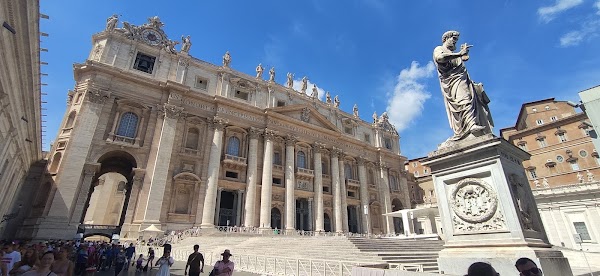
Photo: Jebulon · CC0 · Wikimedia Commons
The Vatican Obelisk is an obelisk in Rome. Carved from one solid piece of Egyptian red granite. The free Lokali audio guide runs 7 minutes.
✓ Published October 2026 · how we write these guides
Visitor facts
| Lokali audio guide | 7 min · free |
|---|---|
| Type | Monument |
| Location | Rome, Vatican City |
| Coordinates | 41.9022, 12.4563 |
| Languages | 50+, in the Lokali app |
The story
Stand still for a moment in the centre of Saint Peter's Square. Under your feet, the cobblestones fan outward in long grey arcs. Pigeons lift and settle. Somewhere behind you, a fountain splashes without pause. And in front of you, a single shaft of reddish granite rises straight into the Roman sky. It carries no carvings and no hieroglyphs. Its surface is plain, polished by weather, and very, very old. This is the Vatican obelisk, and it is older than the city of Rome as a Christian capital.
The stone came from Egypt. It is a monolith, which means it was cut as one solid piece of granite. Including its pedestal and the cross on top, the whole monument stands roughly forty metres high. The shaft alone is about twenty-five metres. Here is the first surprise. Unlike most obelisks in Rome, this one has no hieroglyphs at all. Scholars still debate which pharaoh first ordered it cut. Because the stone is silent, nobody can read its original story from the surface.
What we do know is how it reached Italy. In the first century, the emperor Caligula ordered it brought from Alexandria to Rome. Moving an object this heavy across the Mediterranean was an enormous task. The Roman writer Pliny the Elder described the ship built to carry it. According to Pliny, it was one of the largest vessels the Romans had ever seen. Later, under the emperor Claudius, that same ship was filled with stone and sunk at Ostia. It became part of the foundation for a new harbour.
Caligula did not place the obelisk here, in the square. He placed it a short distance away, in a racetrack on the Vatican hill. This was a circus, a long Roman arena for chariot races. It is often called the Circus of Caligula and Nero, because Nero later used it too. The obelisk stood on the central barrier of the track. Chariots thundered around it, again and again, while crowds shouted from the stands. Imagine the dust, the noise, and the horses.
This racetrack also carries a heavier memory. According to long Christian tradition, Saint Peter was executed near this circus under Nero. Tradition says he was crucified upside down and buried close by on the hillside. Centuries later, the first basilica of Saint Peter rose over that burial site. So for Christians, this granite shaft became something special. It was seen as a silent witness, the last thing standing that may have looked down on the apostle's death. That is tradition, but it shaped how the stone was treasured.
Here is the second surprise. Rome has many ancient obelisks, but almost all of them fell. Earthquakes, wars, and neglect brought them down, and they lay broken or buried for centuries. The Vatican obelisk is the only one in Rome that never fell after antiquity. For more than fifteen hundred years, it stayed upright beside the old basilica. Pilgrims walked past it in the Middle Ages, when the circus had long vanished. It stood in a quiet corner, half forgotten, but whole.
In the Middle Ages, a bronze ball sat on the very top. Locals believed it held the ashes of Julius Caesar. This was a popular legend, not history. When the obelisk was finally moved, the ball was opened. Accounts say it contained only dust. The ball itself survived and is now kept in the Capitoline Museums, across the city. Today a cross crowns the top instead. It is said to hold a relic believed to be a fragment of the True Cross.
The great move came in 1586. Pope Sixtus the Fifth wanted the obelisk at the centre of the space in front of the new Saint Peter's. He gave the job to the engineer and architect Domenico Fontana. Many experts thought it could not be done without breaking the stone. Fontana built a huge wooden tower around the shaft. Teams of hundreds of men and many horses turned dozens of winches at once. The operation took several months from start to finish.
From that day comes a famous story, and we should call it a legend. The pope reportedly ordered total silence during the lift, on pain of death, so workers could hear commands. As the ropes strained and began to smoke, a sailor broke the silence. He shouted that the ropes needed water. The crew soaked the ropes, and they held. Instead of punishment, the story says, his family won a lasting honour. They were granted the right to supply palms for Palm Sunday.
Now look at the base. The obelisk does not sit directly on its pedestal. It rests on four bronze lions, crouching at the corners, as if they carry the weight. Above and around the stone you can see heraldic symbols of the popes who shaped this square. There are mountains and stars, the family emblems of later popes. The Latin inscriptions on the pedestal record the papal moves and dedications. Notice how the old Egyptian stone now carries a Christian message.
The square itself was designed around the obelisk decades later. The sculptor and architect Gian Lorenzo Bernini built the curving colonnades in the seventeenth century. He imagined them as two arms opening to embrace visitors. Two fountains stand on either side of the obelisk, balancing the space. Between the obelisk and each fountain, look for a round stone set in the paving. Stand on one, and the four rows of columns line up behind each other. The colonnade suddenly looks like a single row.
The obelisk also works as a giant sundial. In the early nineteenth century, a meridian line was set into the paving. It runs out from the base, marked with round stones showing the signs of the zodiac. At noon, the shadow of the obelisk falls along this line. Around the base, other marble discs mark the directions of the winds, like a compass laid in the ground. Many visitors walk right over them without noticing. Look down, and you will find them.
So take one last look before you move on. The granite has stood in Egypt, beside a Roman racetrack, next to a medieval basilica, and now at the heart of this square. It has seen chariots, pilgrims, popes, and crowds. Feel the open space around you, and the curve of the columns at your sides. As you walk away toward the basilica or the river, glance back once. The shadow of the obelisk is still moving slowly across the stones.
Key facts
What to look for
Practical tips
Common questions
Is there a free audio guide to The Vatican Obelisk?
Yes — the Lokali app narrates The Vatican Obelisk free of charge in 50+ languages. The guide runs about 7 minutes, covers the history, what to look for on site and practical tips, and works offline once downloaded.
Where is The Vatican Obelisk?
The Vatican Obelisk is in Rome, Vatican City, at 41.9022, 12.4563. Tap the map link on this page for directions from where you are.
What is The Vatican Obelisk known for?
Carved from one solid piece of Egyptian red granite. Caligula brought it from Alexandria in the first century.
What should you look for at The Vatican Obelisk?
Four bronze lions supporting the granite shaft. Zodiac stones set into the paving along the meridian. Marble wind discs arranged around the obelisk's base.
What should you know before visiting The Vatican Obelisk?
Come at midday to watch the shadow on the meridian. Visit early morning to avoid crowds around the base.
When is the best time to visit The Vatican Obelisk?
Visit early morning to avoid crowds around the base.
On the map
Opens directions to The Vatican Obelisk from your location.
More to see in Rome


Hear The Vatican Obelisk in your language
The full story, narrated, in 50+ languages. Download it before you go and it plays offline, at your own pace, with no ticket and no tour group.