
Photo: Burkhard Mücke · CC BY-SA 4.0 · Wikimedia Commons
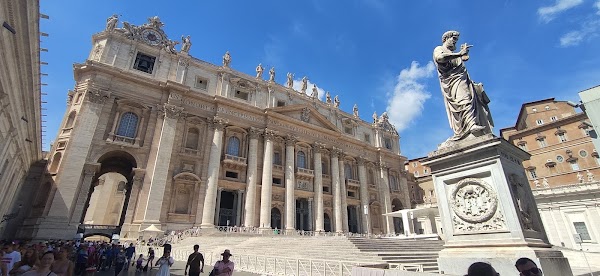
Apostolic Palace is an official residence of the Pope in Vatican City. It is in Rome, Vatican City. Official residence of the Pope inside Vatican City. The free Lokali audio guide runs 7 minutes.
✓ Published October 2026 · how we write these guides
Visitor facts
| Lokali audio guide | 7 min · free |
|---|---|
| Type | Palace |
| Location | Rome, Vatican City |
| Coordinates | 41.9036, 12.4564 |
| Languages | 50+, in the Lokali app |
The story
Stand in Saint Peter's Square and turn slightly to your right. Above the curving colonnade, past the rows of travertine columns, a tall, plain block of buildings rises against the sky. Its walls are a soft ochre and cream. Its windows are tidy and evenly spaced. Pigeons drift along the ledges. On a warm day, the stone pavement gives back the heat under your feet, and the murmur of a hundred languages rolls across the square. That quiet building is the Apostolic Palace.
This is the official residence of the Pope. It is also the working heart of the Vatican, the smallest independent state in the world. Here, popes have lived, governed, prayed and received visitors for centuries. And yet, from the square, it looks almost modest. There is no golden dome, no grand façade of statues. Many visitors walk straight past it on their way to the basilica. That is the first surprise. The real palace is not a single building at all.
It is a whole cluster of buildings, joined over hundreds of years. Wings, courtyards, chapels, libraries, corridors and staircases grew one after another, as each pope added something new. It is often described as having more than a thousand rooms. Some are private offices. Some are reception halls. And some of them hold the most famous paintings in Western art. When people talk about the Vatican Museums, they are walking through parts of this same palace complex.
For much of the Middle Ages, the popes did not live here. Their main home was the Lateran Palace, across the city. Then, in the fourteenth century, the papacy moved to Avignon, in southern France, for several decades. When the popes returned to Rome, the old Lateran was in poor condition. The Vatican Hill, beside the tomb of Saint Peter, slowly became the new centre. Building after building followed through the Renaissance.
The block you see from the square, the one with the papal apartments, dates mainly from the late sixteenth century. It was built under Pope Sixtus the Fifth, with the architect Domenico Fontana. Look at the top floor. On the right side, there is one window that millions of people know. On Sunday at midday, the Pope traditionally appears there to pray the Angelus with the crowd below. A red banner is often hung from the sill. For a few minutes, the whole square looks up together.
Now look toward the end of the right-hand colonnade. There you can find a great bronze door, guarded by men in striped uniforms of blue, red and yellow. They are the Swiss Guard, the Pope's own security force. Their history goes back to the early sixteenth century. The uniforms look theatrical, but these are trained soldiers. Behind that door, a long ceremonial staircase called the Scala Regia climbs into the palace. Gian Lorenzo Bernini, the sculptor who also designed this square, reshaped it with a clever trick of perspective.
Bernini knew the staircase passage was long and narrow. So he made the columns get closer together and the space grow smaller as it rises. To a person standing at the bottom, it looks longer and grander than it really is. It is an illusion built in stone. Most visitors never see it. But it tells you something about this palace. Everything here was designed to impress ambassadors, kings and pilgrims, and to show the authority of the Church.
Inside the complex sits the Sistine Chapel. It takes its name from Pope Sixtus the Fourth, who built it in the late fifteenth century. Its walls were painted by leading artists of the time, including Botticelli and Perugino. Then, in the early sixteenth century, Michelangelo painted the ceiling. He was a sculptor, not mainly a painter, and he did not want the job at first. Decades later, he returned to paint the Last Judgment on the altar wall.
The chapel is not only a museum. It is still a working chapel. When a pope dies or resigns, the cardinals gather here, under Michelangelo's ceiling, to elect his successor. This is the conclave. During that time, a small chimney is fixed to the chapel roof. Black smoke means no decision yet. White smoke means a new pope. Crowds wait in this square for hours, watching that thin pipe against the sky.
Not far from the chapel are the Raphael Rooms. Pope Julius the Second asked the young Raphael to paint a series of rooms for his private use. The best known painting is the School of Athens. It shows the great thinkers of ancient Greece gathered under high arches. Here is a detail many people miss. Raphael is said to have given some of the philosophers the faces of artists he knew, and he placed himself near the edge, looking out at you.
The palace also holds the Vatican Apostolic Library, one of the oldest libraries in the world. Its collection includes ancient manuscripts, early printed books and letters written by popes and princes. It serves scholars, not casual visitors, so you will not walk through its reading rooms. Still, it is worth knowing it is there. Behind these walls, quiet researchers turn pages that are many centuries old, only a short walk from the noise of the square.
Here is a last surprise. Not every recent pope chose to live in the papal apartments. Pope Francis, elected in 2013, preferred a simpler room in a guesthouse inside the Vatican walls, called Casa Santa Marta. He still used the palace for official meetings and appeared at the famous window. The building, in other words, is more than a home. It is a stage, an office, a chapel and an archive, all in one.
Before you move on, look up at that window one more time. Notice how small it is against the long, plain wall. Listen to the fountains in the square, and the soft footsteps on the stones around you. Much of what happens inside this palace is private. But from here, you can see its outline, its guards and its quiet windows. As you walk away, glance back once more. The palace does not try to catch your eye... it simply waits.
Key facts
What to look for
Practical tips
Common questions
Is there a free audio guide to Apostolic Palace?
Yes — the Lokali app narrates Apostolic Palace free of charge in 50+ languages. The guide runs about 7 minutes, covers the history, what to look for on site and practical tips, and works offline once downloaded.
Where is Apostolic Palace?
Apostolic Palace is in Rome, Vatican City, at 41.9036, 12.4564. Tap the map link on this page for directions from where you are.
What is Apostolic Palace known for?
Official residence of the Pope inside Vatican City. The Sistine Chapel is part of the palace complex.
What should you look for at Apostolic Palace?
The Angelus window on the top floor, right side. Swiss Guards in striped uniforms at the Bronze Door. Red banner sometimes hung from the papal window sill.
What should you know before visiting Apostolic Palace?
Book Vatican Museums access ahead to see the palace interiors. Cover shoulders and knees before entering the Sistine Chapel.
On the map
Opens directions to Apostolic Palace from your location.
More to see in Rome



Hear Apostolic Palace in your language
The full story, narrated, in 50+ languages. Download it before you go and it plays offline, at your own pace, with no ticket and no tour group.