
Vatican Necropolis
41.9023° N · 12.4533° E · Archaeological Site
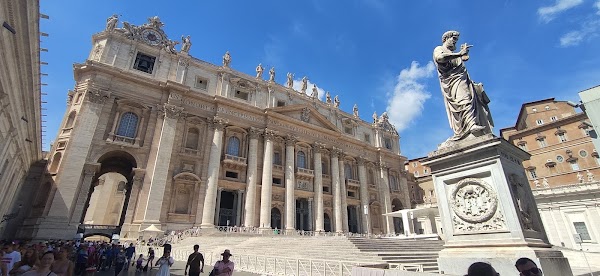
Photo: Blue 439 · CC BY-SA 3.0 · Wikimedia Commons
Vatican Necropolis is a cemetery underneath the Vatican City. It is in Rome, Vatican City. Excavations began in 1939 during preparations for a papal burial. The free Lokali audio guide runs 7 minutes.
✓ Published October 2026 · how we write these guides
Visitor facts
| Lokali audio guide | 7 min · free |
|---|---|
| Type | Archaeological Site |
| Location | Rome, Vatican City |
| Coordinates | 41.9023, 12.4533 |
| Languages | 50+, in the Lokali app |
The story
The air changes first. A few steps below Saint Peter's Basilica, it turns warm, close and damp, like the inside of a greenhouse at night. The noise of the piazza disappears. You hear shoes on old brick, the low voice of your guide, and the soft hum of the machines that keep the humidity under control. You are now walking along a Roman street that was buried on purpose, about seventeen centuries ago.
This is the Vatican Necropolis, often called the Scavi, which simply means the excavations. A necropolis is a city of the dead, and that is a fair description. Rows of family tombs line a narrow lane, built of thin red bricks with doorways, inscriptions and small windows. In ancient Rome, burials were not allowed inside the city walls. So families built their tombs along roads outside, and this slope of the Vatican hill was one of those places.
Picture the area as it looked in the first centuries after Christ. There was no basilica here, no dome, no colonnade. There was a hillside, a road, and nearby, a large chariot-racing track known as the Circus of Gaius and Nero. Christian tradition holds that the apostle Peter was executed in this area during the persecutions under the emperor Nero, and that his followers buried him close by, in a simple grave on the hill.
Over the next two centuries, the hillside filled with tombs. Most of what you see now dates from the second and third centuries. Many of the families were pagan. They decorated their tombs with painted birds, garden scenes, and figures from Greek and Roman myth. Some families were Christian, and some tombs seem to mix the two worlds. Walking here, you can see a city slowly changing its beliefs, one family at a time.
Then, in the fourth century, everything changed. The emperor Constantine, the first Roman emperor to support Christianity, decided to build a great church over the place where Christians honoured Peter's grave. This created a serious engineering problem. The ground sloped steeply, and the hillside was covered in tombs. Constantine's builders solved it in a dramatic way. They cut into the hill on one side, and on the other side they filled the tombs with earth.
That is the first surprise of this place. The tombs were not destroyed. Roofs were removed and the chambers were packed solid with soil to create a flat platform for the basilica. Burying the city of the dead preserved it. The paintings, the stucco, and the inscriptions stayed sealed in darkness for more than sixteen hundred years. Even when the old basilica was replaced by the present one during the Renaissance, this layer stayed largely untouched.
The tombs came back to light almost by accident. In 1939, workers were preparing space in the Vatican Grottoes, the level just under the basilica floor, for the burial of Pope Pius XI. They found evidence of older structures below. His successor, Pope Pius XII, authorised a systematic excavation. The work went on through the years of the Second World War and into the following decade, carried out quietly and with great care under the most important church in the Catholic world.
As you walk, look closely at the mausoleum known as the Tomb of the Julii, if your route includes it. On its ceiling is a mosaic of gold and green tiles. A figure rides a chariot across the sky, with rays of light around his head, inside a frame of vine leaves. Many scholars read this as Christ shown in the style of the sun god. It is often described as one of the earliest Christian mosaics known. Here, an old Roman image was given a new Christian meaning.
The path leads uphill, towards the area directly beneath the high altar of the basilica. Archaeologists found a small open space here, called Field P, with a red-plastered wall. Against this wall stood the remains of a modest monument, a little shrine with columns and niches. An early Roman Christian writer, around the year 200, mentioned a memorial to Peter on the Vatican hill. Many historians connect that memorial with this shrine. Today it is often called the Trophy of Gaius, after that writer.
Next to the red wall stands a later supporting wall covered in scratched graffiti. These are prayers and names left by ancient visitors, scratched with whatever sharp object they carried. In the decades after the excavation, the archaeologist Margherita Guarducci studied these marks closely. She argued that some of them referred to Peter. Her work also led to a set of bones found in a niche in this wall, which she identified as the apostle's remains.
This is the second surprise, and an honest one. The identification is not universally accepted. In 1950, Pope Pius XII announced that the tomb of Peter had been found. In 1968, Pope Paul VI said that the bones had been identified in a way the Church considered convincing. Some archaeologists still question parts of the evidence. What everyone agrees on is this: Christians were honouring this exact spot by the second century, and every later church was built around it.
Stand still for a moment near the end of the route. Directly above you, layer on layer, rise the Constantinian foundations, the papal altar, and Bernini's bronze canopy, and above that, Michelangelo's dome. The entire basilica is aligned to this small patch of earth. Architects did not choose the location for convenience. They accepted a difficult hillside because of one grave, and they built the largest church of its age on top of it.
When you climb back towards the daylight, notice how the air dries and cools. The voices of the piazza return, and the crowds in the basilica feel enormous after the narrow lane below. Take a last look at the brick under your hand, the faded painted walls, the quiet street. Most people above you will never know it exists. You now carry a picture of Rome in two layers... the city that everyone sees, and the city that holds it up.
Key facts
What to look for
Practical tips
Common questions
Is there a free audio guide to Vatican Necropolis?
Yes — the Lokali app narrates Vatican Necropolis free of charge in 50+ languages. The guide runs about 7 minutes, covers the history, what to look for on site and practical tips, and works offline once downloaded.
Where is Vatican Necropolis?
Vatican Necropolis is in Rome, Vatican City, at 41.9023, 12.4533. Tap the map link on this page for directions from where you are.
What is Vatican Necropolis known for?
Excavations began in 1939 during preparations for a papal burial. Most tombs date from the second and third centuries.
What should you look for at Vatican Necropolis?
Gold and green ceiling mosaic in the Tomb of the Julii. Thin red Roman bricks framing the tomb doorways. Scratched ancient graffiti covering the wall beside the red wall.
What should you know before visiting Vatican Necropolis?
Book through the Vatican Excavations Office well in advance. Visits run in small guided groups with age restrictions.
When is the best time to visit Vatican Necropolis?
Arrive early at the meeting point near the Swiss Guard.
On the map
Opens directions to Vatican Necropolis from your location.
More to see in Rome



Hear Vatican Necropolis in your language
The full story, narrated, in 50+ languages. Download it before you go and it plays offline, at your own pace, with no ticket and no tour group.