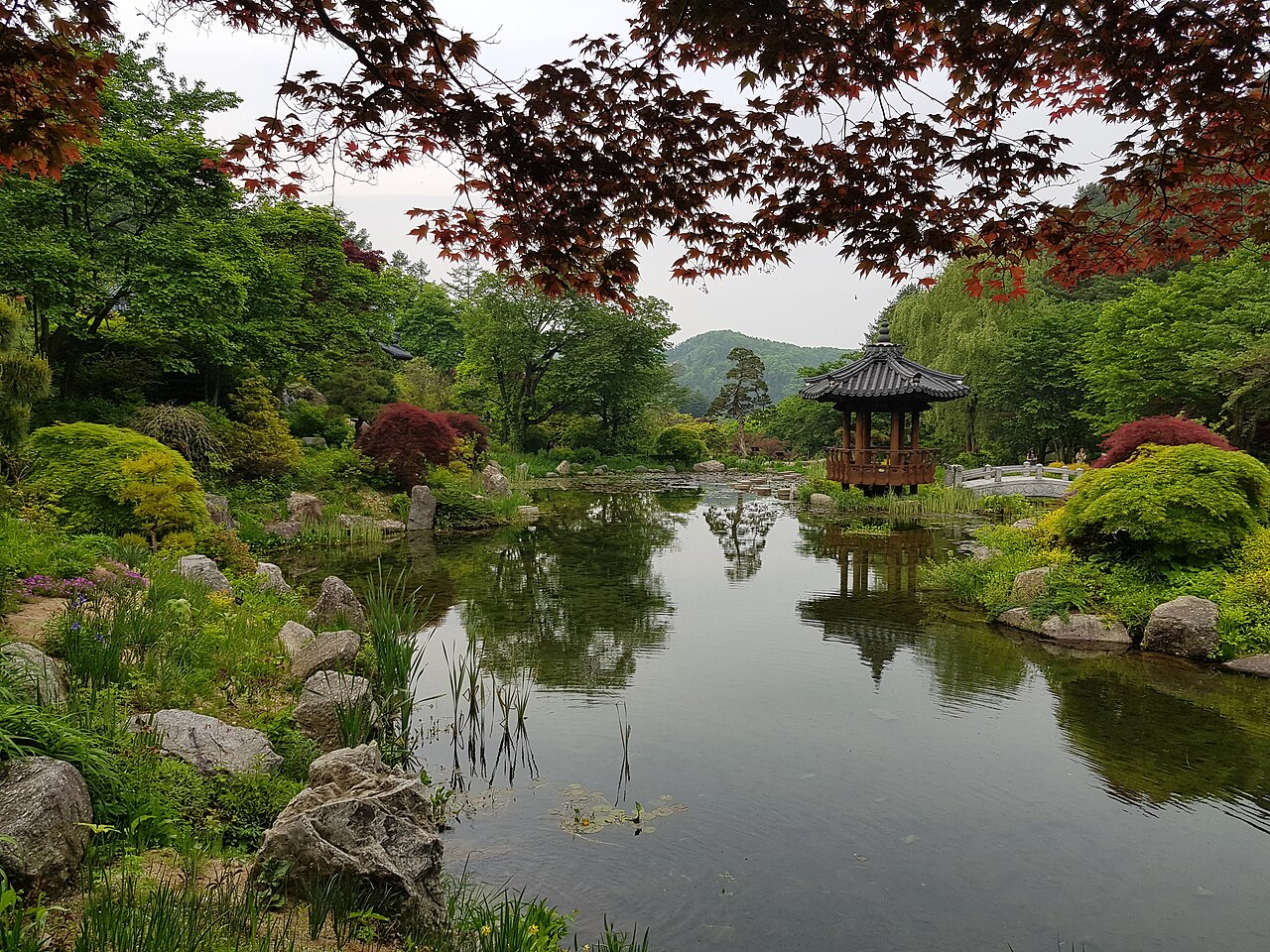
Garden of Morning Calm is a 30,000-square-metre private botanical garden near Gapyeong featuring themed zones: rose garden, water garden, woodland paths, and seasonal flower displays. It is in Seoul, South Korea. Most visitors spend 2–3 hours here. The free Lokali audio guide runs 5 minutes.
✓ Verified August 2026 · how we write these guides
Visitor facts
| Time needed | 2–3 hours |
|---|---|
| Lokali audio guide | 5 min · free |
| Type | Garden |
| Best for | Photography |
| Location | Seoul, South Korea |
| Coordinates | 37.7280, 127.5180 |
| Languages | 45, in the Lokali app |
The story
You step through the gate, and the air smells of soil and leaves. Paths curve away in front of you, lined with flowers and low shrubs. The ground rises and falls in gentle folds. Birds call from the trees. This is a garden made by hand over many years, set among the hills of Gapyeong.
It is called the Garden of Morning Calm. The name comes from an old name for Korea itself, which was once called the Land of the Morning Calm. The garden took that quiet phrase and made it into a place you can walk through. It sits among the hills, away from the noise of the city.
The garden was opened in 1996. It was founded by a professor of horticulture, a man named Han Sang-kyung, who wanted to show the beauty of Korean plants and Korean garden design. It is one of the oldest private gardens in the country. What began as a personal project grew, year by year, into the wide grounds you see today.
The design follows the shape of the land. Rather than flatten the hills, the makers worked with their curves. Paths wind along the slopes. Streams run down through the beds. Open lawns lie between groves of trees. The plan is meant to feel natural, as if the garden had grown on its own, though every part of it was chosen with care.
The grounds are divided into many smaller gardens, each with its own character. There is a sunken garden set below the path. There is a garden of wildflowers. There are beds shaped to be seen from above, their colors forming patterns across the slope. You move from one mood to the next as you walk along.
Each season brings its own flowers. Spring opens with bulbs and blossom. Summer fills the beds with deep color and the lawns with green. Autumn turns the leaves to red and gold and brings out the chrysanthemums. The garden is planted so that something is always in bloom, from the first warm days to the last.
The most famous time is winter, though the flowers are gone by then. Through the cold months the garden is hung with many thousands of small lights. The trees and paths are outlined in color after dark. People come in the evening, in heavy coats, to walk among the glowing shapes while their breath shows in the cold air.
Walk slowly and look closely. The garden rewards your attention. A small stream may hold stepping stones. A bed may be edged with moss. Old pots and stone pieces are set among the plants. The makers thought about the near view as well as the far one, about what lies at your feet as well as what fills the hillside.
There are quiet places to rest. Benches sit at the turns of the path, placed where the view is best. Small pavilions give shelter and shade. You can sit and watch the light move across the beds, or listen to the water, or simply breathe the cool air that comes down off the surrounding hills.
The garden is also a place of learning. It holds many kinds of plants, both wild and cultivated, gathered and labeled with care. Students of horticulture come to study here. For the ordinary visitor, it is a chance to see how a garden can be both a work of beauty and a living collection at once.
Photographers love this place. The curving beds, the layered slopes, and the changing light give endless views. In the lighting season the camera finds color everywhere after dark. But even without a camera, the garden asks you to slow down and use your own eyes, and that is perhaps its first and best gift.
The garden marks the turning of the year with festivals. Spring brings a display of bulbs and blossom. Summer has its roses. Autumn fills the beds with chrysanthemums and turns the maples red. Each festival draws its own crowd, but the grounds are wide enough to absorb them. Even on a busy day you can find a corner where you hear only water and wind, and the calls of birds in the trees above.
Before you leave, find a high point on the path and look back across the grounds. The beds fall away below you in waves of color. The hills rise beyond. This place was built slowly, by people who loved plants, and it keeps the old promise of its name. For a moment, the morning is calm. Carry that calm out the gate.
Key facts
What to look for
Practical tips
Common questions
How long do you need at Garden of Morning Calm?
Plan 2–3 hours. That is the time most visitors spend at Garden of Morning Calm. The free Lokali audio guide adds about 5 minutes of narration you can listen to as you walk, so it fits inside your visit rather than adding to it.
Is there a free audio guide to Garden of Morning Calm?
Yes — the Lokali app narrates Garden of Morning Calm free of charge in 50+ languages. It covers the history, what to look for on site and practical tips, and it works offline once downloaded.
Where is Garden of Morning Calm?
Garden of Morning Calm is in Seoul, South Korea, at 37.7280, 127.5180. Tap the map link on this page for directions from where you are.
What should you know before visiting Garden of Morning Calm?
Visit after dark during the winter lighting season.
What is Garden of Morning Calm known for?
Opened in 1996 in the Gapyeong hills.
What is the best time to visit Garden of Morning Calm?
The morning mist lingers longest in the valley garden.
On the map
Opens directions to Garden of Morning Calm from your location.
More to see in Seoul


Hear Garden of Morning Calm in your language
The full story, narrated, in 50+ languages. Download it before you go and it plays offline, at your own pace, with no ticket and no tour group.