
Banteay Srei
13.5989° N · 103.9629° E · Archaeological Site
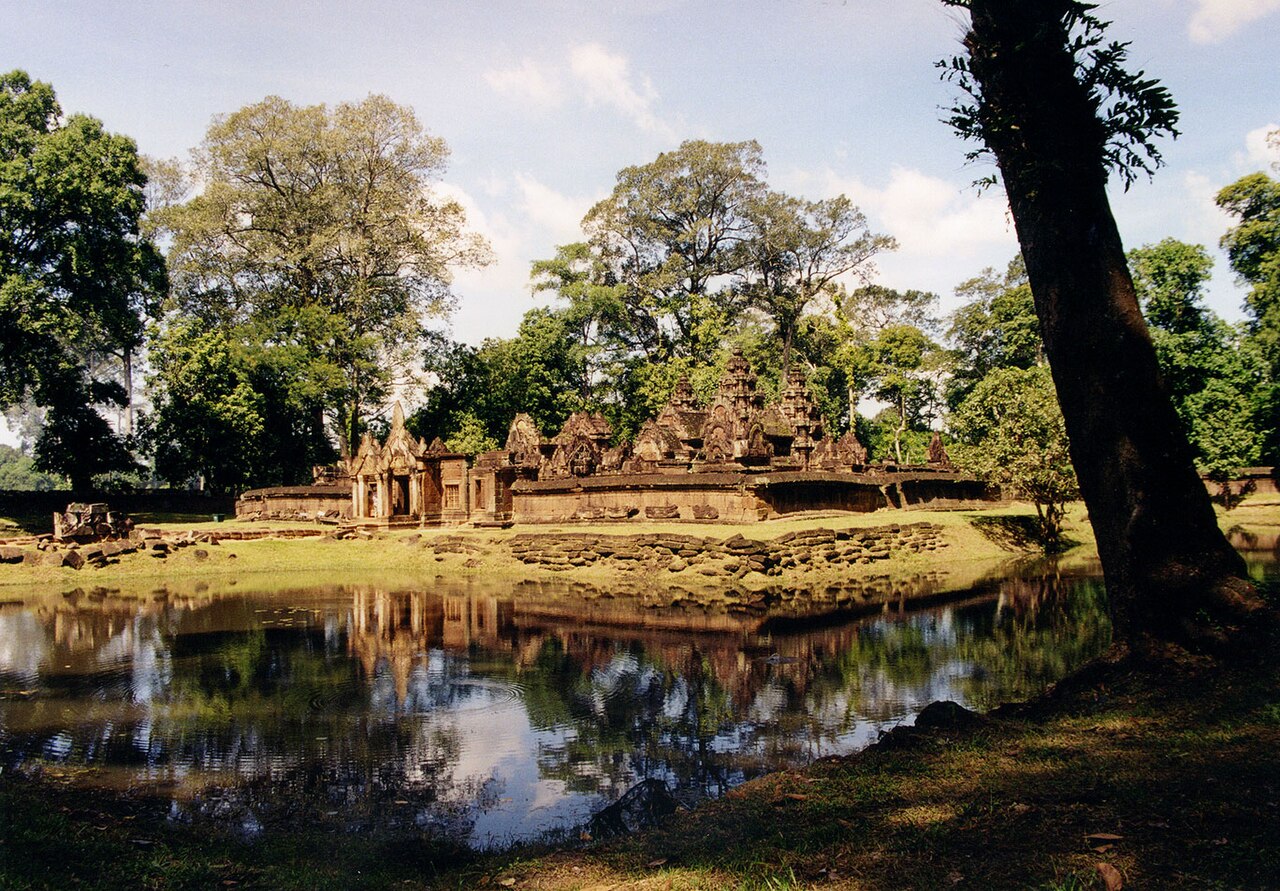
Photo: Tsui · CC BY-SA 3.0 · Wikimedia Commons
Banteay Srei is a temple. It is in Siem Reap, Cambodia. Built in 967 by a Brahmin counselor, not royalty. The free Lokali audio guide runs 6 minutes.
✓ Published October 2026 · how we write these guides
Visitor facts
| Lokali audio guide | 6 min · free |
|---|---|
| Type | Archaeological Site |
| Location | Siem Reap, Cambodia |
| Coordinates | 13.5989, 103.9629 |
| Languages | 50+, in the Lokali app |
The story
Run your fingers over the carved pink sandstone — though you cannot actually touch it anymore, you can see how the stone would feel. Warm, smooth, almost buttery. This is the first thing that sets Banteay Srei apart from every other Angkorian temple. The stone itself is different. Softer, finer-grained, the color of a sunset caught in rock.
The name means Citadel of Women, though no women ruled here. Some say it refers to the delicacy of the carvings, too intricate for men's hands — a romantic fiction, but one that speaks to how startling the detail is. Built in 967, this temple predates Angkor Wat by nearly two centuries. It was not a royal commission. A Brahmin counselor named Yajnavaraha built it as a private act of devotion to Shiva, far from the capital, deep in what was then forest.
The scale surprises everyone. Banteay Srei is tiny by Angkorian standards. The central sanctuary stands barely taller than a person. You could walk the entire complex in ten minutes if you rushed. But no one rushes here. The carvings hold you. Every surface is worked — lintels, pediments, doorframes, false doors, library walls. Apsaras dance in freeze-frame. Demons grimace. Gods ride their mounts across stone oceans. The detail reaches a level found nowhere else in Cambodia, possibly because the softer sandstone allowed sculptors to carve with a precision impossible in the harder gray stone used at Angkor Wat.
Look closely at the eastern gopura pediment. It shows the demon king Ravana shaking Mount Kailash, trying to dislodge Shiva from his throne. Shiva presses down with one toe and the mountain settles, trapping Ravana beneath. You can see the strain in Ravana's multiple arms, the calm in Shiva's posture. The narrative reads like a comic strip carved in stone, each figure's emotion legible across a thousand years.
The temple was looted repeatedly over the centuries. In 1923, a French writer named André Malraux attempted to steal four major carvings, prying them off the walls with crowbars. He was caught, arrested, and the pieces returned. The scandal made international news. Today those same panels sit behind protective barriers, and the Cambodian government watches Banteay Srei more carefully than almost any other site.
The pink deepens as the day progresses. Early morning light makes the stone glow pale rose. By late afternoon it burns coral, almost red. Photographers chase this light obsessively. The temple faces east, so the front facades catch the sunrise directly, every carved detail thrown into sharp relief by the low angle. By midday the sun is overhead and the contrast flattens. By four in the afternoon the western light rakes across the carvings again, and the stone seems to ignite.
Banteay Srei sits thirty-two kilometres northeast of Angkor Wat, a forty-minute drive through flat rice country and small villages. Most visitors arrive mid-morning after the main temples, which means the site is quieter than it deserves to be at dawn. The complex is small enough that crowding becomes a problem quickly. Twenty people in the central courtyard and it feels packed. Fifty and you are jostling for clear photos.
The restoration work here has been meticulous. The French began in the 1930s, using a technique called anastylosis — dismantling the structure stone by stone, documenting each piece, then rebuilding from the ground up, replacing only what is missing or too damaged to reuse. The method worked so well at Banteay Srei that it became the model for later projects across Angkor. Walk around the back of the libraries and you can see which stones are original and which are replacement — the new ones lack the weathered patina, the edges still crisp.
The inscriptions on the doorposts record donations, prayers, the names of priests who served here. One records the gift of land to support the temple, another the installation of a linga, the phallic symbol of Shiva, in the central shrine. These are administrative texts, not poetry, but they root the temple in lived history. Real people brought rice and cattle here, real priests chanted at dawn, real pilgrims walked these same stones barefoot.
Stand in the central courtyard and turn slowly. The layout is compact, symmetrical, almost domestic in scale. Two small libraries flank the walkway. Three towers rise in a row, the central one tallest but still modest. The whole composition feels balanced, considered, human. This is not a monument to imperial power. It is a prayer made solid, a private conversation with the divine that happened to be carved in stone fine enough to last a millennium.
As you walk back toward the entrance, look at the causeway lining stones. Many are carved with lotus petals, guardian figures, geometric patterns. Even the infrastructure here received attention. Even the parts no one was meant to notice. That is the signature of Banteay Srei — nothing was too small to perfect. The light is changing as you leave, the pink stone shifting tone again, and you realize the temple is never quite the same color twice.
Key facts
What to look for
Practical tips
Common questions
Is there a free audio guide to Banteay Srei?
Yes — the Lokali app narrates Banteay Srei free of charge in 50+ languages. The guide runs about 6 minutes, covers the history, what to look for on site and practical tips, and works offline once downloaded.
Where is Banteay Srei?
Banteay Srei is in Siem Reap, Cambodia, at 13.5989, 103.9629. Tap the map link on this page for directions from where you are.
What is Banteay Srei known for?
Built in 967 by a Brahmin counselor, not royalty. Carved from pink sandstone softer than other Angkorian temples.
What should you look for at Banteay Srei?
Ravana shaking Mount Kailash on the eastern gopura pediment. Replacement stones with crisp edges on library backs. Lotus petal carvings on the causeway lining stones.
What should you know before visiting Banteay Srei?
Arrive at dawn for pink stone glow and fewer crowds. Bring a zoom lens for carving details behind barriers.
When is the best time to visit Banteay Srei?
Arrive at dawn for pink stone glow and fewer crowds.
On the map
Opens directions to Banteay Srei from your location.
More to see in Siem Reap


Hear Banteay Srei in your language
The full story, narrated, in 50+ languages. Download it before you go and it plays offline, at your own pace, with no ticket and no tour group.