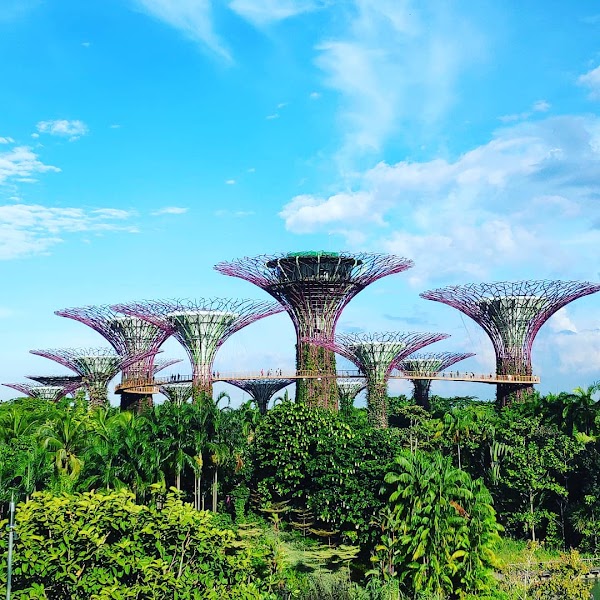
Gardens by the Bay is a 101-hectare horticultural garden featuring two biodomes (Cloud Forest and Flower Dome) and the iconic Supertree Grove — 18 artificial trees up to 50 metres tall that light up at…. It is in Singapore. Most visitors spend 2–3 hours here. The free Lokali audio guide runs 9 minutes.
✓ Verified August 2026 · how we write these guides
Visitor facts
| Time needed | 2–3 hours |
|---|---|
| Lokali audio guide | 9 min · free |
| Type | Park |
| Best for | Family |
| Location | Singapore, Singapore |
| Coordinates | 1.2816, 103.8636 |
| Languages | 45, in the Lokali app |
The story
The air here feels different — cooler than the rest of Singapore, threaded with the scent of orchids and wet earth. Around you, steel and concrete trees rise eighteen stories into the sky, their canopies hung with ferns and bromeliads. This is Gardens by the Bay, a hundred and one hectares of reclaimed land that opened in two thousand and twelve, proof that a city-state with almost no natural resources could engineer its own Eden.
Singapore has always been a city of pragmatic dreamers. When the British arrived in eighteen nineteen, they found a swampy island with six hundred people and turned it into the busiest port in Southeast Asia. By the nineteen sixties, independence brought a new challenge — how to build a nation on a tropical rock with no hinterland, no fresh water, no farmland. Lee Kuan Yew, the country's first prime minister, had an answer: make Singapore a garden. Plant trees along every road. Green the housing estates. Show the world that a modern city could also be lush.
But Gardens by the Bay took that vision further. The land beneath your feet did not exist fifty years ago. It was dredged from the seabed and stabilized in the early two thousands, part of a massive reclamation project that pushed Singapore's coastline outward. The government held an international design competition in two thousand and six. Two British firms — Grant Associates and Wilkinson Eyre — won with a concept that mixed horticulture and engineering at a scale no one had attempted before.
Those towering structures — the Supertrees — are not decorative. Each one is a vertical garden wrapped around a steel frame, designed to collect rainwater, generate solar power, and vent hot air from the glasshouses below. The tallest reaches fifty metres. At night they pulse with light, choreographed to music, but their real work happens quietly all day — photovoltaic cells on the canopies feed energy back into the park, and the trunks channel rainwater into underground reservoirs. Singapore imports most of its fresh water from Malaysia. Every litre captured here is a litre the island does not have to buy.
The two glasshouses — the Cloud Forest and the Flower Dome — are climate-controlled biomes, each replicating ecosystems that could never survive in Singapore's heat. The Flower Dome is the largest columnless glasshouse in the world, spanning one point two hectares under a single arched roof. Inside, the temperature holds steady at twenty-three degrees Celsius. Mediterranean plants — olive trees, succulents, proteas from South Africa — grow in beds of engineered soil. The Cloud Forest houses a thirty-five-metre artificial mountain wrapped in mist, its slopes planted with species from tropical highlands. Water cascades down the centre in the tallest indoor waterfall on earth.
This is expensive nature. The park cost over a billion Singapore dollars to build, and it runs on cutting-edge systems — sensors monitor every plant, algorithms adjust humidity and light, desalination units pull drinking water from the sea. Critics called it a Disneyland for plants, artificial and wasteful. But Singapore's leaders saw it differently. The city-state has no oil, no minerals, no space to sprawl. What it has is knowledge — engineers, botanists, architects who can turn swamp into forest and sand into soil. Gardens by the Bay is a laboratory as much as a park, testing whether technology can sustain green space in a world running out of land.
The history here is not ancient, but it reflects a longer story. Singapore has always lived by reinvention. The port that fed the British Empire became a Japanese stronghold in World War Two, then a manufacturing hub, then a financial centre. Each transformation required the city to imagine itself anew. Gardens by the Bay is the latest chapter — a bet that in the twenty-first century, nature itself can be designed, that a garden does not have to be inherited from the past but can be built for the future.
Walk the elevated skyway between the Supertrees and you will see the city skyline to the south — glass towers, container cranes, the haze of the shipping lanes. To the north, the green slope of the park rolls toward the reservoir. Fifty years ago this was open water. In fifty more, who knows. Singapore keeps building, keeps filling in the sea. But for now, this garden holds.
Stand still for a moment beneath the Supertrees. Listen to the hum of the ventilation systems, the rustle of the ferns overhead, the distant sound of water cycling through pipes. This is what a twenty-first-century forest sounds like — part machine, part living thing, engineered to survive in a city that refuses to choose between concrete and green. It is not wilderness. It is something else entirely, and that may be the point.
Key facts
What to look for
Practical tips
Common questions
How long do you need at Gardens by the Bay?
Plan 2–3 hours. That is the time most visitors spend at Gardens by the Bay. The free Lokali audio guide adds about 9 minutes of narration you can listen to as you walk, so it fits inside your visit rather than adding to it.
Is there a free audio guide to Gardens by the Bay?
Yes — the Lokali app narrates Gardens by the Bay free of charge in 50+ languages. It covers the history, what to look for on site and practical tips, and it works offline once downloaded.
Where is Gardens by the Bay?
Gardens by the Bay is in Singapore, Singapore, at 1.2816, 103.8636. Tap the map link on this page for directions from where you are.
What should you know before visiting Gardens by the Bay?
Visit Cloud Forest first when morning mist is thickest.
What is Gardens by the Bay known for?
Opened in two thousand and twelve on reclaimed seabed.
What is the best time to visit Gardens by the Bay?
The Supertree canopy walk (between two trees) offers a rare elevated vantage of the park.
On the map
Opens directions to Gardens by the Bay from your location.
More to see in Singapore


Hear Gardens by the Bay in your language
The full story, narrated, in 50+ languages. Download it before you go and it plays offline, at your own pace, with no ticket and no tour group.