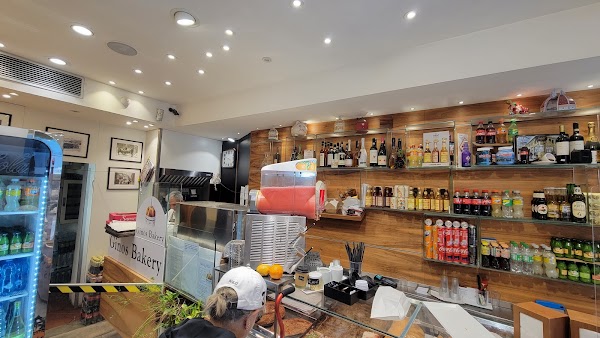
Gino Bread Factory is a working bakery and café in the Vake district famous for its wood-fired traditional Georgian bread and pastries. It is in Tbilisi, Georgia. Most visitors spend 20–30 min here. The free Lokali audio guide runs 9 minutes.
✓ Verified August 2026 · how we write these guides
Visitor facts
| Time needed | 20–30 min |
|---|---|
| Lokali audio guide | 9 min · free |
| Type | Bakery |
| Best for | Local life |
| Location | Tbilisi, Georgia |
| Coordinates | 41.7092, 44.7703 |
| Languages | 45, in the Lokali app |
The story
The smell hits you first — warm yeast and toasted grain, drifting out from the open loading bay where metal racks of fresh loaves cool in the morning air. This is not a museum reconstruction or a heritage display. The Gino Bread Factory is a working bakery, turning out thousands of loaves a day, and the hum of machinery inside is the same rhythm that has run here for decades.
Gino started small, a single oven and a handful of workers, supplying bread to nearby neighborhoods when industrial baking was just beginning to replace the corner bakehouse. Over the years, the operation expanded — more ovens, larger mixers, delivery trucks instead of handcarts — but the core process stayed recognizable. Flour, water, salt, yeast. Time and heat. The simplicity is deceptive; getting it right at scale takes precision.
Step closer to the entrance and you can see through the wide doorway into the production floor. Stainless steel mixers churn dough in slow, patient arcs. Workers in white aprons move between stations, shaping rounds and loading trays. The timing is choreographed — dough needs to rise at the right temperature, bake at the right moment, cool without collapsing. Miss a step and the whole batch fails.
The bread that comes out of Gino is straightforward — round country loaves, oblong sandwich bread, sometimes flatbreads or rolls depending on the season. No sourdough experiments or artisan branding. This is daily bread, the kind that shows up on breakfast tables and in corner shops, reliable and unpretentious. For many locals, Gino is simply where the bread comes from, a fixture so constant it fades into the background of everyday life.
But there is craft here, even in the repetition. The bakers know how humidity changes the dough, how altitude affects rising time, how to read the crust color to judge doneness without a thermometer. These are skills passed down through shifts and seasons, learned by watching and adjusting, not from manuals. The factory preserves a kind of knowledge that thrives in motion, in the doing.
If you visit in the early morning, you might catch the shift change — one crew finishing the overnight bake, another arriving to start the day's production. The air is cooler then, the streets quieter, and the bread racks outside are stacked high, waiting for the delivery vans. There is something grounding about seeing food made at this scale, the industrial and the elemental overlapping in the same space.
The building itself is functional — concrete floors, high ceilings for ventilation, wide doors for loading. No ornament, no historical plaques. The architecture serves the process, nothing more. But that plainness has its own honesty. This is a place built to work, and it works still.
Around the factory, the neighborhood has changed. New shops, different traffic patterns, residents who may not remember when Gino first opened. But the bakery remains, adapting quietly — new equipment when the old breaks, updated health standards, shifts in customer demand — without losing the thread of what it does. Bread, every day, on time.
Stand near the loading bay for a few minutes and you will see the rhythm. A worker wheels out a rack, checks the loaves, wheels it back in. A truck pulls up, doors open, trays slide into place. The factory breathes in flour and breathes out bread, a cycle so regular it becomes invisible until you stop and watch.
Before you leave, notice the dust on the windowsills — not dirt, but a fine coating of flour that settles everywhere in a working bakery. It catches the light, a reminder that this is not a sanitized tour but a living operation. The bread you might buy at a shop down the street passed through these hands, these ovens, this air. That connection, modest and direct, is what makes Gino worth noticing — not for spectacle, but for the quiet persistence of making something necessary, day after day.
Key facts
What to look for
Practical tips
Common questions
How long do you need at Gino Bread Factory?
Plan 20–30 min. That is the time most visitors spend at Gino Bread Factory. The free Lokali audio guide adds about 9 minutes of narration you can listen to as you walk, so it fits inside your visit rather than adding to it.
Is there a free audio guide to Gino Bread Factory?
Yes — the Lokali app narrates Gino Bread Factory free of charge in 50+ languages. It covers the history, what to look for on site and practical tips, and it works offline once downloaded.
Where is Gino Bread Factory?
Gino Bread Factory is in Tbilisi, Georgia, at 41.7092, 44.7703. Tap the map link on this page for directions from where you are.
What should you know before visiting Gino Bread Factory?
Visit early morning to see shift change and fresh racks.
What is Gino Bread Factory known for?
Working bakery producing thousands of loaves daily.
What is the best time to visit Gino Bread Factory?
Arrive before noon when the bread comes fresh from the oven.
On the map
Opens directions to Gino Bread Factory from your location.
More to see in Tbilisi


Hear Gino Bread Factory in your language
The full story, narrated, in 50+ languages. Download it before you go and it plays offline, at your own pace, with no ticket and no tour group.