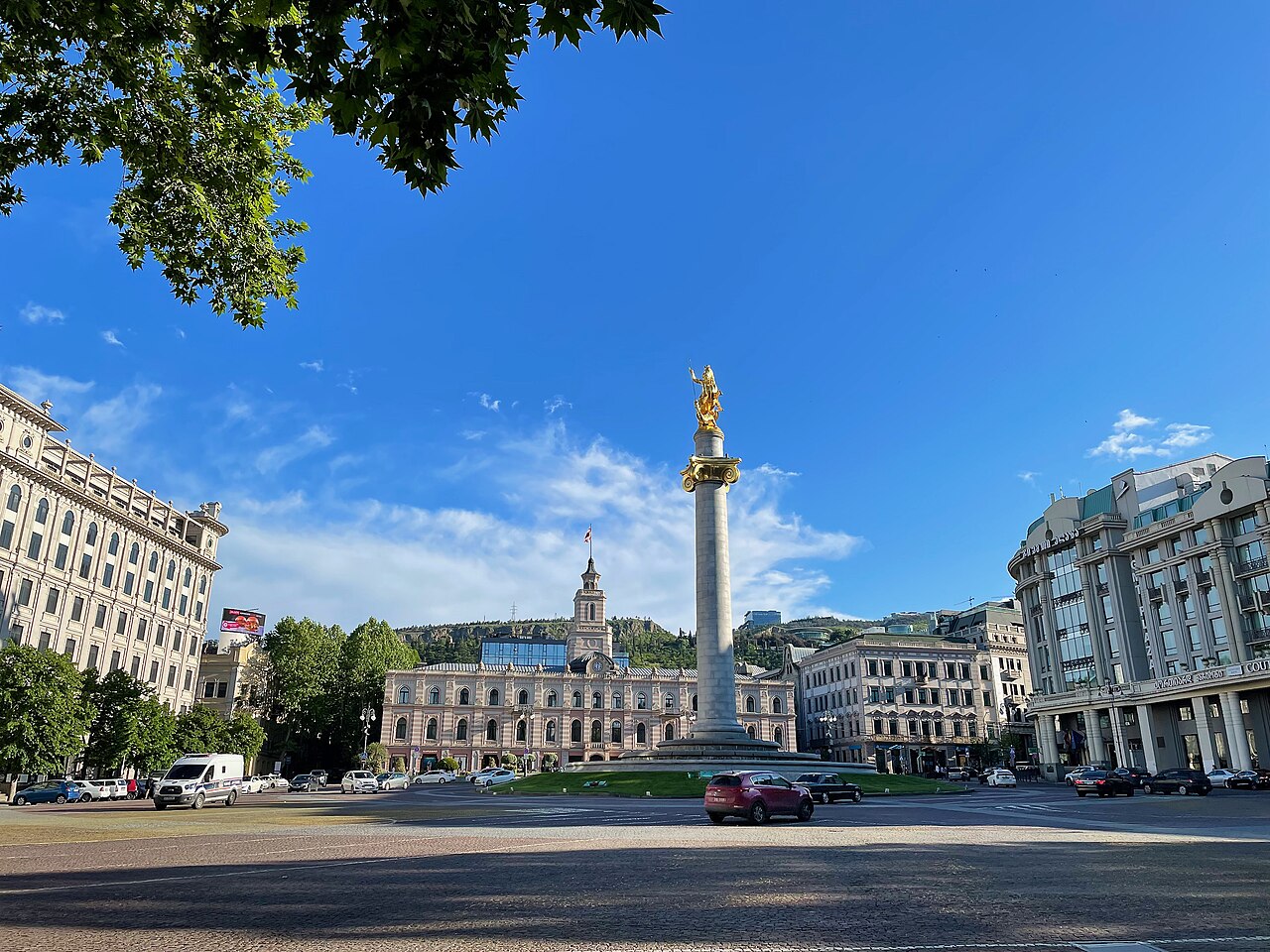
Liberty Square is a square in Tbilisi, Georgia. Tbilisi's main plaza, anchored by a towering golden statue of Georgia (Kartlis Deda) and ringed by government buildings and cafés. Most visitors spend 20–30 min here. The free Lokali audio guide runs 5 minutes.
✓ Verified August 2026 · how we write these guides
Visitor facts
| Time needed | 20–30 min |
|---|---|
| Lokali audio guide | 5 min · free |
| Type | Square |
| Best for | Editors' pick |
| Location | Tbilisi, Georgia |
| Coordinates | 41.7165, 44.7889 |
| Languages | 45, in the Lokali app |
The story
Traffic curves around you in a wide ring. At the centre, on a tall stone column, a golden figure catches the light. A man on horseback drives his spear into a dragon below. This is Liberty Square, the open heart of Tbilisi, where the city gathers and the main roads meet. The square is busy from early morning until late at night.
The square sits at the eastern end of Rustaveli Avenue, the main street of the capital. From here roads run out in several directions, like spokes from a wheel. For two centuries this open space has been the place where Tbilisi comes together, to celebrate, to protest, and to mark the turning points of its story.
The square has changed its name many times. Each name belonged to a different ruler. Under the Russian Empire it was called Erivansky Square, and later Paskevich-Erivansky Square, after a general. Those names were not chosen by the people who lived here. They were handed down from above, by whoever held power at the time.
In 1918 the square was first called Freedom Square. That year Georgia declared itself an independent republic, after the Russian Empire fell apart. The new name marked a new hope. But that first independence was short. Within a few years Soviet rule arrived, and the names on the square changed once again.
Under the Soviet Union the square carried heavy names. For a time it was called Beria Square, after a feared official. Later it became Lenin Square. In 1956 a large statue of Vladimir Lenin was raised at its centre. For decades that figure looked out over the traffic and the gathering crowds. His outstretched arm pointed across the avenue for thirty-five years.
Then the ground shifted once more. As Soviet power collapsed, the people of Georgia pushed hard for independence. In August 1991 the Lenin statue was pulled down. The column at the centre then stood empty for years. An empty pedestal can speak as loudly as a full one. It marked a country caught between two chapters.
The figure you see today arrived later. On the twenty-third of November, 2006, a new monument was unveiled. It shows Saint George on horseback, killing a dragon with his spear. Saint George is the patron saint of Georgia. In many minds, the country and this saint have long been bound together. The red cross on a white field, his emblem, also marks the national flag.
The monument was made by Zurab Tsereteli, a Georgian sculptor whose work appears in many countries. The whole structure stands about 35 metres tall, built of granite and gold. The statue of the saint alone is 5.6 metres high. It is cast in bronze and covered in gold, so it shines above the square in almost any weather.
This open space has seen more than ceremonies. In 1907 it was the site of a famous robbery. Armed revolutionaries attacked a bank coach here and seized a large sum of money. The young Stalin is often linked to the planning of that raid. Several people were killed in the chaos, and the story spread far beyond Georgia.
In recent times the square has been the stage for peaceful change. Huge crowds gathered here during the Rose Revolution of 2003. People stood shoulder to shoulder, calling for new leadership. The protests stayed peaceful, and they brought a change of government without a shot. Again and again, when Georgians have wanted to be heard, they have come to this circle of stone and pavement.
Around the edges, the buildings tell their own story. The elegant Tbilisi City Hall faces the square, with its arches and clock tower. Banks, hotels, and shops fill the other fronts. Old carved stone and new glass stand side by side. A small fountain and benches give people a place to pause.
From this circle, the city unfolds in every direction. Walk west and you enter Rustaveli Avenue, lined with theatres, museums, and grand fronts. Slip downhill to the southeast and the narrow lanes of the old town begin, leading toward the river and the baths. The square is less a destination than a doorway. Most visits to Tbilisi pass through it more than once.
Watch the golden saint for a moment as the cars stream past. He has stood here only since 2006, yet he marks a far longer struggle. Every name this square has worn was someone's idea of order. The people kept choosing freedom. Look up, and you are reading that long, stubborn wish, written in gold.
Key facts
What to look for
Practical tips
Common questions
How long do you need at Liberty Square?
Plan 20–30 min. That is the time most visitors spend at Liberty Square. The free Lokali audio guide adds about 5 minutes of narration you can listen to as you walk, so it fits inside your visit rather than adding to it.
Is there a free audio guide to Liberty Square?
Yes — the Lokali app narrates Liberty Square free of charge in 50+ languages. It covers the history, what to look for on site and practical tips, and it works offline once downloaded.
Where is Liberty Square?
Liberty Square is in Tbilisi, Georgia, at 41.7165, 44.7889. Tap the map link on this page for directions from where you are.
What should you know before visiting Liberty Square?
Use the underground passages to cross the busy roads.
What is Liberty Square known for?
First named Freedom Square in 1918 after independence.
What is the best time to visit Liberty Square?
The square empties of crowds by early evening — visit then to appreciate its scale and the statue's proportions without the daytime bustle.
On the map
Opens directions to Liberty Square from your location.
More to see in Tbilisi


Hear Liberty Square in your language
The full story, narrated, in 50+ languages. Download it before you go and it plays offline, at your own pace, with no ticket and no tour group.