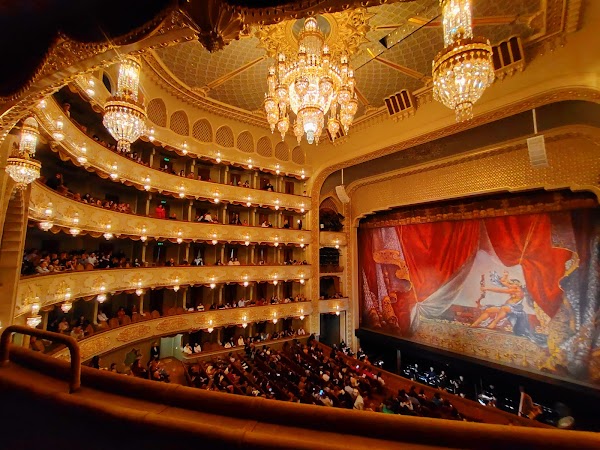
Tbilisi State Opera and Ballet Theatre
41.7151° N · 44.7910° E · Theatre
Tbilisi State Opera and Ballet Theatre is a neoclassical masterpiece built in 1896, this opera house stands as one of the Caucasus's finest cultural institutions. It is in Tbilisi, Georgia. Most visitors spend 2–3 hours here. The free Lokali audio guide runs 5 minutes.
✓ Verified August 2026 · how we write these guides
Visitor facts
| Time needed | 2–3 hours |
|---|---|
| Lokali audio guide | 5 min · free |
| Type | Theatre |
| Best for | Editors' pick |
| Location | Tbilisi, Georgia |
| Coordinates | 41.7151, 44.7910 |
| Languages | 45, in the Lokali app |
The story
On the main avenue, among grand nineteenth-century facades, one building breaks the pattern with horseshoe arches, patterned brick, and a silhouette that looks borrowed from somewhere much further east. This is the Tbilisi opera house, the home of Georgian opera and ballet, and its unusual design has made it a landmark on Rustaveli Avenue for well over a century.
The style has a name: Moorish Revival, all rounded arches, fine brickwork, and dense ornament, drawn from the architecture of the Islamic world. It was a deliberate choice in its day and an unusual one among the European-style buildings around it, a nod to the meeting of east and west that the city has long stood for. It still makes the opera house instantly recognisable from along the avenue.
The building has lived several lives. An opera house first opened on this avenue in the middle of the nineteenth century, but fire destroyed it, and the theatre you see was rebuilt and reopened in 1896. Since then it has carried on through empire, revolution, the Soviet decades, and independence, surviving further fires, closures, and long restorations along the way.
It is named for a composer at the centre of Georgian music. The theatre honours Zakaria Paliashvili, widely regarded as the father of the country's classical tradition, and his operas remain central to its programme. To hear one of his works performed here, in the building that carries his name, is the fullest version of the experience the house can offer.
Inside, the decoration carries on the theme. The auditorium is richly worked, with gilding and ornament, and a grand foyer to gather in before the performance. The hall is smaller and more intimate than some of the great European opera houses, which makes for a close, warm connection between the stage and the audience rather than a distant spectacle.
Opera and ballet share the stage through the cooler months, which form the main season. The programme leans on the classics alongside Georgian works, and the company has a particular strength in ballet, a tradition the country takes seriously and has exported talent from for generations.
Going to a performance here is refreshingly accessible. Tickets are modest by the standards of western Europe, and dressing up, arriving early, and taking a slow turn around the foyer are all part of how locals enjoy a night out at the opera. It is a grand experience without the grand prices.
Even if you never step inside for a show, the exterior repays attention. Pause across the avenue to take in the arches and brickwork, especially in the evening when the facade is lit and the patterns stand out against the dark. It is one of the most photogenic buildings on the whole street.
Its location makes it easy to include. The opera house sits on Rustaveli Avenue among theatres, museums, the parliament building, and cafes, so it folds naturally into a walk along the city's main artery. You can take in the facade in passing and decide later whether to come back for a performance.
If you do want to attend, a little planning pays off. Check the current programme and book online ahead of time, because popular nights sell out, and seasons pause in the height of summer. Knowing what is on, and when, is the difference between catching a performance and admiring a closed door.
Georgia has a deep musical tradition, from ancient polyphonic singing to a strong modern classical and ballet scene, and this house is its grandest stage. Performers trained here have gone on to major companies abroad, so a night at the opera connects you to a living tradition rather than a museum piece.
The avenue outside is worth lingering on too. Rustaveli is the city's main boulevard, lined with grand public buildings, and the opera house is one of its set pieces. Seeing it as part of an evening stroll along the avenue, rather than in isolation, shows it at its best.
Stand across the avenue for a moment and take in the arches and brickwork against the line of grander stone neighbours. The building's eastern dress on a European boulevard is a small, deliberate portrait of the city itself, caught between continents. Whether you step inside for a performance or simply pass by, it anchors this stretch of Rustaveli and rewards a second glance.
Key facts
What to look for
Practical tips
Common questions
How long do you need at Tbilisi State Opera and Ballet Theatre?
Plan 2–3 hours. That is the time most visitors spend at Tbilisi State Opera and Ballet Theatre. The free Lokali audio guide adds about 5 minutes of narration you can listen to as you walk, so it fits inside your visit rather than adding to it.
Is there a free audio guide to Tbilisi State Opera and Ballet Theatre?
Yes — the Lokali app narrates Tbilisi State Opera and Ballet Theatre free of charge in 50+ languages. It covers the history, what to look for on site and practical tips, and it works offline once downloaded.
Where is Tbilisi State Opera and Ballet Theatre?
Tbilisi State Opera and Ballet Theatre is in Tbilisi, Georgia, at 41.7151, 44.7910. Tap the map link on this page for directions from where you are.
What should you know before visiting Tbilisi State Opera and Ballet Theatre?
Check the programme and book online ahead.
What is Tbilisi State Opera and Ballet Theatre known for?
Home of Georgian opera and ballet on Rustaveli Avenue.
What is the best time to visit Tbilisi State Opera and Ballet Theatre?
Arrive early to admire the facade and lobby mosaics.
On the map
Opens directions to Tbilisi State Opera and Ballet Theatre from your location.
More to see in Tbilisi


Hear Tbilisi State Opera and Ballet Theatre in your language
The full story, narrated, in 50+ languages. Download it before you go and it plays offline, at your own pace, with no ticket and no tour group.