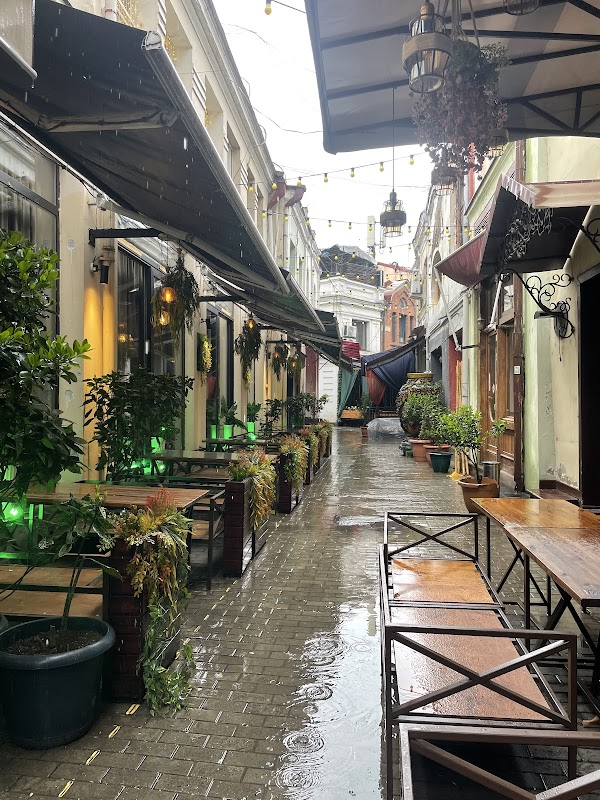
Shardeni Street is a street in Tbilisi, Georgia. Pedestrian shopping street connecting Metekhi Square to Freedom Square. Most visitors spend 20–30 min here. The free Lokali audio guide runs 9 minutes.
✓ Verified August 2026 · how we write these guides
Visitor facts
| Time needed | 20–30 min |
|---|---|
| Lokali audio guide | 9 min · free |
| Type | Street |
| Best for | Local life |
| Location | Tbilisi, Georgia |
| Coordinates | 41.7155, 44.7945 |
| Languages | 45, in the Lokali app |
The story
The cobblestones under your feet are worn smooth by centuries of footsteps — merchants, pilgrims, soldiers, lovers. Shardeni Street curves gently through the oldest quarter of Tbilisi, a narrow lane where the buildings lean close enough that you could almost reach across from balcony to balcony. The air smells of wood smoke and coffee, sometimes bread baking in a courtyard oven you cannot see.
This street takes its name from Jean Chardin, a French jeweller and traveller who passed through Tbilisi in the sixteen-sixties. He left behind vivid accounts of the city's markets and caravanserais, the mix of Persian and Georgian trade that flowed through these lanes. The street was not always called Shardeni — locals knew it by other names over the centuries — but the current name stuck after independence, a nod to one of the first Europeans to write about Tbilisi with genuine curiosity rather than conquest in mind.
The buildings on either side are a patchwork of eras. Ground floors date back to the eighteenth and nineteenth centuries, though most have been rebuilt or refaced after earthquakes and wars. Look up and you will see wooden balconies cantilevered over the street, their railings carved or painted in fading blues and greens. Some are original, some are careful reconstructions from the early two thousands when the old town began its long restoration. The Soviets had let much of this quarter decay, and by the nineteen-nineties many buildings were near collapse.
Today Shardeni is the heart of Tbilisi's café culture. Tables spill onto the cobblestones from morning until late at night, locals and visitors sitting elbow to elbow under strings of lights. The street hums with conversation in a dozen languages, the clink of wine glasses, the hiss of espresso machines. It is a far cry from the quiet residential lane it was thirty years ago, when washing hung from the balconies and grandmothers called down to children playing in the street.
Halfway along, the street opens into a small square where a church stands — Sioni Cathedral, one of the oldest in the city, its stone walls dark with age. Shardeni runs parallel to the Mtkvari River, and if you step into one of the side alleys you can catch glimpses of the water below, the cliffs of Narikala Fortress rising on the far bank. The neighbourhood is layered like this, lanes doubling back on themselves, courtyards hidden behind unmarked doors.
The street is busiest after sunset, when the heat lifts and the lights come on. Musicians sometimes set up near the square, a guitarist or a small ensemble playing Georgian polyphony, the harmonies weaving through the chatter. The sound carries differently at night, softer, as if the stone walls absorb it. In summer the air stays warm until midnight, and the tables stay full.
Shardeni has become a symbol of Tbilisi's revival, the old town reborn as a place where people gather rather than just pass through. But it is also a point of tension — some locals worry the street has become too polished, too aimed at tourists, that the cafés have priced out the families who lived here for generations. You will hear this debate in the city, the balance between preservation and change, between making a living and keeping a place alive in the way it was.
Walk slowly here. The details reward attention — a carved doorway, a fragment of Persian tilework set into a wall, the way the light falls through the balconies in the late afternoon. The street is short, no more than two hundred metres from end to end, but it holds more layers than you can take in on a single pass. Each building has been rebuilt, repaired, reimagined, and the street itself is a kind of palimpsest, old Tbilisi visible beneath the new.
If you come early in the morning, before the cafés open, you will see the street as it might have looked decades ago — quiet, the cobblestones still in shadow, a few pigeons pecking near the church steps. The city wakes slowly here, and for an hour or so Shardeni belongs to the people who live above the shops, hanging laundry, sweeping doorsteps, calling to neighbours in Georgian.
As you leave, notice the way the street bends out of sight at both ends, the buildings closing in so you cannot see what comes next. This is the old town's grammar, a place that never reveals itself all at once. Shardeni is a threshold, a passage between the river and the fortress, between past and present, between the Tbilisi that was and the one still taking shape.
Key facts
What to look for
Practical tips
Common questions
How long do you need at Shardeni Street?
Plan 20–30 min. That is the time most visitors spend at Shardeni Street. The free Lokali audio guide adds about 9 minutes of narration you can listen to as you walk, so it fits inside your visit rather than adding to it.
Is there a free audio guide to Shardeni Street?
Yes — the Lokali app narrates Shardeni Street free of charge in 50+ languages. It covers the history, what to look for on site and practical tips, and it works offline once downloaded.
Where is Shardeni Street?
Shardeni Street is in Tbilisi, Georgia, at 41.7155, 44.7945. Tap the map link on this page for directions from where you are.
What should you know before visiting Shardeni Street?
Visit early morning to see the street before crowds arrive.
What is Shardeni Street known for?
Named after French traveller Jean Chardin who visited in the sixteen-sixties.
What is the best time to visit Shardeni Street?
Early morning is quietest; by noon it fills with locals and tourists.
On the map
Opens directions to Shardeni Street from your location.
More to see in Tbilisi


Hear Shardeni Street in your language
The full story, narrated, in 50+ languages. Download it before you go and it plays offline, at your own pace, with no ticket and no tour group.