
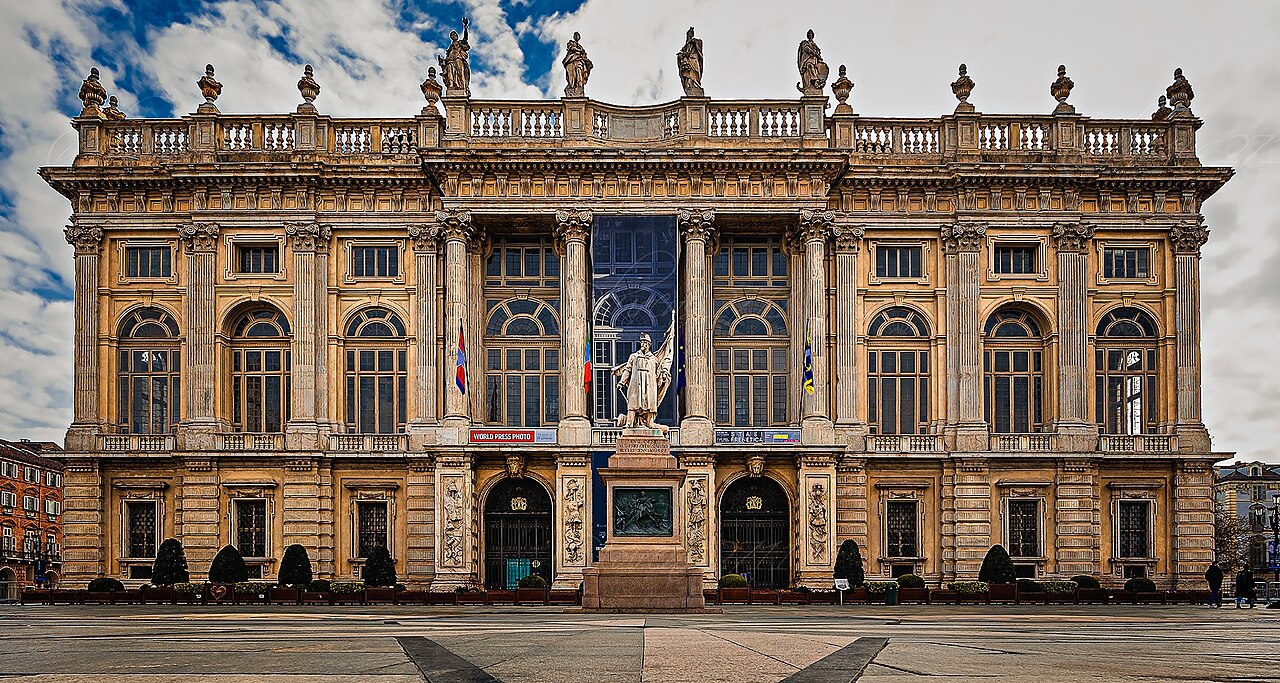
Photo: Iron Bishop · CC BY-SA 3.0 · Wikimedia Commons
Teatro Regio is a theater in Turin, Italy. The first theatre opened in 1740 for the House of Savoy. The free Lokali audio guide runs 6 minutes.
✓ Published October 2026 · how we write these guides
Visitor facts
| Lokali audio guide | 6 min · free |
|---|---|
| Type | Opera House |
| Location | Turin, Italy |
| Coordinates | 45.0706, 7.6878 |
| Official website | teatroregio.torino.it |
| Languages | 50+, in the Lokali app |
The story
Stand for a moment under the stone arcades of Piazza Castello. The air is cool here, even in summer, and footsteps echo off the paving. Above you, the porticoes run in a long, steady rhythm toward the Royal Palace. Then your eye catches something that does not belong to the eighteenth century at all: a tall gate of dark bronze, twisted and rough, like a forest frozen in metal. Behind it sits one of the most surprising opera houses in Europe.
This is the Teatro Regio, the Royal Theatre of Turin. Its story has two halves, and you are looking at both of them right now. The arcaded front belongs to the old royal city. Everything behind that bronze gate belongs to the twentieth century. Few buildings in Italy hold two such different worlds so close together, with only a thin wall between them.
The first theatre opened in 1740. It was built for the House of Savoy, the dynasty that ruled Piedmont from Turin and later became the royal family of a united Italy. The architect was Benedetto Alfieri, a court designer who shaped much of this central square. For the Savoy rulers, opera was not only entertainment. It was a display of power, taste, and wealth, placed directly beside their palace.
That is why the theatre stands exactly here. This square was the heart of what historians call the command zone of the Savoy state. The palace, the government offices, the archives, and the theatre all sat within a few minutes' walk of each other. Today this group of royal buildings forms part of a UNESCO World Heritage listing for the Residences of the Royal House of Savoy. The theatre's old façade is one piece of that larger picture.
In the late nineteenth century, this stage saw two moments that opera lovers still talk about. In 1893, Giacomo Puccini's Manon Lescaut had its world premiere here. It was the work that made his name. Three years later, in 1896, Puccini returned with La Bohème, his story of poor young artists in Paris. The conductor that night was a young Arturo Toscanini, who would become one of the most famous conductors of the century.
Here is the first surprise. La Bohème did not win over every critic at its first performance. Some reviewers in Turin were unsure about it. Audiences, however, came back again and again, and the opera soon spread across the world. Today it is one of the most performed operas anywhere. So the next time you hear its melodies in a film or an advertisement, remember that it all began a few steps from where you stand.
Then came disaster. In 1936, a fire swept through the theatre and destroyed the interior. The great auditorium of the Savoy court was lost. For decades, the site stood without a working opera house, and the city debated what to do. Plans came and went. The Second World War, and the hard years that followed, pushed the question further into the future. Only the outer shell along the square survived the flames.
The answer, when it finally came, was bold. The commission went to Carlo Mollino, a Turin architect who was anything but ordinary. Mollino designed furniture with curves like the human body. He raced cars, flew aerobatic planes, and loved skiing. He also took photographs that are now collected around the world. For many people in Turin, he was a strange and brilliant figure, and this theatre became one of his greatest works.
The new Teatro Regio opened in 1973. Mollino kept the historic façade on the square and built a completely modern theatre behind it. That is the second surprise. From the arcades, the building looks like part of the royal past. But once you go inside, the eighteenth century disappears. You enter a world of dark red, deep shadow, flowing curves, and light that seems to float in the air.
If you can see the auditorium, look up first. The ceiling is covered with hundreds of slender, transparent rods that hold small lights. Together they hang like a cloud of glowing crystals above the seats. The hall itself has a rounded, shell-like form, and it seats well over a thousand people. Mollino avoided the traditional horseshoe of stacked boxes. Instead, he wanted the audience to feel gathered together in one shared space, all facing the stage.
Now come back to the bronze gate. It is the work of the sculptor Umberto Mastroianni, and it was added later, long after Mollino's opening. Its rough, broken forms suggest movement and sound, almost like music turned into metal. Some visitors walk past it without a second look, thinking it is simply a fence. Take a closer look. The surface changes with the light, from almost black in shade to warm brown when the sun reaches it.
The theatre is not a museum. It is a working opera house, with its own orchestra and chorus, and a season of opera, ballet, and concerts. On performance nights, the arcades fill with people in coats and good shoes, talking in low voices before the doors open. In the daytime, you may hear the faint sound of rehearsals, or see stage crews moving equipment through side entrances. The building lives through the people who work inside it.
Before you move on, step back into the square. Look at the long line of arcades, the palace beyond, and the bronze gate set into the old stone. You are looking at three centuries in a single view. A royal court built this theatre, a fire took it away, and a restless modern architect gave it a new life. As you walk away under the porticoes, listen to the echo of your own footsteps... the same sound that opera audiences have heard here for nearly three hundred years.
Key facts
What to look for
Practical tips
Common questions
Is there a free audio guide to Teatro Regio?
Yes — the Lokali app narrates Teatro Regio free of charge in 50+ languages. The guide runs about 6 minutes, covers the history, what to look for on site and practical tips, and works offline once downloaded.
Where is Teatro Regio?
Teatro Regio is in Turin, Italy, at 45.0706, 7.6878. Tap the map link on this page for directions from where you are.
What is Teatro Regio known for?
The first theatre opened in 1740 for the House of Savoy. Benedetto Alfieri designed the original eighteenth-century royal theatre.
What should you look for at Teatro Regio?
Mastroianni's rough bronze gate set into the old arcade. Hundreds of glowing transparent rods across the auditorium ceiling. The rounded, shell-like shape of Mollino's main hall.
What should you know before visiting Teatro Regio?
Book a guided tour ahead to see the auditorium by day. Check the season programme online before your visit.
When is the best time to visit Teatro Regio?
Arrive early on performance nights to enjoy the foyer.
On the map
Opens directions to Teatro Regio from your location.
More to see in Turin



Hear Teatro Regio in your language
The full story, narrated, in 50+ languages. Download it before you go and it plays offline, at your own pace, with no ticket and no tour group.