
Photo: Zairon · CC BY-SA 4.0 · Wikimedia Commons
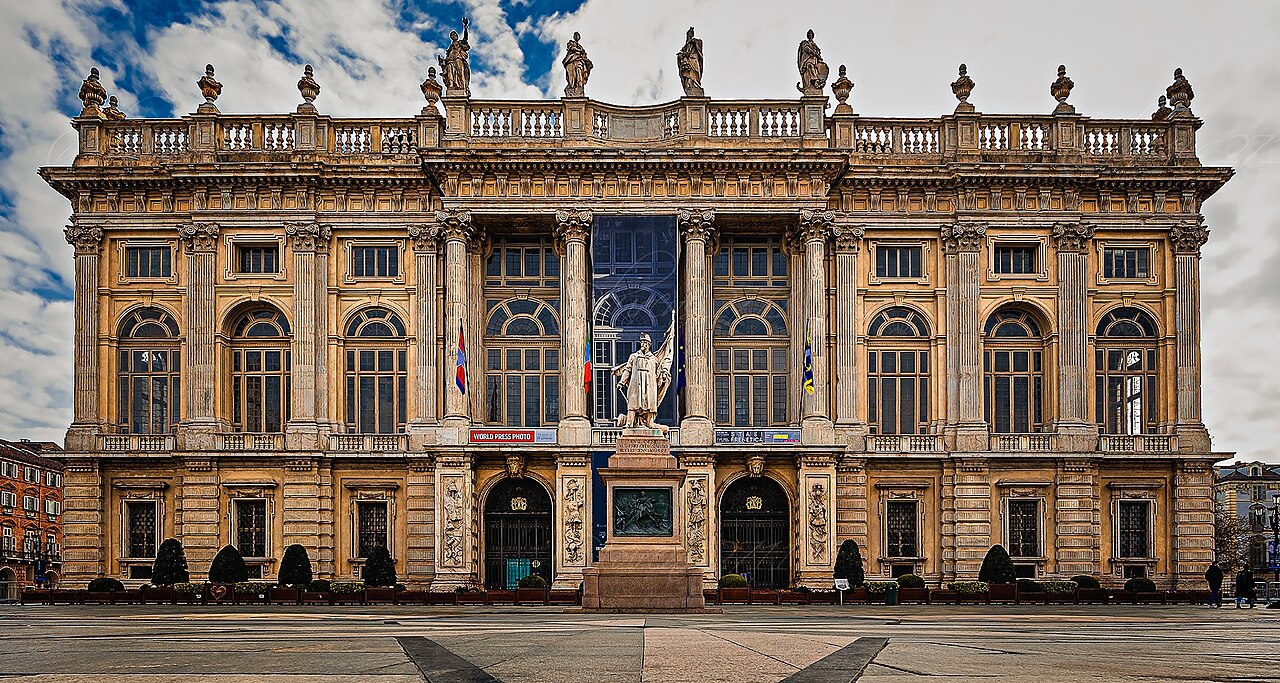
Palazzo Carignano is a historical building in the centre of Turin, Italy. Designed by Guarino Guarini in the late seventeenth century. The free Lokali audio guide runs 7 minutes.
✓ Published October 2026 · how we write these guides
Visitor facts
| Lokali audio guide | 7 min · free |
|---|---|
| Type | Museum |
| Location | Turin, Italy |
| Coordinates | 45.0690, 7.6856 |
| Official website | polomusealepiemonte.beniculturali.it |
| Languages | 50+, in the Lokali app |
The story
Stand still for a moment and look at the wall in front of you. It does not stay flat. The brick swells outward in the centre, then curves back, then swells again, like a slow wave frozen in clay. The colour is a warm, dusty red. In the late afternoon it turns almost copper. Run your eyes across the surface and you will see that every part of it is brick. There is no marble here, no white stone hiding the structure.
This is Palazzo Carignano, and that curving front is one of the boldest pieces of Baroque architecture in Italy. Baroque, for anyone unfamiliar with the term, is the seventeenth-century style that loved movement, drama and theatrical light. Most Baroque palaces use stone or plaster for their show front. This one chose brick, and then made the brick dance in and out. Builders in Piedmont knew brick well. Here it was pushed further than almost anyone had tried.
The architect was Guarino Guarini, a priest, a mathematician and a designer with a restless mind. Turin is full of his work. He also shaped the Chapel of the Holy Shroud, with its dizzying stacked dome, and the Church of San Lorenzo near Piazza Castello. Guarini thought in geometry. He liked curves that met other curves, and spaces that seemed to expand as you moved through them. This façade is that same thinking, turned outward to face the street.
Work on the palace began in the late seventeenth century, in the 1670s. It was built for Emanuele Filiberto of Savoy, Prince of Carignano. He came from a junior branch of the ruling House of Savoy. He was born deaf, and history remembers him by the nickname "the Mute". Despite this, he was a capable figure at court. He wanted a home that matched his rank, and he wanted it close to the heart of the city. He got both.
Now look closer at the decoration. The brick is moulded into stars, ribbons and repeating patterns, all crisp and deep. Here is a detail most visitors walk past. Around some of the windows you can find heads wearing feathered headdresses. The usual explanation links them to a regiment connected with the Carignano family, which fought in French North America against the Iroquois. Whatever the full story, it is a surprising thing to find on a palace in northern Italy.
For its first century and a half, this was a family residence. Then the Carignano branch became the main line. In the nineteenth century, members of this family inherited the throne of the Kingdom of Sardinia, which was ruled from Turin. Two future kings were born inside these walls. One was Charles Albert, born in 1798. The other was his son, Victor Emmanuel the Second, born in 1820. That second name matters very much to Italians.
Victor Emmanuel the Second became the first king of a united Italy. And this building played a direct part in that story. In 1848, a constitution created an elected parliament for the kingdom. Its lower house, called the Subalpine Parliament, met here, in Palazzo Carignano. Debates in this building shaped the politics of the period Italians call the Risorgimento — the movement of the nineteenth century that joined many separate states into one nation.
The chamber of that parliament still survives inside. It is a small, rounded room with tiers of seats. Statesmen such as Camillo Benso, Count of Cavour, spoke here. Cavour was the chief architect of unification in political terms, a patient negotiator rather than a soldier. Then, in 1861, the first parliament of the new Kingdom of Italy met in this palace. The kingdom was proclaimed in the same year. For a short time, Turin was the capital of Italy.
Here is the second surprise. If you walk around to the other side of the building, to Piazza Carlo Alberto, you will see a completely different palace. That rear front is nineteenth-century work, grander and more formal, built in a classical style. It was added to hold a much larger chamber for the new national parliament. But in 1865 the capital moved to Florence. The great new hall was finished, yet it never held the Italian parliament.
Today the palace is home to the National Museum of the Risorgimento. Its rooms tell the story of unification through paintings, uniforms, flags, weapons, letters and portraits. It can feel dense, so take it slowly. The visit also gives you access to the preserved Subalpine chamber, which for many people is the emotional centre of the building. Standing in that modest room, it is easy to picture the arguments that made a country.
Outside again, notice the square around you. Piazza Carignano is compact and enclosed, and it works almost like an open-air room. Across from the palace stands the Teatro Carignano, an old theatre with a long history. Nearby is the restaurant Del Cambio, which has served diners for a very long time. Local tradition says Cavour liked to eat there, close to his seat in parliament. The square still has a quiet, civic feel.
The palace is also part of a larger group. The residences of the House of Savoy in and around Turin are listed together as a UNESCO World Heritage Site. That group includes royal palaces, hunting lodges and villas spread across the region. Palazzo Carignano is one piece of that network. Together they show how one ruling family shaped the look of a whole city and its countryside over several centuries.
Before you leave, step back toward the far side of the square. Let your eyes follow the curve of the façade one more time — in, out, and in again. Notice how the shadows gather in the hollows and the light catches the edges of the brick. Somewhere behind those windows, a king was born and a nation was declared. And yet, from out here, it is simply a red wall, moving gently, in the middle of an ordinary Turin afternoon.
Key facts
What to look for
Practical tips
Common questions
Is there a free audio guide to Palazzo Carignano?
Yes — the Lokali app narrates Palazzo Carignano free of charge in 50+ languages. The guide runs about 7 minutes, covers the history, what to look for on site and practical tips, and works offline once downloaded.
Where is Palazzo Carignano?
Palazzo Carignano is in Turin, Italy, at 45.0690, 7.6856. Tap the map link on this page for directions from where you are.
What is Palazzo Carignano known for?
Designed by Guarino Guarini in the late seventeenth century. Built for Emanuele Filiberto, Prince of Carignano, called the Mute.
What should you look for at Palazzo Carignano?
The wave-like curve of the brick main façade. Feathered heads moulded around some window frames. Star patterns cut deep into the terracotta brick.
What should you know before visiting Palazzo Carignano?
Visit in late afternoon when the brick glows warmest. Walk around to Piazza Carlo Alberto for the rear façade.
When is the best time to visit Palazzo Carignano?
Visit in late afternoon when the brick glows warmest.
On the map
Opens directions to Palazzo Carignano from your location.
More to see in Turin


Hear Palazzo Carignano in your language
The full story, narrated, in 50+ languages. Download it before you go and it plays offline, at your own pace, with no ticket and no tour group.