
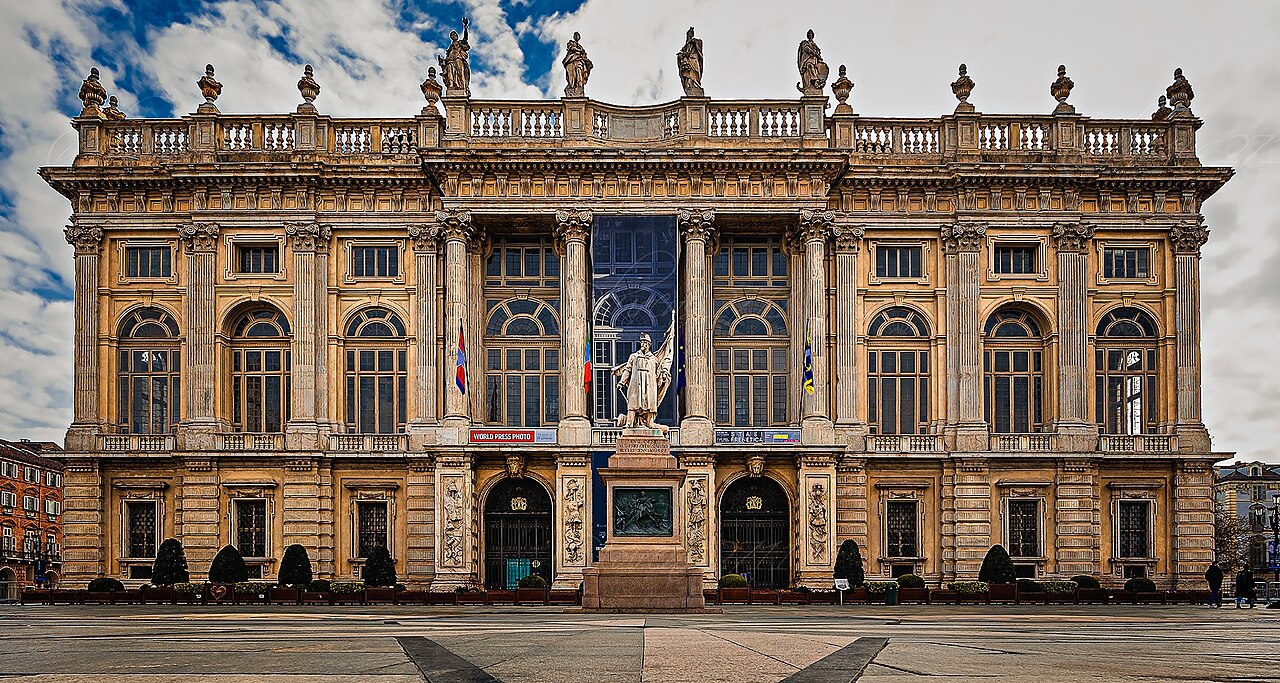
Photo: Georgius LXXXIX at Italian Wikipedia · Public domain · Wikimedia Commons
Museo Egizio is an ancient Egyptian art and history museum in Turin, Italy. Opened in 1824, oldest museum devoted solely to Egypt. The free Lokali audio guide runs 7 minutes.
✓ Published October 2026 · how we write these guides
Visitor facts
| Lokali audio guide | 7 min · free |
|---|---|
| Type | Museum |
| Location | Turin, Italy |
| Coordinates | 45.0683, 7.6844 |
| Official website | museoegizio.it |
| Languages | 50+, in the Lokali app |
The story
Step in from the street and the air changes. Outside, Turin's arcades echo with trams and the clink of espresso cups. Inside, the light drops low and soft, and the floors go quiet under your shoes. Somewhere ahead, in the dark, stone pharaohs sit waiting. This is the Museo Egizio, and it holds one of the largest collections of ancient Egyptian objects anywhere outside Egypt itself. Many scholars rank it second only to the great museum in Cairo.
It is a strange thought, isn't it? An Alpine city in northern Italy, far from the Nile, keeping the belongings of people who lived three, four, even five thousand years ago. The story of how they arrived here begins with one man and one royal decision. And it begins earlier than most visitors expect — this museum opened in 1824, which makes it the oldest museum in the world devoted entirely to Egyptian culture.
The man was Bernardino Drovetti. He was born in Piedmont, the region around Turin, and he served as French consul in Egypt in the early nineteenth century. Like many diplomats of that era, he gathered antiquities on a vast scale — statues, papyri, coffins, small amulets. The King of Sardinia, Charles Felix of the House of Savoy, bought this collection for his capital. Turin was then the seat of the Savoy kings, and the purchase was a statement of prestige.
The timing mattered. Only a few years earlier, the French scholar Jean-François Champollion had cracked the code of hieroglyphs. Soon he travelled to Turin to study the new collection, reading texts that nobody had read for well over a thousand years. Champollion is often credited with saying that the road to Memphis and Thebes passes through Turin. Whether or not he phrased it exactly that way, the idea stuck. For early Egyptology, this city was a working laboratory.
Look up at the building around you. The museum sits inside a large seventeenth-century palace of warm brick, built originally as a college for young noblemen and later home to the Academy of Sciences. Its long corridors and tall windows were never designed for mummies. Over the past decade, though, the interior has been heavily rebuilt. A major renovation finished in 2015, and more work followed for the museum's two-hundredth birthday in 2024.
Here is one practical secret. The visit is usually designed to start at the top of the building and work downwards. You ride up first, then descend through the centuries. Early rooms cover the long prehistory of the Nile valley, before the pharaohs, when people buried their dead in simple pits. Pottery, flint blades and small carved figures show a culture slowly taking shape. Give these quieter rooms a few minutes — they explain everything that comes after.
Now to the treasure that surprises almost everyone. In 1906, an Italian expedition led by the archaeologist Ernesto Schiaparelli opened a tomb at Deir el-Medina, the village of the royal tomb builders near Luxor. It belonged to Kha, an architect, and his wife Merit. The tomb was intact. Robbers had never found it. Almost everything inside came to Turin, and you can see it here together, more than three thousand years after the door was sealed.
What makes Kha's tomb so moving is how ordinary it is. There is furniture. There are linen garments, folded and ready. There are wigs, a game board, toiletries, and bowls that still hold the remains of food — bread, grains, dried fruit. Kha also had his tools of the trade, including a measuring rod linked to royal favour. Gods and gold fill most Egyptian galleries. Here you meet a working man who expected to need his clothes and his lunch.
Papyrus fills another part of the collection, and it is easy to walk past. Do not. Turin keeps a fragile document known as the Turin King List, which records the names of rulers in long sequence. Historians still use it to piece together the order of Egypt's kings. Nearby, if it is on display, is a papyrus map showing a desert route and mining area. It is often described as one of the oldest surviving maps in the world.
Then the light changes again. You enter the statuary galleries, and the mood turns theatrical. The rooms are dark. Spotlights pick out granite gods and kings, and tall mirrors multiply them into the distance, so a handful of statues seems to become a whole army of stone. This design was created by Dante Ferretti, a film set designer who won Academy Awards for his work. It feels more like a stage than a museum hall.
Among these figures, one usually stops people. A seated statue of Ramesses the Second, carved in dark stone, rests calmly with the symbols of kingship in his hands. Ramesses ruled for decades in the thirteenth century before the Common Era, and he filled Egypt with monuments to himself. Here, at human distance, you can study the polish of the stone, the crisp line of the eyes, and the small figures of his family carved beside his legs.
The second big surprise is a whole temple. In the 1960s, the building of the Aswan High Dam threatened to flood ancient sites in Nubia, the region of southern Egypt and northern Sudan. Many countries helped to rescue them. As thanks, Egypt gave Italy the small rock-cut Temple of Ellesiya. It was cut into blocks, shipped north and rebuilt here. You can stand inside a sanctuary that once looked out over the Nile.
Before you leave, pause somewhere quiet — perhaps beside a painted coffin, or in front of a single small amulet. Notice how many of these objects were made to last forever, and how carefully they were wrapped, painted and named. Then walk back out into the Turin afternoon. Under the arcades the trams still rattle past. A few streets away, the Savoy palaces rise around Piazza Castello. Somehow, after everything you have seen, they suddenly look very young.
Key facts
What to look for
Practical tips
Common questions
Is there a free audio guide to Museo Egizio?
Yes — the Lokali app narrates Museo Egizio free of charge in 50+ languages. The guide runs about 7 minutes, covers the history, what to look for on site and practical tips, and works offline once downloaded.
Where is Museo Egizio?
Museo Egizio is in Turin, Italy, at 45.0683, 7.6844. Tap the map link on this page for directions from where you are.
What is Museo Egizio known for?
Opened in 1824, oldest museum devoted solely to Egypt. Founding collection was bought from diplomat Bernardino Drovetti.
What should you look for at Museo Egizio?
Ancient bread and food still resting in Kha's bowls. Mirrors multiplying the statues in the darkened statuary gallery. Small family figures carved beside Ramesses the Second's legs.
What should you know before visiting Museo Egizio?
Book a timed entry online, especially on weekends. Start on the top floor and descend through time.
When is the best time to visit Museo Egizio?
Arrive early to see the statuary galleries less crowded.
On the map
Opens directions to Museo Egizio from your location.
More to see in Turin



Hear Museo Egizio in your language
The full story, narrated, in 50+ languages. Download it before you go and it plays offline, at your own pace, with no ticket and no tour group.