
Atlantis The Palm
25.1409° N · 55.1184° E · Resort & Aquarium
Atlantis The Palm is a sprawling resort on Palm Jumeirah featuring a massive aquarium with over 65,000 marine animals, themed restaurants, and pools. It is in United Arab Emirates. Most visitors spend 2–4 hours here. The free Lokali audio guide runs 5 minutes.
✓ Verified August 2026 · how we write these guides
Visitor facts
| Time needed | 2–4 hours |
|---|---|
| Lokali audio guide | 5 min · free |
| Type | Resort & Aquarium |
| Best for | Family |
| Location | United Arab Emirates, United Arab Emirates |
| Coordinates | 25.1409, 55.1184 |
| Languages | 45, in the Lokali app |
The story
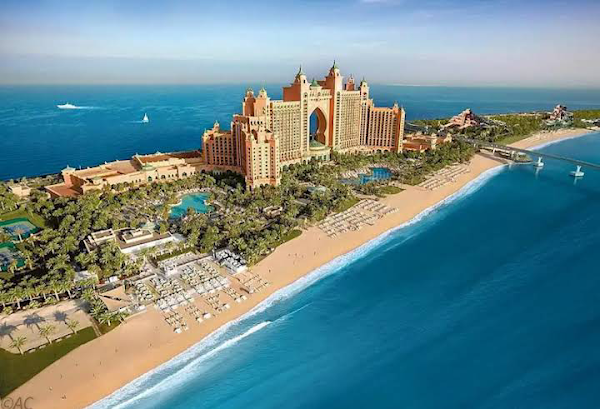
From the beach, it looks like a gate standing in the open sea. Two pink towers rise side by side, joined near the top, with a wide arch cut through the middle. Sky shows through the gap. Waves move below it. This is Atlantis The Palm, the resort that crowns the outer edge of Dubai's palm-shaped island.
You are standing on Palm Jumeirah, an artificial island built in the shape of a palm tree. A central trunk carries roads and towers. Sixteen fronds spread out from it, lined with villas. A long breakwater, called the crescent, curves around the whole shape and holds back the open Gulf. Atlantis sits at the top of that crescent, facing the city across the water. From the air, the palm shape reads clearly. From the ground, it feels like any waterfront district, until you notice the sea on both sides of the road.
The resort opened in September 2008. It was the first hotel on the island, finished while many of the villas around it were still empty. Its grand opening that November filled the sky over the crescent with fireworks, a launch party that made news around the world. Dubai wanted a landmark for its new island, and this was it.
Atlantis The Palm was created by Kerzner International, the company behind the original Atlantis resort in the Bahamas, together with Nakheel, the developer that built the island itself. The two towers hold about 1,500 rooms. The style mixes Arabian arches, domes, and shell patterns with the story of a lost city beneath the sea. Building it out on the breakwater, before the island had settled into ordinary life, was a bet that visitors would cross the water for spectacle. The bet paid off quickly.
That story is the heart of the place. Atlantis is a legend, first written down by the Greek philosopher Plato more than two thousand years ago: an island civilization that sank beneath the waves. None of it is history, and the resort does not pretend otherwise. It treats the myth as a stage set, and builds fantasy ruins you can walk through.
Step into the lobby and look up. A tall sculpture of curling blue and white glass rises beneath the painted dome, like a wave frozen in mid-air. Beyond the lobby, corridors lead toward the resort's most famous sight: the Ambassador Lagoon, a vast tank holding roughly eleven million litres of seawater behind a single sweep of glass.
Around 65,000 sea animals live at the resort, from rays and groupers to sharks that pass slowly along the glass. The Lost Chambers Aquarium wraps the lagoon in themed tunnels and halls, dressed as the flooded streets of the sunken city. Fish drift between broken columns and carved symbols. Children press their hands to the glass. The light is blue and slow.
Two suites, named Neptune and Poseidon, take the theme further. Their bedrooms sit below the waterline, with floor-to-ceiling windows straight into the lagoon. Guests fall asleep watching sharks pass in the dark. These rooms count among the most expensive hotel stays in Dubai, and they are booked out far in advance.
Next door, the resort runs Aquaventure, a waterpark of towers, slides, and a long artificial river. Its best-known ride, the Leap of Faith, drops nine storeys into a clear tunnel that passes through a lagoon with sharks. Slides thread between palm trees and towers painted like temple ruins. Hotel guests walk in free, and day visitors buy tickets. On hot days, it is the loudest corner of the island.
Food is a show of its own. The resort holds restaurants run by well-known international chefs, and Ossiano, a dining room where one wall is aquarium glass. In 2023, a second resort, Atlantis The Royal, opened a short walk along the crescent, taller and angular, like stacked blocks. The two buildings now share the skyline of the breakwater.
Getting here is part of the visit. The monorail glides down the trunk of the palm and ends at Atlantis Aquaventure station, with the arch framed in the front window. By car, the road dips into a tunnel beneath the seabed and rises again on the crescent. Either way, you cross water to reach a hotel built on land that did not exist at the start of this century.
Public areas are open to walk through: the lobby, the shops of The Avenues, the boardwalk outside. Come toward evening, when the pink walls warm in the low sun and the arch turns to a dark frame around the sky. A myth about a city lost to the sea, rebuilt as a palace standing on sand pulled up from it. The sea, for its part, stays quiet on both sides.
Key facts
What to look for
Practical tips
Common questions
How long do you need at Atlantis The Palm?
Plan 2–4 hours. That is the time most visitors spend at Atlantis The Palm. The free Lokali audio guide adds about 5 minutes of narration you can listen to as you walk, so it fits inside your visit rather than adding to it.
Is there a free audio guide to Atlantis The Palm?
Yes — the Lokali app narrates Atlantis The Palm free of charge in 50+ languages. It covers the history, what to look for on site and practical tips, and it works offline once downloaded.
Where is Atlantis The Palm?
Atlantis The Palm is in United Arab Emirates, United Arab Emirates, at 25.1409, 55.1184. Tap the map link on this page for directions from where you are.
What should you know before visiting Atlantis The Palm?
Ride the monorail to Atlantis Aquaventure station for easy arrival.
What is Atlantis The Palm known for?
Opened September 2008 as Palm Jumeirah's first resort.
What is the best time to visit Atlantis The Palm?
The Aquaventure water park is included with day passes to the aquarium.
On the map
Opens directions to Atlantis The Palm from your location.
More to see in United Arab Emirates


Hear Atlantis The Palm in your language
The full story, narrated, in 50+ languages. Download it before you go and it plays offline, at your own pace, with no ticket and no tour group.