
Palm Jumeirah Monorail
25.1450° N · 55.1200° E · Transport & Viewpoint
Palm Jumeirah Monorail is a transport & viewpoint in United Arab Emirates. Elevated automated train circling the Palm's perimeter, offering 360-degree views of the artificial island, the Arabian Gulf, and Dubai's skyline. Most visitors spend 15–30 min here. The free Lokali audio guide runs 5 minutes.
✓ Verified August 2026 · how we write these guides
Visitor facts
| Time needed | 15–30 min |
|---|---|
| Lokali audio guide | 5 min · free |
| Type | Transport & Viewpoint |
| Best for | Photography |
| Location | United Arab Emirates, United Arab Emirates |
| Coordinates | 25.1450, 55.1200 |
| Languages | 45, in the Lokali app |
The story
The train arrives almost silently, sliding along a single concrete beam high above the road. There is no driver. The front of the cabin is one wide window, and beyond it, a palm-shaped island stretches into the sea. For the next few minutes, that window is the best seat in Dubai.
This is the Palm Monorail, the first monorail in the Middle East. It opened in April 2009, built to carry people along the spine of Palm Jumeirah, the artificial island shaped like a palm tree. The line runs about 5.4 kilometres, from the base of the island out to the Atlantis resort on its outer crescent. It was a landmark project for the region, watched closely as a test of new transit on new land.
Palm Jumeirah rose from open water. Construction began in 2001, with ships pouring dredged sand onto the seabed until a trunk, sixteen fronds, and a protective crescent stood above the surface. No concrete walls hold the island's edges; compacted sand and a rock breakwater do the work. Villas followed, then towers, then hotels. The monorail was planned as its public spine: a way to move visitors along the trunk without adding more cars.
There are four stations. Palm Gateway sits at the mainland end of the trunk, near the tram lines of the coastal city. Al Ittihad Park serves gardens planted with native trees. Nakheel Mall connects to shops and restaurants in the middle of the island. Atlantis Aquaventure, the last stop, delivers you almost to the doors of the resort and its waterpark. Two of the middle stations opened years after the line itself, once the mall and park around them were finished.
The trains run without drivers, guided automatically along the elevated beam. That is why the front window is free for passengers. Arrive early on the platform and take that spot. Children usually get there first, and it is worth the small competition. Standing at the glass, you feel the beam curve and dip like a slow rollercoaster with manners.
The ride takes under ten minutes, but it is dense with views. To one side, the towers of Dubai Marina rise in a wall across the water. To the other, rows of villas line the fronds, each with its strip of private beach. Between them, the sea shows in flat panels of green and blue, cut into shapes no natural coast would make. Ferries and yachts draw white lines across the water below.
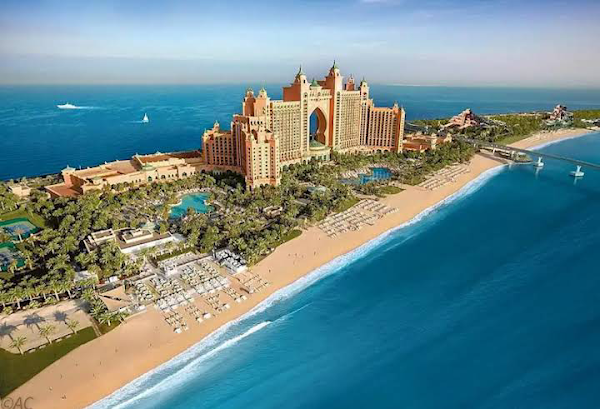
Ahead, Atlantis grows steadily larger: two pink towers joined by an arch, standing alone on the crescent. The approach is theatrical, and the monorail plays it slowly. The arch centers itself in the front window as if the track had been drawn just for the view. It probably was.
Look down as well. The trunk of the palm passes below: apartment blocks, pools, rows of palms along the central road. Al Ittihad Park slides past as a stripe of green. On clear days, you can trace the fronds all the way to their tips, and see how thin the strips of land really are.
The monorail runs on its own ticketing, separate from the city's metro system. Tickets sell at station machines and counters, single or return. If you plan to come back the same day, the return fare saves money and a second queue. Trains come every few minutes through the day, and the whole system feels unhurried: platforms are clean, air-conditioned, and rarely crowded outside holiday peaks.
At Palm Gateway, the line meets the wider city. The Dubai Tram stops across the road, linking toward the Marina and the metro beyond. Many visitors combine them: metro, tram, monorail, one elevated ride handing you to the next, from the mainland out onto land that engineers invented. It is possible to cross half the city without once touching a road.
Ride it near sunset if you can. The low light softens the villas, the Marina towers turn to silhouettes, and the sea takes the color of the sky. Evening trains fill with families heading to dinner at the mall or the resort, and the front window becomes a shared cinema screen. After dark, the towers light up and the ride becomes a slow pass through electric color.
A monorail is usually just transport. This one is closer to a moving viewpoint, a slow reveal of one of the strangest coastlines ever built. Sit by the glass, let the beam carry you out to sea, and watch an island that did not exist a generation ago pass calmly beneath your feet.
Key facts
What to look for
Practical tips
Common questions
How long do you need at Palm Jumeirah Monorail?
Plan 15–30 min. That is the time most visitors spend at Palm Jumeirah Monorail. The free Lokali audio guide adds about 5 minutes of narration you can listen to as you walk, so it fits inside your visit rather than adding to it.
Is there a free audio guide to Palm Jumeirah Monorail?
Yes — the Lokali app narrates Palm Jumeirah Monorail free of charge in 50+ languages. It covers the history, what to look for on site and practical tips, and it works offline once downloaded.
Where is Palm Jumeirah Monorail?
Palm Jumeirah Monorail is in United Arab Emirates, United Arab Emirates, at 25.1450, 55.1200. Tap the map link on this page for directions from where you are.
What should you know before visiting Palm Jumeirah Monorail?
Claim the front window seat for the forward view.
What is Palm Jumeirah Monorail known for?
Opened in April 2009, first monorail in the Middle East.
What is the best time to visit Palm Jumeirah Monorail?
Ride it at sunset for unobstructed photo angles of the Palm's fronds and the coast.
On the map
Opens directions to Palm Jumeirah Monorail from your location.
More to see in United Arab Emirates


Hear Palm Jumeirah Monorail in your language
The full story, narrated, in 50+ languages. Download it before you go and it plays offline, at your own pace, with no ticket and no tour group.