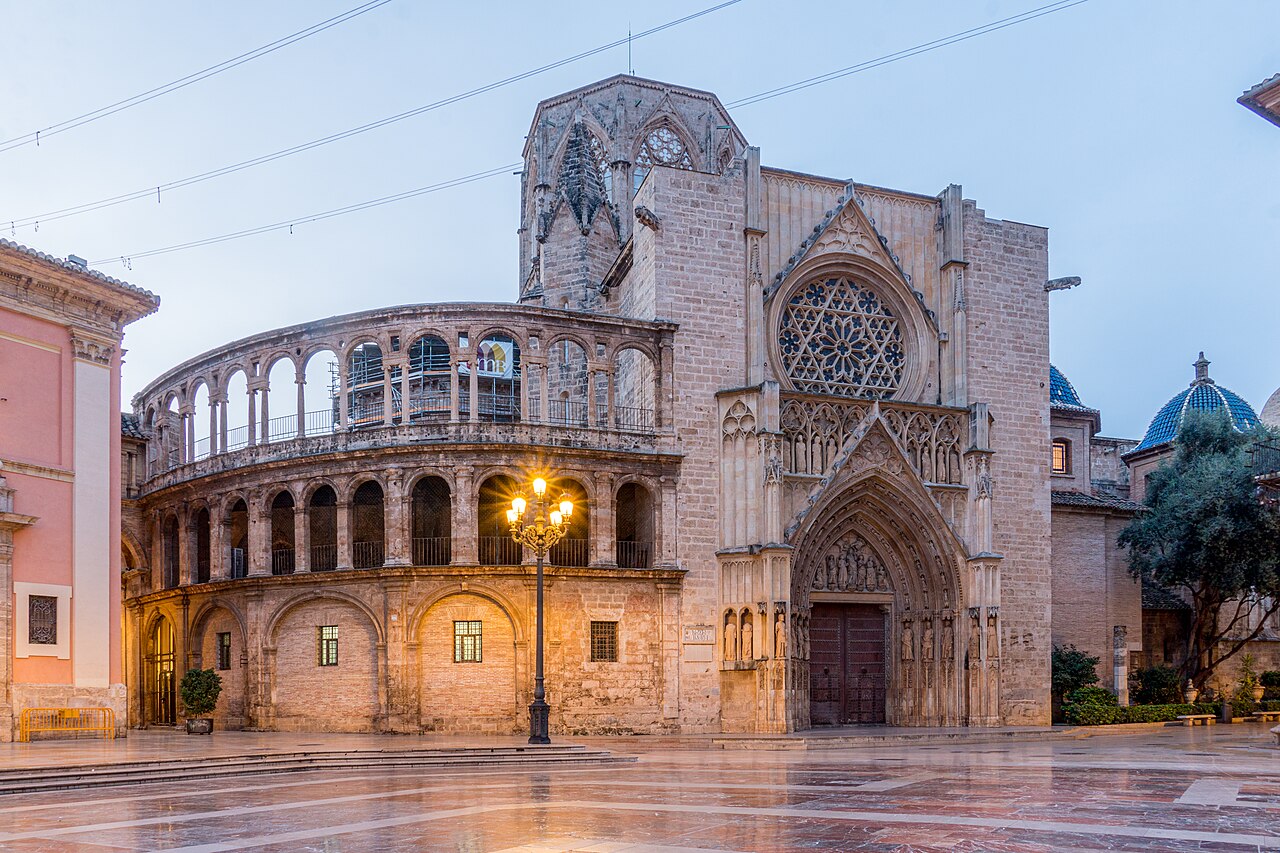
Cathedral of Valencia
39.4745° N · 0.3759° W · Cathedral
Cathedral of Valencia is a cathedral in Valencia, Spain. Gothic cathedral begun in the 13th century, with Renaissance and Baroque additions. Most visitors spend 1–2 hours here. The free Lokali audio guide runs 5 minutes.
✓ Verified August 2026 · how we write these guides
Visitor facts
| Time needed | 1–2 hours |
|---|---|
| Lokali audio guide | 5 min · free |
| Type | Cathedral |
| Best for | History |
| Location | Valencia, Spain |
| Coordinates | 39.4745, -0.3759 |
| Languages | 45, in the Lokali app |
The story
In the heart of the old town, a great cathedral of pale stone gathers around it the squares and lanes of medieval Valencia, its octagonal bell tower rising above the rooftops. This is the Cathedral of Valencia, a building of many centuries and styles, and, by one famous tradition, the home of the Holy Grail.
The cathedral was built over a long span beginning in the thirteenth century, on the site of earlier places of worship, so it mixes Gothic, Romanesque, and later Baroque elements, a record of the centuries that raised and changed it.
Its most famous claim is its greatest draw: a chapel within the cathedral holds an ancient stone cup that many believe to be the Holy Grail, the cup of the Last Supper. Whatever the truth, the relic has drawn pilgrims and the curious for centuries.
The bell tower, known locally as the Micalet, is an octagonal Gothic tower beside the cathedral, and climbing its winding stair to the top rewards you with a wide view over the rooftops, domes, and squares of the old town.
Inside, the cathedral is a calm, high space of Gothic arches, with chapels around the edges, fine paintings, and the relic chapel at its heart, a building to wander slowly rather than rush through.
The cathedral sits between two of the old town's loveliest squares, one before its main front and one beside it, both ringed with cafes and old buildings, so the building anchors a whole quarter of the historic centre.
One of those squares is the setting, on certain days, for an ancient water court, a tribunal that has met outdoors for centuries to settle disputes over the irrigation of the surrounding farmland, a living piece of medieval custom.
The mix of styles on the outside rewards a slow circuit: a Romanesque doorway here, a Gothic one there, a Baroque front on the main square, each from a different age of the cathedral's long life.
As the mother church of the city, it remains a working cathedral, with services and music, so visitors share it with worshippers and should treat it with the usual respect.
The surrounding old town, with its lanes, squares, and markets, spreads out from the cathedral, so it makes the natural centre of a day exploring the historic heart of Valencia on foot.
A few practical notes. Entry to the cathedral and the relic chapel is usually ticketed, the tower climb a little extra; dress modestly, and come in the morning to climb the tower before the heat. The squares around it are free to enjoy.
Stand in the relic chapel before the ancient cup, then climb the tower for the view over the old town, and the cathedral's blend of faith, legend, and long history comes together. When you step back out into the square, the cafes and the medieval water court carry the old city on into the present.
Key facts
What to look for
Practical tips
Common questions
How long do you need at Cathedral of Valencia?
Plan 1–2 hours. That is the time most visitors spend at Cathedral of Valencia. The free Lokali audio guide adds about 5 minutes of narration you can listen to as you walk, so it fits inside your visit rather than adding to it.
Is there a free audio guide to Cathedral of Valencia?
Yes — the Lokali app narrates Cathedral of Valencia free of charge in 50+ languages. It covers the history, what to look for on site and practical tips, and it works offline once downloaded.
Where is Cathedral of Valencia?
Cathedral of Valencia is in Valencia, Spain, at 39.4745, -0.3759. Tap the map link on this page for directions from where you are.
What should you know before visiting Cathedral of Valencia?
Climb the tower in the cooler morning.
What is Cathedral of Valencia known for?
The medieval cathedral at the heart of Valencia.
What is the best time to visit Cathedral of Valencia?
Climb the Micalet bell tower for panoramic views of the old town and Turia Gardens.
On the map
Opens directions to Cathedral of Valencia from your location.
More to see in Valencia



Hear Cathedral of Valencia in your language
The full story, narrated, in 50+ languages. Download it before you go and it plays offline, at your own pace, with no ticket and no tour group.