
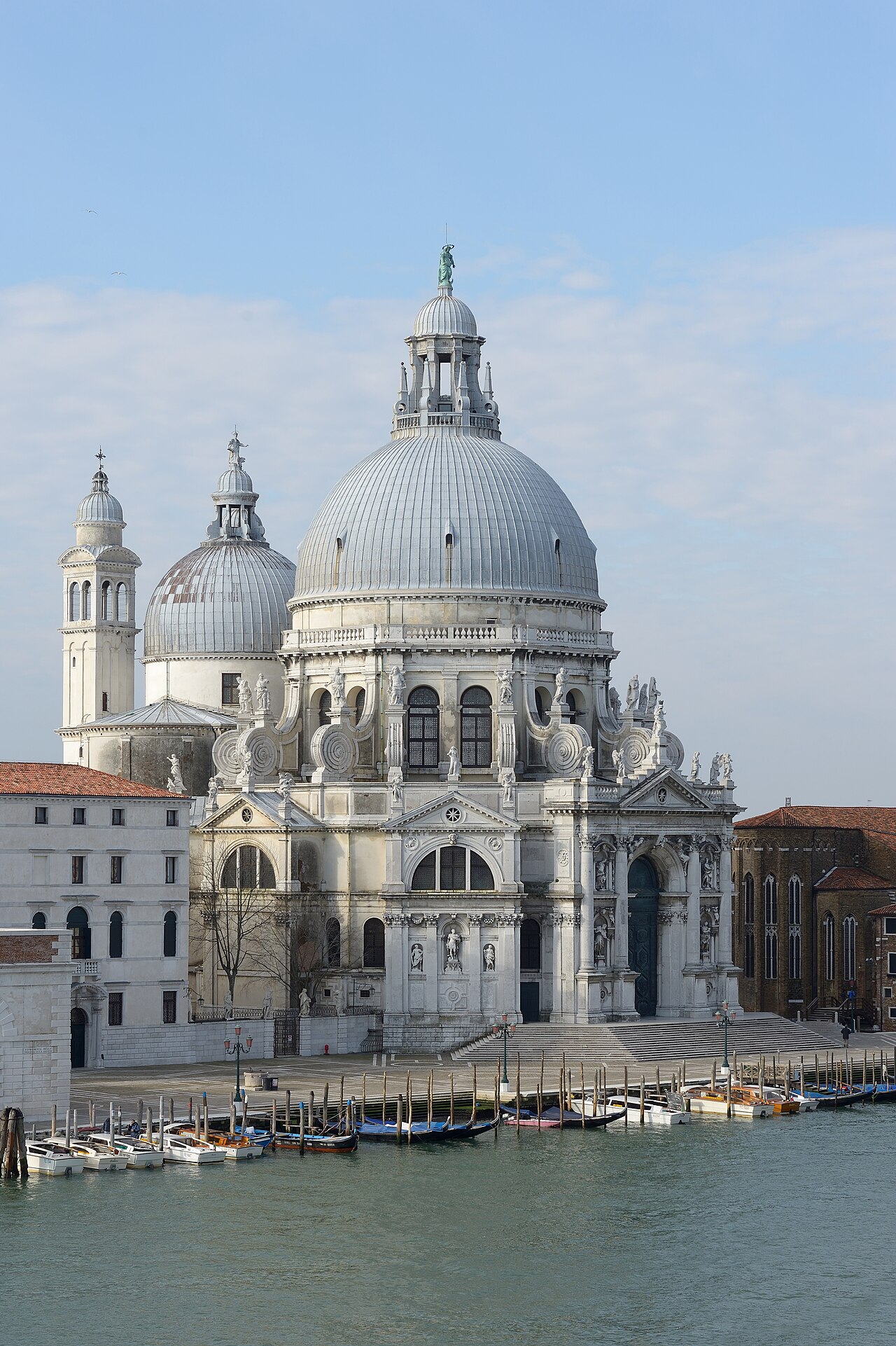
Photo: kallerna · CC BY-SA 4.0 · Wikimedia Commons
Ponte dell'Accademia is a bridge in Venice, Italy. One of only four bridges across the Grand Canal. The free Lokali audio guide runs 6 minutes.
✓ Published October 2026 · how we write these guides
Visitor facts
| Lokali audio guide | 6 min · free |
|---|---|
| Type | Bridge |
| Location | Venice, Italy |
| Coordinates | 45.4317, 12.3290 |
| Languages | 50+, in the Lokali app |
The story
Listen to the boards under your feet. Each step makes a soft, hollow knock, and the wood gives just slightly as you climb. Below you, the water of the Grand Canal slaps against hulls and stone. A vaporetto engine growls, slows, and pulls away. You are standing on one of the very few bridges in Venice that crosses the city's main waterway. Here, a timber arch carries you over the widest street in town.
This is the Ponte dell'Accademia. It links two districts of Venice. Behind you, or ahead, depending on your direction, lies San Marco, with its grand squares and busy lanes. On the other bank is Dorsoduro, a quieter area of galleries, small canals and student cafés. The bridge takes its name from the art museum at its southern foot, the Gallerie dell'Accademia. For centuries, there was no bridge here at all. People crossed by boat.
That detail surprises many visitors. For most of the city's long history, the Grand Canal had only one bridge, at Rialto. Everywhere else, Venetians paid a ferryman. They still can, in a way. Look along the canal and you may spot a traghetto, a simple gondola that carries passengers straight across. Standing up for the short ride is a local habit. The bridges came late, and they came slowly.
The first bridge on this spot was not wood at all. It was iron. It opened in the middle of the nineteenth century, when Venice was under Austrian rule. A British engineer named Alfred Neville designed it. It was flat and practical, a piece of industrial engineering in a city of marble and brick. Many Venetians did not love it. It looked like it belonged in a railway yard, not beside palaces.
The iron bridge also had a practical problem. It sat low over the water. As steam-powered boats arrived on the Grand Canal, the bridge got in their way. The metal also suffered in the damp, salty air. By the early twentieth century, the city decided the iron bridge had to go. The question was what should replace it. A stone design was discussed, but a full permanent solution would take time and money.
So in the 1930s, Venice built a temporary bridge. The engineer Eugenio Miozzi designed a single high arch made of wood. It was meant to last only a few years, until a proper stone bridge could be built. Here is the second surprise... that stone bridge never came. The temporary structure stayed. Venetians grew used to it, and then grew fond of it. Today it is one of the most loved views in the city.
A wooden bridge over salt water does not last forever, though. Over the decades, the timber weakened. In the 1980s, the bridge was rebuilt. Engineers added a metal structure inside to give it strength, while keeping the wooden look on the outside. So the bridge you are walking on is, in a sense, a copy of the temporary one. It is an honest compromise between affection and engineering.
Now, walk to the top of the arch and stop. Face east, toward the open water. This is the view that brings people here. On the right bank rises the great white dome of Santa Maria della Salute, a church built after a plague in the seventeenth century. Its curved stone volutes, the scroll-shaped supports around the dome, look like rolled paper from here. Beyond it, the canal widens toward the lagoon.
Let your eyes move along the palaces on both banks. Notice how each façade has its own colour. Some are pale pink, some ochre, some faded white. Many have wooden poles in the water outside their doors, painted in stripes. These are mooring posts for private boats. Their colours once helped identify the family who lived there. Watch the water too. It shifts from green to grey to silver as the light changes.
Now turn around and look west. The canal bends away, lined with more palaces. At the San Marco end of the bridge stands a large Gothic-style palace with pointed windows, Palazzo Cavalli-Franchetti. Its garden sits right beside the bridge. On the Dorsoduro side, the museum fills a former religious complex. Inside are paintings by Venetian masters such as Bellini, Titian and Tintoretto. The bridge is a natural doorway into that collection.
For a while, the railings here filled with padlocks. Couples locked them on as a sign of love and threw the keys into the canal. The weight and the metal damaged the structure, and the city began removing them. Venice now asks visitors not to add any. It is a small reminder that this bridge is still a working part of the city, not only a backdrop for photographs.
Think about the people who cross here every day. A delivery worker pushes a trolley up the steps. A student hurries to class in Dorsoduro. An older Venetian pauses at the top, as though checking the weather over the lagoon. In a city without cars, bridges are where daily life meets. Every step up and every step down is part of how Venice moves.
Before you go, stand still for one more moment at the highest point. Feel the wood beneath you, warmed or cooled by the day. Listen to the water against the stone below, and to the voices of people around you in many languages. A temporary bridge has carried this crowd for almost a century. As you walk down the steps, notice how the city closes around you again, narrow and quiet, after that wide open view.
Key facts
What to look for
Practical tips
Common questions
Is there a free audio guide to Ponte dell'Accademia?
Yes — the Lokali app narrates Ponte dell'Accademia free of charge in 50+ languages. The guide runs about 6 minutes, covers the history, what to look for on site and practical tips, and works offline once downloaded.
Where is Ponte dell'Accademia?
Ponte dell'Accademia is in Venice, Italy, at 45.4317, 12.3290. Tap the map link on this page for directions from where you are.
What is Ponte dell'Accademia known for?
One of only four bridges across the Grand Canal. First bridge here was iron, built under Austrian rule.
What should you look for at Ponte dell'Accademia?
The white dome of Santa Maria della Salute to the east. Striped mooring poles painted outside the palace doors. Gothic pointed windows of Palazzo Cavalli-Franchetti.
What should you know before visiting Ponte dell'Accademia?
Come early morning to see the Salute view without crowds. Pause at the very top for the clearest canal view.
When is the best time to visit Ponte dell'Accademia?
Come early morning to see the Salute view without crowds.
On the map
Opens directions to Ponte dell'Accademia from your location.
More to see in Venice


Hear Ponte dell'Accademia in your language
The full story, narrated, in 50+ languages. Download it before you go and it plays offline, at your own pace, with no ticket and no tour group.