
Photo: Македонец · CC BY-SA 4.0 · Wikimedia Commons
Aigai is an ancient Macedonian capital. It is near Vergina, Greece. Aigai was the first royal capital of ancient Macedon. The free Lokali audio guide runs 7 minutes.
✓ Published October 2026 · how we write these guides
Visitor facts
| Lokali audio guide | 7 min · free |
|---|---|
| Type | Archaeological Site |
| Location | Vergina, Greece |
| Coordinates | 40.4780, 22.3228 |
| Official website | aigai.gr |
| Languages | 50+, in the Lokali app |
The story
Stand still for a moment and listen. The hills here are soft and green. Wind moves through olive trees and dry grass, and somewhere a dog barks in the village of Vergina. Underfoot the earth is reddish and fine. It feels like quiet farmland. Yet beneath these slopes lay one of the great archaeological discoveries of the twentieth century. This is Aigai, the first royal capital of the ancient kingdom of Macedon.
Long before Alexander the Great marched to India, his ancestors ruled from this spot. Aigai sits in the foothills of the Pierian Mountains, above the broad plain of the Aliakmonas River. The site was a natural stronghold, with mountains behind and fertile land below. Macedonian kings later moved their main seat to Pella, further north. But Aigai kept a special status. It stayed the place of royal ceremony, and the place where kings were buried.
For centuries, the name Aigai survived mainly in ancient texts. Scholars knew the city existed, but they argued about where it was. Then the evidence pointed here, to this corner of northern Greece. Excavations continued through the twentieth century, slowly and patiently. The breakthrough came in 1977. The Greek archaeologist Manolis Andronikos was digging into a huge artificial mound locally called the Great Tumulus. A tumulus is simply an earth mound piled over graves.
What Andronikos found inside changed Greek archaeology. Beneath the earth lay several tombs, and some had never been robbed. One of them, known today as Tomb Two, had its painted facade and its stone doors still in place. Inside were weapons, armour, silver vessels, and a solid gold chest. Here is the first surprise for many visitors. Ancient Macedonian royal tombs were usually looted in antiquity. To find a royal burial intact was almost unheard of.
That gold chest held cremated bones wrapped in purple cloth. On its lid is a star or sun with sixteen rays. Today people call it the Vergina Sun, and it has become a powerful modern symbol in northern Greece. Andronikos argued that Tomb Two belonged to Philip the Second, the father of Alexander. Philip transformed Macedon into the strongest power in the Greek world. But please note — this identification is still debated. Some scholars believe the tomb belonged to a later king, Philip the Third Arrhidaeus.
The argument has continued for decades, through studies of the bones, the objects, and the architecture. Some researchers think Philip the Second lies instead in the neighbouring Tomb One, which was looted in antiquity. The honest answer is that the question is open. What is certain is this: these were royal Macedonian burials of the fourth century before Christ. And they are among the richest ever found in Greece.
Today you visit the tombs in an unusual way. The museum is built inside the mound itself. Engineers reconstructed the tumulus over a protective structure, so you walk into the earth. The light inside is low and the air is cool. The building keeps the tombs where they were found, rather than moving them to a city gallery. That choice gives the space its strange stillness. You look at the facades in the same place where the mourners left them.
Slow down at the facade of Tomb Two. Above the doorway runs a long painted frieze of a hunt. Riders and men on foot chase a lion, a boar, and deer through a landscape of trees. The colours are faded but still readable. Original large-scale Greek wall painting is extremely rare. Most of what we know about ancient Greek painting comes from vases and later Roman copies. So this frieze is a second surprise — a direct look at the art of the period.
Nearby is a smaller tomb with another painting, often called the Tomb of Persephone. It shows the god Hades carrying off Persephone, the daughter of the harvest goddess Demeter. In Greek myth, this abduction explains the seasons. Persephone spends part of the year in the underworld, and the earth grows cold. The brushwork is quick and confident. Look at the movement in the figures and the twist of Persephone's body.
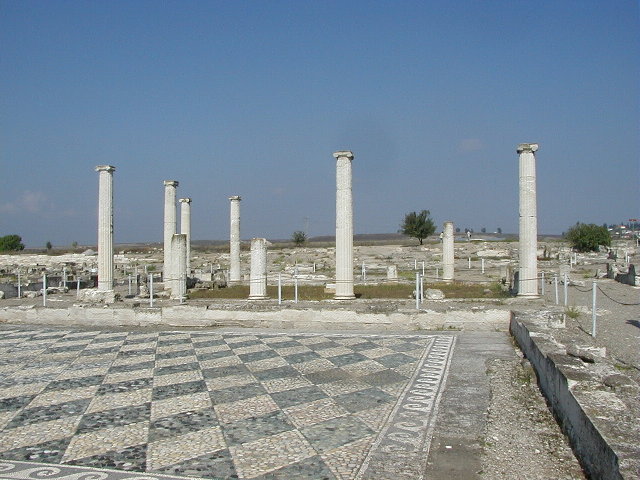
Now lift your eyes from the tombs to the hill above. There stand the remains of the royal palace of Aigai. It was one of the largest buildings in classical Greece, arranged around a great central courtyard. It probably dates to the time of Philip the Second. After years of careful restoration, visitors can again walk among its foundations. You can see mosaic floors made of small river pebbles, laid in patterns of flowers and geometric shapes.
Just below the palace lies the theatre. It is modest in size, and only the lowest row of stone seats survives. But a dramatic event happened here. In 336 BC, Philip the Second entered this theatre during celebrations for his daughter's wedding. One of his own bodyguards stabbed him to death. Ancient writers describe the scene, though they disagree on the motive. Alexander was proclaimed king soon afterwards. A new chapter of world history began here.
Around the town, the hills hold hundreds of smaller burial mounds. Together they form a vast ancient cemetery used over many centuries. Some graves are far older than the Macedonian kings. The Great Tumulus itself was probably raised after the royal tombs were damaged by raiders, perhaps to hide and protect them. If that is true, the plan worked. The earth guarded its secrets for more than two thousand years. In 1996, UNESCO listed Aigai as a World Heritage Site.
As you leave, walk back out into the daylight and pause. Notice the change in light, from the dim museum to the open sky. Look at the shape of the mound against the hills. From outside it looks like a gentle green hill and nothing more. That is exactly why it stayed hidden for so long. Listen again to the wind and the village. Kings were crowned and buried on this quiet ground.
Key facts
What to look for
Practical tips
Common questions
Is there a free audio guide to Aigai?
Yes — the Lokali app narrates Aigai free of charge in 50+ languages. The guide runs about 7 minutes, covers the history, what to look for on site and practical tips, and works offline once downloaded.
Where is Aigai?
Aigai is near Vergina, Greece, at 40.4780, 22.3228. Tap the map link on this page for directions from where you are.
What is Aigai known for?
Aigai was the first royal capital of ancient Macedon. Manolis Andronikos opened the Great Tumulus tombs in 1977.
What should you look for at Aigai?
The painted hunting frieze above Tomb Two's doorway. The sixteen-rayed sun on the gold burial chest. Hades seizing Persephone in the smaller painted tomb.
What should you know before visiting Aigai?
Visit the tomb museum before climbing to the palace. Bring water and a hat for the exposed palace hill.
When is the best time to visit Aigai?
Come early to see the hills in soft morning light.
On the map
Opens directions to Aigai from your location.
More to see near Aigai


Hear Aigai in your language
The full story, narrated, in 50+ languages. Download it before you go and it plays offline, at your own pace, with no ticket and no tour group.