
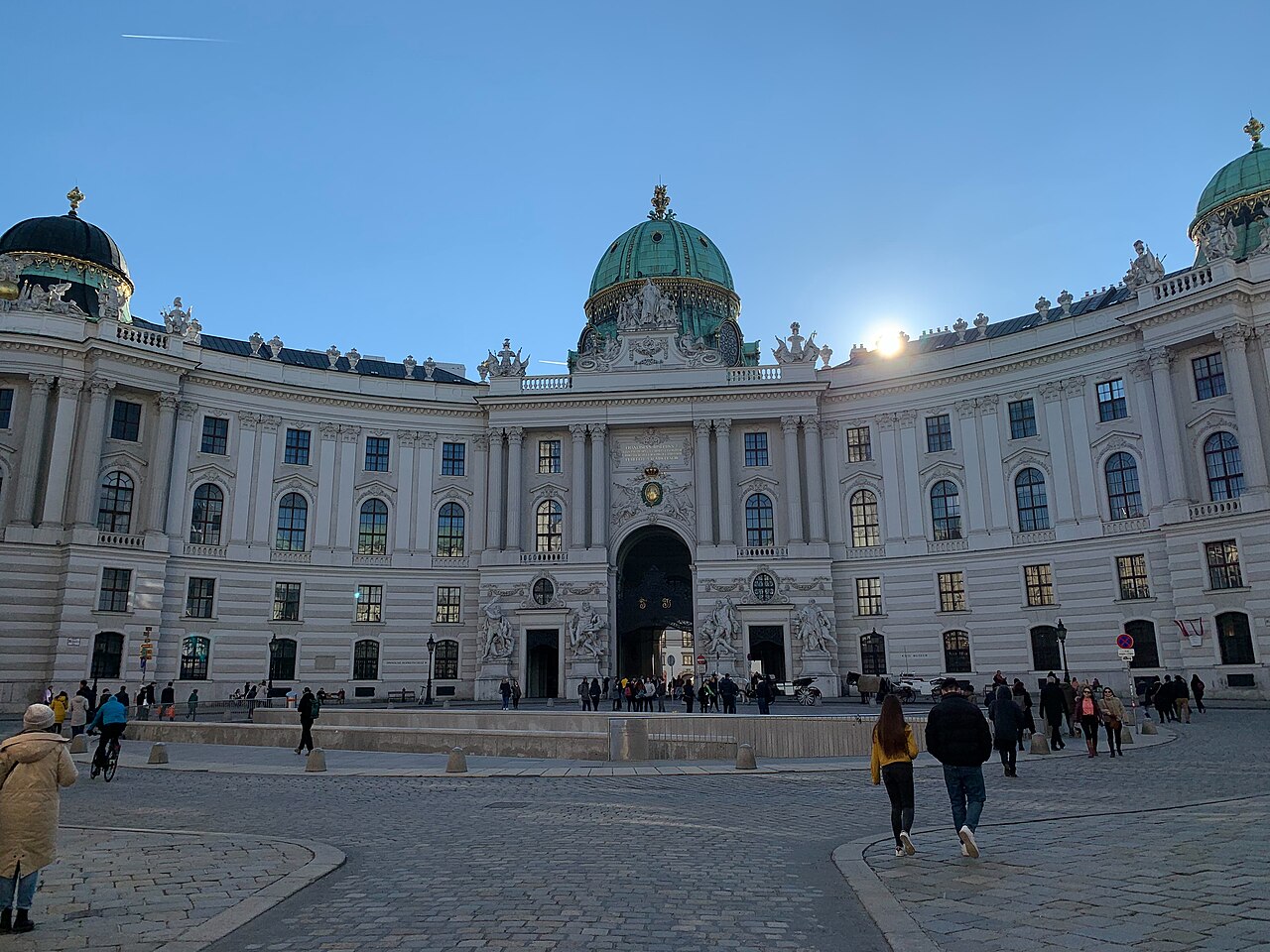
Photo: C.Stadler/Bwag · CC BY-SA 4.0 · Wikimedia Commons
Burgtheater is a state drama theatre in Vienna, Austria. Founded in 1741 beside the Hofburg imperial palace. The free Lokali audio guide runs 8 minutes.
✓ Published October 2026 · how we write these guides
Visitor facts
| Lokali audio guide | 8 min · free |
|---|---|
| Type | Theatre |
| Location | Vienna, Austria |
| Coordinates | 48.2103, 16.3614 |
| Official website | burgtheater.at |
| Languages | 50+, in the Lokali app |
The story
Stand on the edge of the Ringstrasse for a moment and listen. Trams grind and chime along the rails behind you. Bicycles hiss past on the cycle path. In front of you, a long pale facade curves gently outward, like a great stone bow facing the street. This is the Burgtheater, and Viennese people often call it simply "die Burg", the castle. For more than two centuries, a night at this theatre has meant something special to the city. Actors still measure their careers by whether they ever performed on its stage.
The story does not begin here, on the Ring. It begins a short walk away, beside the imperial palace, the Hofburg. In 1741, Empress Maria Theresa allowed a theatre to operate in a converted building next to the palace, on what is now Michaelerplatz. The court could walk almost straight from its rooms to its seats. In 1776, her son, Emperor Joseph the Second, gave the house a new status. He named it the German National Theatre. That was a bold idea at a time when French and Italian work dominated court stages across Europe.
Here is the first surprise. The old Burgtheater was also a place for music. Some of the most loved works in classical music had their first nights in that earlier building. Mozart premiered "The Abduction from the Seraglio" there in 1782. "The Marriage of Figaro" followed in 1786, and "Così fan tutte" in 1790. Then, in 1800, Beethoven presented his First Symphony in the same house. So the name on this facade carries an echo of Mozart and Beethoven, even though neither of them ever entered this particular building.
By the late nineteenth century, Vienna was rebuilding itself on a grand scale. The old city walls had come down, and the Ringstrasse rose in their place. This was a wide boulevard lined with parliament, university, museums and city hall. The theatre needed a home to match. The new building was designed by two architects, Gottfried Semper and Carl von Hasenauer. Semper was a German architect famous for theatres and museums. The new Burgtheater opened in 1888, and the old house beside the palace was soon demolished.
Look at the shape of the front. The central section bends outward in a smooth curve, while two long wings stretch to the left and right. Those wings are not just decoration. Each one holds a grand staircase. One was meant for the imperial court, and the other for the general public. Even the way you climbed to your seat told everyone who you were. The style draws on the Italian Renaissance. That means calm symmetry, arched windows, columns and carefully balanced proportions, all borrowed from the palaces of fifteenth and sixteenth century Italy.
Now let your eyes travel up to the roofline and the upper facade. Sculpture fills the building. High above the centre stands a figure associated with Apollo, the Greek god of the arts, joined by figures representing tragedy and comedy. Lower down, along the front, you will find portrait busts of great playwrights. Look for Shakespeare, Goethe, Schiller, and the Austrian dramatist Franz Grillparzer. Together they form a kind of stone reading list. The building announces, before you ever buy a ticket, which writers it considers the foundation of serious theatre.
The second surprise is inside, in those staircases. When the new theatre was decorated, a small group of young painters received the commission for the ceiling paintings. They were Gustav Klimt, his brother Ernst Klimt, and their colleague Franz Matsch. At the time, Gustav Klimt was not yet the famous painter of gold and pattern that the world knows today. These ceilings show scenes from the history of theatre, painted in a careful, traditional style. Many visitors pass beneath them without realising they are looking at early Klimt.
There is a lovely twist connected to the move. Before the old theatre was torn down, Klimt and Matsch were asked to paint its auditorium. They filled the canvas with recognisable faces from Viennese society, sitting in their seats and looking back toward the stage. It became a farewell portrait of the old house and its audience. People reportedly asked to be included, because appearing in the picture was a sign of belonging. That painting is now held by the Wien Museum, the city museum of Vienna.
The grand new building did not please everyone at first. Audiences complained that it was hard to hear the actors and hard to see the stage from many seats. A theatre that looked magnificent from the street did not work perfectly for spoken drama. So, less than ten years after the opening, the auditorium was rebuilt in 1897 to improve the sightlines and the sound. It is a useful reminder that beautiful architecture and practical acoustics do not always arrive together.
The twentieth century brought much harder times. In the final weeks of the Second World War, in the spring of 1945, the Burgtheater was badly damaged, and fire destroyed much of the auditorium. The company did not stop working. It moved to other stages in the city while the building was restored. The theatre reopened in 1955. That same year, Austria regained full independence through the State Treaty, and the State Opera also reopened. For many Viennese, these reopenings marked the true end of the war years.
Today the Burgtheater is one of the largest spoken theatre companies in the German-speaking world. Its repertoire mixes classic plays with new writing and bold modern productions. Performances are almost always in German, so for many visitors the building itself is the main experience. Even so, an evening here can still be rewarding. Watching a full Viennese audience settle into the red and gold auditorium is a piece of local culture in its own right. Guided tours are also offered, and they take you into spaces you cannot see from the street.
Now turn around. Directly across the Ringstrasse rises the Vienna City Hall, the Rathaus, with its tall Gothic tower and lacy stonework. Between the two buildings lies a park. In winter it often holds a large Christmas market and ice rink, and in summer it hosts open air film and music events. The theatre and the city hall face each other almost like two actors on a stage. One represents civic government and the other represents culture. Both belong to the same confident era of the Ring.
Before you walk on, take one last look at the curved front of the Burg. Notice how the light falls across the pale stone, and how the busts of the playwrights look out over the traffic. Every day, thousands of people pass this building on their way to work, to class, or to a café. Few of them stop to look up. You have just done that. As you leave, listen again to the trams and the bicycles, and imagine the quiet that will fall inside tonight, just before the curtain rises.
Key facts
What to look for
Practical tips
Common questions
Is there a free audio guide to Burgtheater?
Yes — the Lokali app narrates Burgtheater free of charge in 50+ languages. The guide runs about 8 minutes, covers the history, what to look for on site and practical tips, and works offline once downloaded.
Where is Burgtheater?
Burgtheater is in Vienna, Austria, at 48.2103, 16.3614. Tap the map link on this page for directions from where you are.
What is Burgtheater known for?
Founded in 1741 beside the Hofburg imperial palace. Joseph the Second named it German National Theatre in 1776.
What should you look for at Burgtheater?
The gently curved central facade bowing toward the street. Portrait busts of Shakespeare, Goethe and Schiller on the front. Sculpted figures of tragedy and comedy near the roofline.
What should you know before visiting Burgtheater?
Join a guided tour to see the staircases inside. Cross the Ring to the Rathaus park for a wide view.
On the map
Opens directions to Burgtheater from your location.
More to see in Vienna



Hear Burgtheater in your language
The full story, narrated, in 50+ languages. Download it before you go and it plays offline, at your own pace, with no ticket and no tour group.