
Church of Saint Michael, Vienna
48.2080° N · 16.3670° E · Church
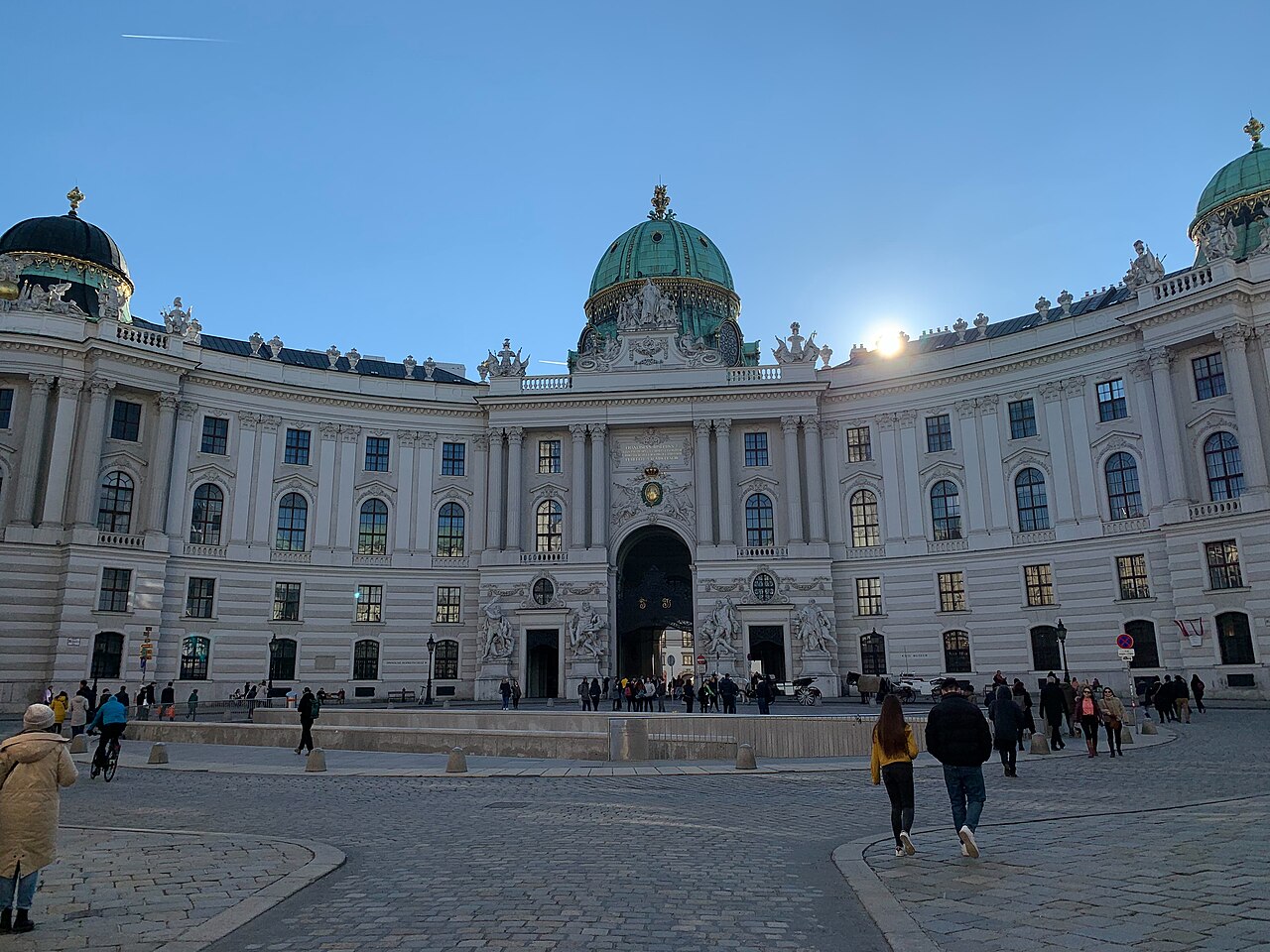
Photo: Gryffindor This panoramic image was created with Autostitch (stitched images may differ · Public domain · Wikimedia Commons
Church of Saint Michael, Vienna is a church in Vienna. One of Vienna's oldest churches, with thirteenth century Romanesque origins. The free Lokali audio guide runs 7 minutes.
✓ Published October 2026 · how we write these guides
Visitor facts
| Lokali audio guide | 7 min · free |
|---|---|
| Type | Church |
| Location | Vienna, Austria |
| Coordinates | 48.2080, 16.3670 |
| Official website | michaelerkirche.at |
| Languages | 50+, in the Lokali app |
The story
Stand still on Michaelerplatz for a moment and listen. Hooves click on cobblestones as the horse-drawn carriages wait for passengers. There is a faint smell of horses and cold stone. Across the square, the green dome of the imperial palace rises behind its curved gateway. And right beside you, a pale classical front with tall columns hides something much older. This is the Church of Saint Michael. Locals call it the Michaelerkirche, and it is one of the oldest churches in Vienna.
The classical facade can mislead you. Those clean columns and that calm triangular pediment are a late eighteenth century addition. Behind them stands a church whose roots go back to the early thirteenth century. Its first form was Romanesque. That was the heavy, round-arched style of medieval Europe before the Gothic period. Over the following centuries the church grew and changed. Gothic builders added a taller choir and the slender spire you can see above the roofline. Later generations added Baroque altars inside. So you are not looking at one building, but at many centuries stacked together.
Look up above the main entrance before you go in. A sculpture group shows the archangel Michael in battle. He is the church's patron, the warrior angel who, in Christian tradition, threw the rebel angels out of heaven. The figures are the work of Lorenzo Mattielli, an Italian sculptor who worked for the Habsburg court in the early eighteenth century. Notice how the bodies twist and fall. Even in stone, the scene has real motion. It sets the theme you will meet again inside.
Location explains much of this church's importance. For centuries it served as the parish church of the imperial court. The Hofburg, the winter palace of the Habsburg family, stands just across the square. Courtiers, servants and officials of the palace belonged to this parish. Many people who worked in the shadow of the emperors were baptised, married and mourned here. It was a neighbourhood church, but the neighbourhood happened to be the centre of an empire.
Now step inside, and let your eyes adjust. The nave is long and fairly dim. The air is cool and carries the smell of old wood and candle wax. Then your eye travels to the far end of the church, above the high altar. There, a great cascade of white and gold seems to pour down from the ceiling. It is a frozen waterfall of angels, clouds and rays of light. This is the Fall of the Angels, created in stucco in the late eighteenth century.
Take a few steps closer and look carefully. Near the top, angels float in light and glory. Lower down, the figures twist, tumble and darken. The fallen angels are dropping away from heaven. Stucco is a plaster that artists can shape while it is still wet, and here it is used almost like sculpture in the air. It is one of the last great Baroque works in Vienna, made just as tastes were turning towards a cooler classical style.
Here is something many visitors miss. Music history passed through this room. In December 1791, only days after Wolfgang Amadeus Mozart died, a memorial service for him took place in this church. According to tradition, parts of his unfinished Requiem were performed at that service. If that account is right, these walls heard some of the earliest notes of a work that still fills concert halls today. It is a quiet thought to hold while you stand in the nave.
Music has another link to this corner of Vienna. The large building attached to the church, known as the Michaelerhaus, once housed a young Joseph Haydn. Before he became famous, Haydn lived here in a small attic room. He was poor, he taught music lessons, and he studied hard. Later he became one of the most important composers of his age. So when you walk out of the church, remember that a future master once climbed these stairs with very little money in his pocket.
The church also holds the grave of Pietro Metastasio. He was an Italian poet who wrote opera texts for the imperial court. In the eighteenth century, his words were set to music by many composers across Europe. He lived and worked in Vienna for decades, and he was buried here. Look for memorials and tomb plaques along the walls and side chapels. Each one marks a life once connected to the court.
Now for the second surprise, and it lies below your feet. Under the church is a large crypt. For centuries, wealthy families and court officials were buried down there. Because of the cool, dry and steady air, some bodies did not decay in the usual way. They became naturally mummified. Some coffins still show clothing, wigs and faces. The crypt can usually be visited only on a guided tour, and the experience is quiet and serious.
When you step back out onto the square, turn slowly in a full circle. The middle of Michaelerplatz holds an open excavation. Behind low rails, you can see Roman and later foundations. Long before the Habsburgs, this ground was part of the Roman military world on the Danube. Directly opposite the church stands the Looshaus. It is a plain building by the architect Adolf Loos from the early twentieth century. Its bare upper facade shocked many Viennese at the time.
This square places centuries side by side in a very small space. There are Roman ruins, a medieval church with a classical face, an imperial palace gate, and an early modern building that once caused a scandal. Vienna often builds on top of itself. Here, the layers sit openly next to each other. Standing on this square, you can read a short history of the city just by moving your eyes from one wall to the next.
Before you go, look once more at the church front. Notice the archangel above the door, frozen in his fight. Then notice the slim spire rising behind the classical columns, older than everything around it. Listen again to the horses and the footsteps on the stones. People have crossed this square to pray, to work and to mourn for many centuries. Now you are one more of them, and the church is still here, still open, and still part of daily life.
Key facts
What to look for
Practical tips
Common questions
Is there a free audio guide to Church of Saint Michael, Vienna?
Yes — the Lokali app narrates Church of Saint Michael, Vienna free of charge in 50+ languages. The guide runs about 7 minutes, covers the history, what to look for on site and practical tips, and works offline once downloaded.
Where is Church of Saint Michael, Vienna?
Church of Saint Michael, Vienna is in Vienna, Austria, at 48.2080, 16.3670. Tap the map link on this page for directions from where you are.
What is Church of Saint Michael, Vienna known for?
One of Vienna's oldest churches, with thirteenth century Romanesque origins. Served for centuries as the parish church of the imperial court.
What should you look for at Church of Saint Michael, Vienna?
Archangel Michael sculpture group above the main entrance. White and gold stucco cascade of falling angels. Slender Gothic spire rising behind the classical facade.
What should you know before visiting Church of Saint Michael, Vienna?
Book a guided tour to see the mummified crypt. Walk to the far end to view the altar closely.
On the map
Opens directions to Church of Saint Michael, Vienna from your location.
More to see in Vienna


Hear Church of Saint Michael, Vienna in your language
The full story, narrated, in 50+ languages. Download it before you go and it plays offline, at your own pace, with no ticket and no tour group.