
Imperial Treasury, Vienna
48.2066° N · 16.3654° E · Museum
Photo: MyName (Gryffindor) · Public domain · Wikimedia Commons
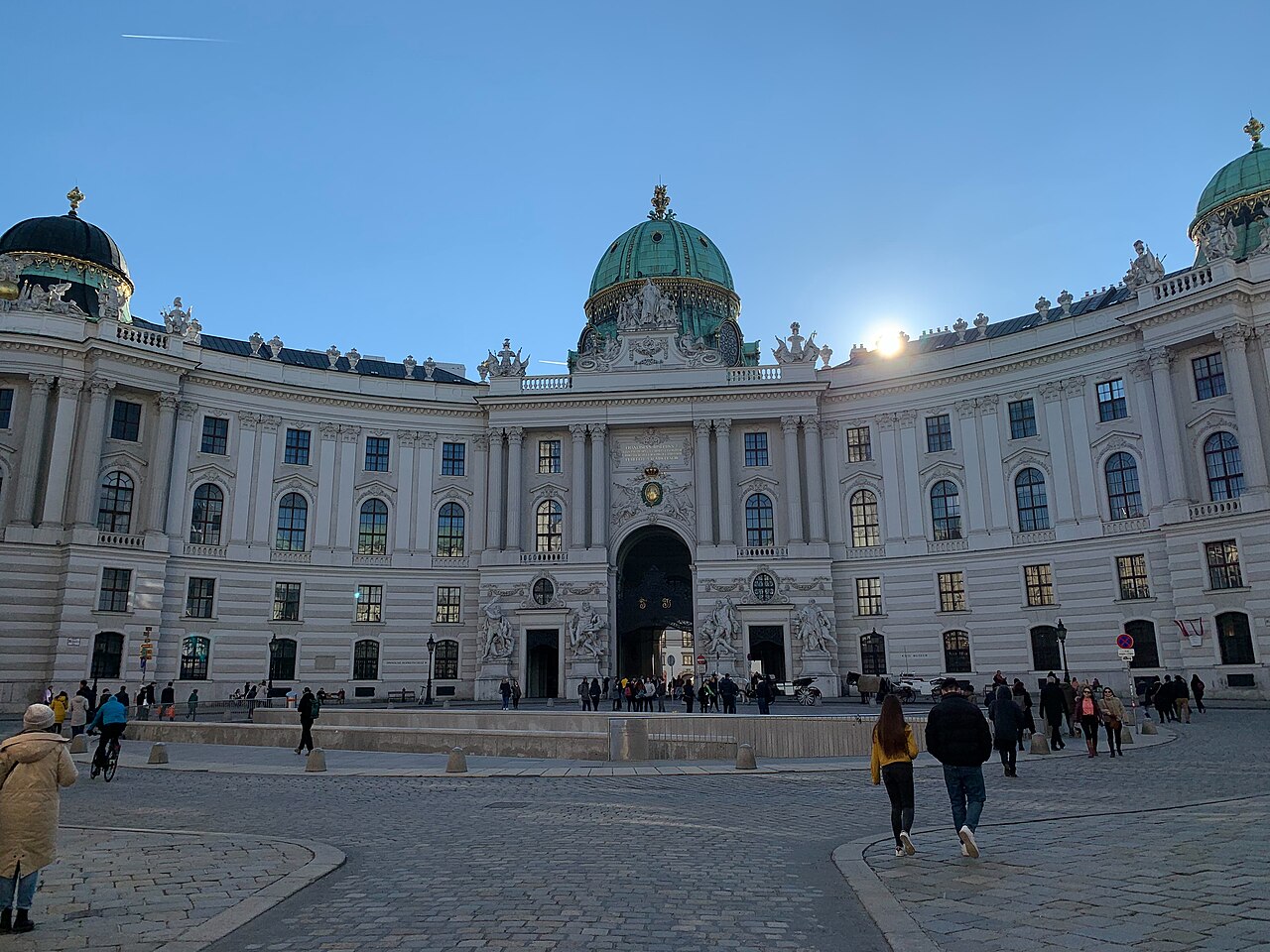
Imperial Treasury, Vienna is a museum in Austria. It is in Vienna, Austria. Housed in the Swiss Wing, oldest part of the Hofburg. The free Lokali audio guide runs 8 minutes.
✓ Published October 2026 · how we write these guides
Visitor facts
| Lokali audio guide | 8 min · free |
|---|---|
| Type | Museum |
| Location | Vienna, Austria |
| Coordinates | 48.2066, 16.3654 |
| Languages | 50+, in the Lokali app |
The story
Before the treasure, there is a gate. You pass under the Swiss Gate, painted in deep red, black and gold, into the oldest courtyard of the Hofburg palace. The stones underfoot are worn smooth. Sound changes here. The traffic of the Ringstrasse falls away, and footsteps echo off plain walls. Then you step inside, and the light drops. The rooms are dim on purpose. Each object glows inside its own glass case, like a small fire kept alive in the dark.
This is the Imperial Treasury, known in German as the Kaiserliche Schatzkammer. It sits inside the Swiss Wing, the medieval core of the Hofburg, the palace complex that served the Habsburg dynasty for centuries. Today it is run by the Kunsthistorisches Museum, Vienna's great art museum. The collection divides into two parts. The Secular Treasury holds crowns, robes and dynastic heirlooms. The Ecclesiastical Treasury holds relics, altar vessels and devotional objects. Together they form one of the most important royal collections in Europe.
Why does a treasury like this exist at all? For a ruling family, objects were proof. A crown was not decoration. It was evidence that the wearer had the right to rule. Relics showed that heaven was on your side. Rare natural wonders showed that you could command the edges of the known world. The Habsburgs collected all three kinds of power, and they kept them close. Walking these rooms, you are looking at the tools of legitimacy, not only at jewellery.
The first great surprise is a crown that is not round. The Imperial Crown of the Holy Roman Empire is shaped as an octagon, made of eight hinged gold plates. Scholars still debate its exact date, but most place it in the tenth or eleventh century. Eight was a number of perfection in medieval thought, linked to the heavenly city of Jerusalem. Four plates carry precious stones and pearls, set high so that light passes through them. The other four carry enamel pictures.
Lean in to those enamel plates. One shows Christ enthroned. Others show the Old Testament kings David and Solomon, and King Hezekiah with the prophet Isaiah. The message was clear to anyone who could read images. A good emperor rules with wisdom, justice and faith. Now look at the arch that rises over the top of the crown. It was added later, and it carries a name in pearls. It names Conrad, the emperor Conrad the Second, who ruled in the early eleventh century.
This crown, with the other imperial regalia, did not always live in Vienna. For centuries much of it was kept in Nuremberg. In the 1790s, as French revolutionary armies advanced, the regalia were moved for safety, and they ended up here. Soon after, in 1806, the Holy Roman Empire itself was dissolved. The crown outlived the state it was made to crown. In the twentieth century the Nazi regime took the regalia to Nuremberg. They returned to Vienna after the Second World War.
Nearby lies an object that looks almost modest — a long iron spearhead wrapped in a sleeve of silver and gold. This is the Holy Lance. According to Christian tradition, it is the spear that pierced the side of Christ at the crucifixion. Scientific study tells a different story. The blade dates to the Carolingian era, roughly the eighth century. A pin set into the blade was venerated as a nail from the cross. For medieval emperors, the Lance was perhaps the most sacred piece of all.
The Austrian Imperial Crown tells a younger story. It was made in Prague in 1602 for Emperor Rudolf the Second, a ruler famous for his love of art, alchemy and curiosities. It was his personal crown, crafted by the goldsmith Jan Vermeyen. Two centuries later, in 1804, it took on a new role. When Francis the Second declared the Austrian Empire, this became its crown. Look for the high mitre shape at its centre, a sign of the emperor's sacred status, and the large sapphire at the top.
The second surprise is a horn. In one case lies a long, spiralled tusk, taller than most visitors. For centuries it was believed to be the horn of a unicorn. Such horns were thought to purify poison, and they were worth more than gold. In truth, it is the tusk of a narwhal, a small whale of the Arctic seas. The Habsburgs treated it as an inalienable heirloom, an object that could never be sold or given away. It stands here like a message from a world of wonder.
Another case holds a large bowl, carved from a single piece of agate. It was likely made in late antiquity, possibly in Constantinople around the fourth century. Its size is unusual for a single stone. Legend later attached itself to the bowl. Some believed it was the Holy Grail. Others claimed they could see the name of Christ written in the natural veins of the stone. Lean close, and you may judge for yourself what the grain shows — and what the imagination adds.
Perhaps the most beautiful textile here is the coronation mantle. It is a great half-circle of red silk, embroidered with gold thread and thousands of pearls. It was made in the royal workshops of Palermo, in Sicily, in the twelfth century, under the Norman king Roger the Second. Two lions attack two camels across its surface. Along the hem runs an inscription in Arabic. So the robe of Christian emperors came from a Mediterranean court where Latin, Greek and Arabic cultures met.
Further on, the mood shifts toward family. There is a cradle made for the infant son of Napoleon, a gift from the city of Paris. The boy later lived in Vienna, at the court of his Habsburg mother's family. You will also find the treasure of the Order of the Golden Fleece, a chivalric order that came to the Habsburgs from the dukes of Burgundy. Gold chains, embroidered vestments and ceremonial vessels show how ritual held the dynasty together.
In the Ecclesiastical Treasury, the tone becomes quieter. Reliquaries of gold and rock crystal hold fragments of bone, cloth and wood. Some are shaped like arms or small churches. Many were made for private prayer within the imperial family. These rooms are often less crowded than the crown rooms. Take your time here. The craftsmanship is just as fine, and the stories are more personal — objects held in the hands of people who prayed for children, health and peace.
When you step back into the courtyard, notice the change. Daylight feels brighter after the dark rooms. The worn stones are the same ones you crossed a short while ago. Above you, the walls of the Swiss Wing look plain from outside. Nothing on the surface tells a passer-by what lies within. Perhaps that is the final lesson of this place. Power was kept behind thick walls and shown only in measured light. As you walk back through the red and black gate, the city returns — one step at a time.
Key facts
What to look for
Practical tips
Common questions
Is there a free audio guide to Imperial Treasury, Vienna?
Yes — the Lokali app narrates Imperial Treasury, Vienna free of charge in 50+ languages. The guide runs about 8 minutes, covers the history, what to look for on site and practical tips, and works offline once downloaded.
Where is Imperial Treasury, Vienna?
Imperial Treasury, Vienna is in Vienna, Austria, at 48.2066, 16.3654. Tap the map link on this page for directions from where you are.
What is Imperial Treasury, Vienna known for?
Housed in the Swiss Wing, oldest part of the Hofburg. Managed today by the Kunsthistorisches Museum.
What should you look for at Imperial Treasury, Vienna?
Red, black and gold paint on the Swiss Gate. Conrad's name spelled in pearls on the crown's arch. Enamel kings David and Solomon on the crown plates.
What should you know before visiting Imperial Treasury, Vienna?
Allow at least ninety minutes for both treasury sections. Visit the Ecclesiastical Treasury for quieter, less crowded rooms.
When is the best time to visit Imperial Treasury, Vienna?
Arrive early to see the crowns without a crowd.
On the map
Opens directions to Imperial Treasury, Vienna from your location.
More to see in Vienna



Hear Imperial Treasury, Vienna in your language
The full story, narrated, in 50+ languages. Download it before you go and it plays offline, at your own pace, with no ticket and no tour group.