
National Air and Space Museum
38.8883° N · 77.0200° W · Museum
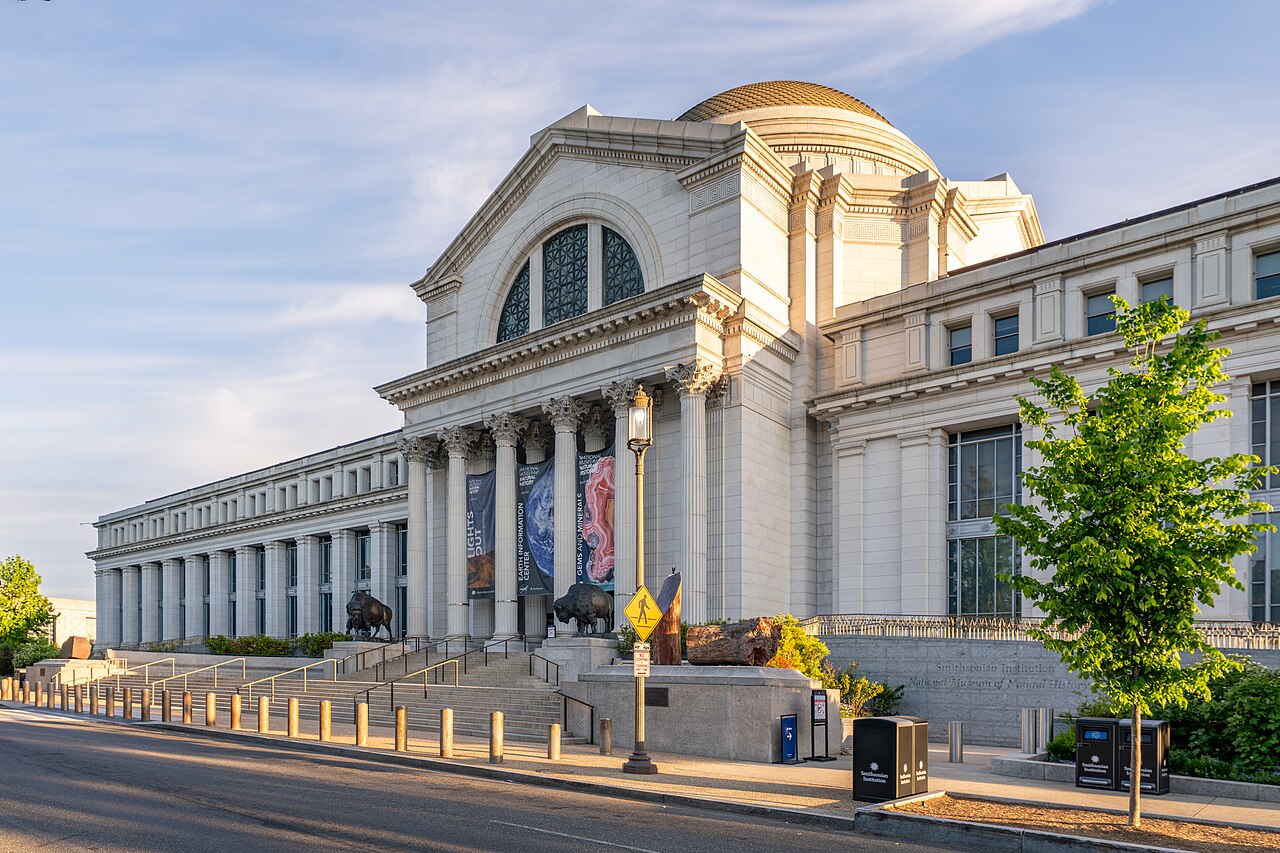
Photo: David Bjorgen · CC BY-SA 3.0 · Wikimedia Commons
National Air and Space Museum is an aerospace museum in Washington, D.C. The museum opened on the National Mall in 1976. The free Lokali audio guide runs 6 minutes.
✓ Published October 2026 · how we write these guides
Visitor facts
| Lokali audio guide | 6 min · free |
|---|---|
| Type | Museum |
| Location | Washington, United States |
| Coordinates | 38.8883, -77.0200 |
| Official website | airandspace.si.edu |
| Languages | 50+, in the Lokali app |
The story
Listen for a moment before you go in. The National Mall has its own sound. You hear gravel under shoes, school groups calling to each other, and the low hum of traffic on Independence Avenue. Then you look up at a long, low building faced in pale pink stone. Its walls are mostly blank. Glass halls sit between them. It looks almost plain from outside, and the plain front is deliberate.
This is the National Air and Space Museum, part of the Smithsonian Institution. It opened in 1976, timed for the two hundredth anniversary of American independence. The architect was Gyo Obata, of the firm Hellmuth, Obata and Kassabaum. He had a difficult brief. The building had to hold aircraft, rockets and spacecraft. It also had to sit quietly on the Mall, facing the National Gallery of Art across the grass.
Obata's answer was a set of four marble-clad blocks joined by three tall glass-and-steel halls. The stone is pink marble from Tennessee. It was chosen to echo the tones of the National Gallery's West Building nearby. The solid blocks hold galleries that need controlled light. The glass halls hold the largest objects, where daylight can fall on aluminium wings and riveted fuselages. When you walk through, notice how you move between these two kinds of space, closed and then open.
The Smithsonian's interest in flight is much older than this building. The institution collected kites and early flying objects in the nineteenth century. For decades, much of the national aviation collection sat in temporary sheds and older buildings. A purpose-built museum came only after the space race had put Americans on the Moon. By then, the collection held objects that had already changed the twentieth century.
The most important of them is small, and made of wood and fabric. It is the 1903 Wright Flyer. Wilbur and Orville Wright, two bicycle makers from Dayton, Ohio, flew it at Kitty Hawk, North Carolina. It made the first sustained, controlled, powered flights by a heavier-than-air machine. The longest flight that December day lasted under a minute. Look at the thin wing ribs, the bicycle-style chains, and the pilot's position, lying flat on the lower wing.
Here is a story many visitors miss. For years, this aircraft was not in America at all. The Wrights quarrelled with the Smithsonian. The institution had promoted a rival machine built by its own former secretary, Samuel Langley, as the first capable of flight. Orville Wright sent the Flyer to the Science Museum in London instead. It came home only in 1948, after the Smithsonian publicly corrected its account. Orville did not live to see the return.
Nearby, look for a silver monoplane with no front window. This is the Spirit of Saint Louis. Charles Lindbergh flew it alone from New York to Paris in 1927, the first solo nonstop flight across the Atlantic. A large fuel tank sat in front of the cockpit, so Lindbergh had no forward view. He used a periscope or turned the plane to look out the side. The small cabin shows how much of that journey depended on a single, tired person.
Then there is the bright orange Bell X-1. In 1947, the test pilot Chuck Yeager flew it faster than the speed of sound, the first piloted aircraft to do so in level flight. He named it Glamorous Glennis, after his wife. The shape is simple: a rounded nose and short, thin wings. Its designers based the body on the shape of a rifle bullet, an object already known to stay stable above the speed of sound.
The space collection tells the next chapter. Here you can see Columbia, the Apollo 11 command module. In July 1969 it carried Neil Armstrong, Buzz Aldrin and Michael Collins to the Moon and back. It is a cone only a few metres across. Three men lived inside it for about eight days. The scorched outer shell shows the heat of re-entry into the atmosphere. Inside, conservators found notes and calendars that the astronauts had written on the walls.
A second surprise is easy to miss. The lunar module on display here is real flight hardware, but it never left the Earth. It was built as a test vehicle, and plans to fly it changed. Look at the gold-coloured foil and the spindly legs. The craft looks fragile because it was designed only for the thin gravity of the Moon and the vacuum of space. It never had to survive air or wind.
Watch for a small dark stone that visitors can touch. It is a sample of the Moon, brought back by an Apollo crew. Its surface is worn smooth by millions of hands. Children reach for it first. Adults often pause before they touch it. It is one of very few places where you can physically touch another world. Many people say this small stone stays with them longer than the large rockets.
In recent years the museum has gone through a long renovation. Galleries have closed and reopened in stages, and the exhibits have been redesigned. What you see today may differ from what a friend saw a few years ago. If one gallery is closed, ask staff which objects have moved. Remember too that this building shows only part of the collection. Many larger aircraft are at the Steven F. Udvar-Hazy Center, near Dulles Airport in Virginia. That second site displays the Space Shuttle Discovery.
As you leave, step out onto the Mall again and turn back toward the building. The pink marble looks warmer in late afternoon light. The glass halls reflect the trees and the sky. Inside are objects that left the ground, and some that left the planet. Out here, look up for a moment. You may see an airliner crossing toward Reagan National Airport, small and silver and ordinary. A little over a century ago, a flight like that was impossible.
Key facts
What to look for
Practical tips
Common questions
Is there a free audio guide to National Air and Space Museum?
Yes — the Lokali app narrates National Air and Space Museum free of charge in 50+ languages. The guide runs about 6 minutes, covers the history, what to look for on site and practical tips, and works offline once downloaded.
Where is National Air and Space Museum?
National Air and Space Museum is in Washington, United States, at 38.8883, -77.0200. Tap the map link on this page for directions from where you are.
What is National Air and Space Museum known for?
The museum opened on the National Mall in 1976. Architect Gyo Obata designed the pink-marble building.
What should you look for at National Air and Space Museum?
Bicycle-style drive chains on the Wright Flyer. Periscope setup in the windowless Spirit of Saint Louis cockpit. Scorched heat-shield surface on the Apollo 11 command module.
What should you know before visiting National Air and Space Museum?
Check online whether a timed-entry pass is needed beforehand. Arrive at opening time to see the Wright Flyer quietly.
When is the best time to visit National Air and Space Museum?
Arrive at opening time to see the Wright Flyer quietly.
On the map
Opens directions to National Air and Space Museum from your location.
More to see in Washington



Hear National Air and Space Museum in your language
The full story, narrated, in 50+ languages. Download it before you go and it plays offline, at your own pace, with no ticket and no tour group.