
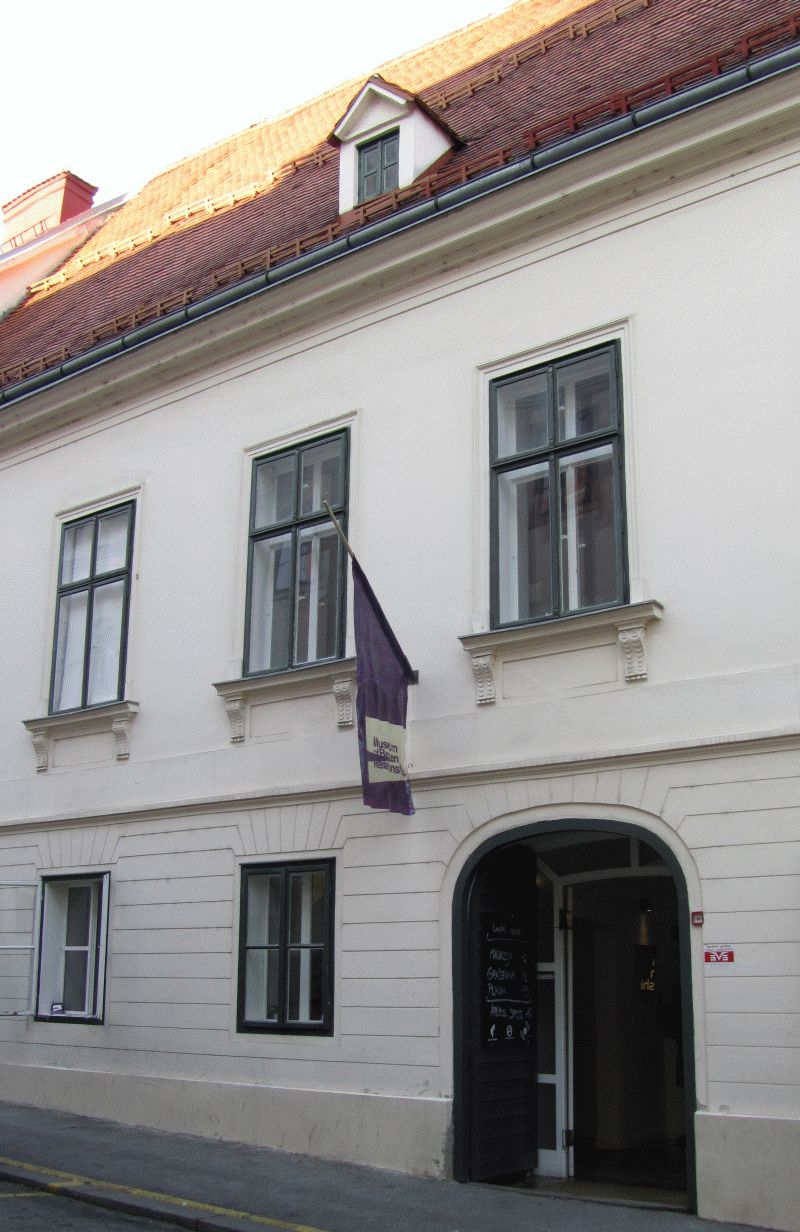
Photo: Bernard Gagnon · CC BY-SA 4.0 · Wikimedia Commons
Mimara Museum is an art museum in Zagreb. Named after collector Ante Topić Mimara, born in Dalmatia. The free Lokali audio guide runs 6 minutes.
✓ Published October 2026 · how we write these guides
Visitor facts
| Lokali audio guide | 6 min · free |
|---|---|
| Type | Museum |
| Location | Zagreb, Croatia |
| Coordinates | 45.8083, 15.9669 |
| Official website | mimara.hr |
| Languages | 50+, in the Lokali app |
The story
Start with the sound of the square. Trams ring along the edges of Zagreb's Lower Town, and plane trees move in the breeze. In front of you stands a long, pale building with tall windows, carved stone details, and a calm, symmetrical face. It looks like a grand school. That is because it was one. Before we go inside, take a moment to look up at the facade. Notice how ordered it is, how every window answers another.
This is the Mimara Museum, one of the largest art collections in Croatia. The building dates from the late nineteenth century. It was built in the neo-Renaissance style, which borrows the proportions and decoration of Italian palaces from the fifteenth and sixteenth centuries. For decades it served as a gymnasium, the Central European name for an academic secondary school. Generations of Zagreb students climbed these steps with their books. Today the same staircases lead to Roman glass, Chinese porcelain, and Old Master paintings.
The square around you belongs to a larger plan. In the late nineteenth century, Zagreb laid out a chain of parks and squares through the Lower Town. Locals call it the Green Horseshoe, after the U-shape it forms on the map. The Croatian National Theatre stands close by, with its yellow walls and green domes. Museums, faculties, and gardens line the route. If you walk this horseshoe slowly, you see how the city once planned culture and greenery together, as one idea.
Now to the man behind the name. Ante Topić Mimara was born in Dalmatia, on the Croatian coast, near the end of the nineteenth century. He spent most of his long life abroad, much of it in Germany and Austria. He was a collector, a dealer, and by many accounts a painter in his youth. Over decades he gathered thousands of objects from almost every period of art. In later life he decided to give that collection to his homeland.
The museum opened to the public in 1987. Here is a detail many visitors miss — Mimara did not live to see the opening. He died earlier that same year. His wife, Wiltrud, carried the project forward. So the rooms you will walk through are, in a sense, a portrait of one man's taste, arranged after he was gone. There was no final walk-through by the collector himself.
The range of the collection is wide. You move from ancient Egypt and the classical world to medieval Europe. You pass through rooms of glass, textiles, ivory, and metalwork. There are sections of art from China and other parts of Asia. Then come the paintings, with names attached to them from the great European schools — Italian, Spanish, Flemish, Dutch, and French. It feels less like a single museum and more like several museums sharing one roof.
And here is the second surprise. Those famous names come with a question mark. For many years, art historians have debated the attributions in this collection. Some works labelled with celebrated painters are accepted by scholars. Others are disputed, or are now seen as workshop pieces, copies, or works by followers. The museum's own labels often reflect this with careful wording. So read them closely. A label that says "attributed to" or "circle of" is telling you something important.
Mimara's own story carries debate too. After the Second World War, he was involved with the return of artworks that had been moved during the war. Questions about how some objects came into his hands have followed his name ever since. Historians still discuss these questions. It is fair to say that his life sits somewhere between generous patron and controversial dealer. Walking these rooms, you can hold both ideas at once.
One object connected to Mimara is not here at all. A carved ivory cross from twelfth-century England, often called the Cloisters Cross, passed through his hands. He sold it in the 1960s to the Metropolitan Museum of Art in New York. Today it is one of the treasures of The Cloisters, the museum's medieval branch. So a piece of this collector's world lives on another continent. It shows how far his network reached.
Take your time in the glass rooms if they are open. Ancient and later glass is easy to rush past, but it rewards a slow look. Watch how the light passes through thin walls of colour. Some pieces carry the cloudy, rainbow surface that comes from centuries underground. That shimmer is not paint. It is the glass itself changing slowly over time. Standing close, you see small bubbles and swirls that the glassmakers left behind.
The building also deserves attention on its own. Notice the height of the ceilings and the width of the corridors. These were made for crowds of students moving between lessons. Large windows were designed to bring daylight into classrooms. Now that same daylight falls on display cases. In some rooms, you can still sense the old school rhythm, a sequence of similar spaces opening one after another along a hallway.
This is not usually a crowded museum, and that is part of its pleasure. On a quiet morning, you may have whole rooms to yourself. Footsteps echo softly on the floors. You can stand in front of a painting for as long as you like. If a guard nods as you pass, nod back. Small museums like this one often feel more personal, and the staff can be a good source of directions.
When you step back outside, pause on the square for a minute. Look again at that ordered facade. You now know it held a school, then a collector's dream, then a long scholarly argument. Behind you, the trams keep ringing along their routes. Ahead, the green paths of the horseshoe lead toward the theatre and the old centre. Walk on slowly. This city keeps its stories close, and this building is only one of them.
Key facts
What to look for
Practical tips
Common questions
Is there a free audio guide to Mimara Museum?
Yes — the Lokali app narrates Mimara Museum free of charge in 50+ languages. The guide runs about 6 minutes, covers the history, what to look for on site and practical tips, and works offline once downloaded.
Where is Mimara Museum?
Mimara Museum is in Zagreb, Croatia, at 45.8083, 15.9669. Tap the map link on this page for directions from where you are.
What is Mimara Museum known for?
Named after collector Ante Topić Mimara, born in Dalmatia. Museum opened to the public in 1987.
What should you look for at Mimara Museum?
Symmetrical neo-Renaissance facade with tall, evenly spaced windows. Rainbow shimmer on ancient glass from centuries underground. Small bubbles and swirls trapped inside old glass.
What should you know before visiting Mimara Museum?
Come on a weekday morning for the quietest rooms. Read each label's wording, like attributed to or circle of.
When is the best time to visit Mimara Museum?
Come on a weekday morning for the quietest rooms.
On the map
Opens directions to Mimara Museum from your location.
More to see in Zagreb



Hear Mimara Museum in your language
The full story, narrated, in 50+ languages. Download it before you go and it plays offline, at your own pace, with no ticket and no tour group.