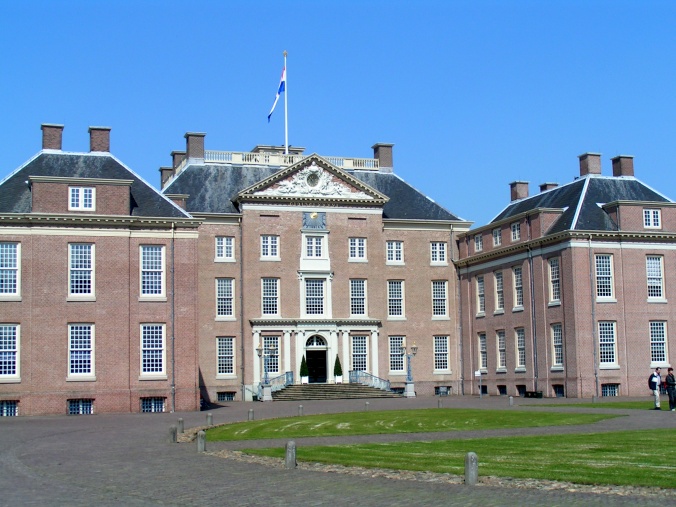
Photo: Wikimedia Commons contributor · CC BY-SA 3.0 · Wikimedia Commons
Het Loo Palace is a palace in Apeldoorn, Netherlands. Built in the 1680s for William the Third of Orange. The free Lokali audio guide runs 7 minutes.
✓ Published October 2026 · how we write these guides
Visitor facts
| Lokali audio guide | 7 min · free |
|---|---|
| Type | Palace |
| Location | Apeldoorn, Netherlands |
| Coordinates | 52.2342, 5.9458 |
| Official website | paleishetloo.nl |
| Languages | 50+, in the Lokali app |
The story
Listen to the gravel under your feet. It crunches softly as you walk the long, straight approach, and the sound carries in the open air. Ahead, a wide brick facade stretches out in warm orange-brown, framed by tall windows set in strict rows. Behind you are the dark oaks and beeches of the Veluwe, the great forest of the central Netherlands. In front of you is order: symmetry, clipped lines, and calm. This is Het Loo Palace, on the edge of Apeldoorn.
The story begins with hunting. In the late seventeenth century, Stadtholder William the Third of Orange loved to ride and hunt in these woods. A stadtholder was the leading official of the Dutch Republic, and William held that role in several provinces. He wanted a country residence close to the game. Work on the palace began in the 1680s, and it grew quickly from a hunting lodge into something far grander. His wife, Mary, shared in its making.
Here is the first surprise. Within a few years of building began, this couple became King and Queen of England. After the events of 1688, often called the Glorious Revolution, William and Mary took the English throne together. So the people who planned these rooms and gardens were not only Dutch royalty. They also ruled from London. Het Loo became their Dutch retreat, a place to return to the forest and the hunt, far from the politics of Westminster.
The design reflects a particular moment in European taste. The architect Jacob Roman worked on the building, and the French-born designer Daniel Marot shaped much of the interior decoration and the gardens. Marot was a Huguenot, a French Protestant who left France because of religious persecution. He brought ideas from the court of Louis the Fourteenth. Yet the result here feels more restrained than Versailles. The Dutch style favoured brick, proportion, and a certain modesty, even in a palace.
Now look closely at the walls. That warm brick was not always visible. In the early nineteenth century, when Louis Napoleon ruled the Kingdom of Holland, the facade was covered with plaster and painted a pale colour. The formal gardens were also buried under a looser English landscape style, with lawns and winding paths. For many decades, visitors saw a very different palace. The brick and the baroque gardens you see today came back through a major restoration in the late twentieth century.
That restoration was careful work. Researchers used old drawings, engravings, and written descriptions to understand how the palace once looked. The plaster was removed, and the original brick came back into view. Rooms were furnished to show different periods of the House of Orange, so walking through the building feels like moving through generations. One room may belong to the age of William and Mary. Another may show the nineteenth century, or the early twentieth. Each room is set to a particular time.
The palace stayed in royal use for close to three centuries. Many members of the Dutch royal family spent time here, especially in summer. Queen Wilhelmina, who led the Netherlands through the Second World War, came to live at Het Loo after she gave up the throne in 1948. She stayed until her death in 1962. After the royal family moved out in the 1970s, the building became a national museum. It opened to the public in the 1980s, after the restoration.
There is a second surprise, and it is under your feet. In recent years the palace closed for a long renovation and expansion. When it reopened in 2023, it had a large new space beneath the forecourt. This underground extension holds an entrance hall, exhibitions, and visitor facilities. From above, you hardly notice it. Light comes down through glass openings in the courtyard. The designers wanted to add modern space without changing the historic silhouette of the palace.
Walk through to the back, and the gardens open out. They are laid out in geometric beds, with low box hedges forming curls and patterns. Coloured gravel and flowers fill the shapes, like a carpet seen from above. Straight paths meet at fountains and statues. The best way to read the design is from a raised point, such as a terrace or the upper windows. From there, the whole plan becomes clear, and the strict mirror symmetry of left and right is easy to see.
Water was central to the original idea. The Veluwe sits on higher sandy ground, and springs and streams in the area made it possible to feed fountains. In the time of William the Third, the fountains here were admired by visitors. Water jumped from basins and ran through channels without modern pumps. Listen for it as you walk. The splash and the trickle soften the formal lines of the garden, and on warm days the air near the basins feels cooler.
The gardens also hold a lot of symbolism. Statues and decorations refer to classical myths, and many details point back to the House of Orange and to William and Mary themselves. Look for monograms and crowns worked into gates, ironwork, and stone. These were reminders of who owned the place and what they claimed. A garden like this was not only for pleasure. It was a statement of power, taste, and order, made from hedges, gravel, and water.
Before you leave, consider the royal stables nearby. They hold historic carriages, sleighs, and early royal cars, and they show another side of court life: the horses, the grooms, the daily movement of a household. Around the palace, the wider estate continues into parkland and forest. Many visitors spend time walking these paths after the main rooms and gardens. If you have the energy, the change from formal garden to open woodland is worth seeing for yourself.
So take a last look. The brick, warm in the light. The hedges, cut in tight curves. The water, moving quietly in its basins. Behind you is the forest that first drew a Dutch prince here to hunt, more than three centuries ago. As you walk back across the gravel, listen again to that soft crunch. It is the same sound that guests, servants, and royals heard as they arrived at this door.
Key facts
What to look for
Practical tips
Common questions
Is there a free audio guide to Het Loo Palace?
Yes — the Lokali app narrates Het Loo Palace free of charge in 50+ languages. The guide runs about 7 minutes, covers the history, what to look for on site and practical tips, and works offline once downloaded.
Where is Het Loo Palace?
Het Loo Palace is in Apeldoorn, Netherlands, at 52.2342, 5.9458. Tap the map link on this page for directions from where you are.
What is Het Loo Palace known for?
Built in the 1680s for William the Third of Orange. William and Mary later became King and Queen of England.
What should you look for at Het Loo Palace?
Exposed orange-brown brick that was once covered with plaster. Low box hedges curling into carpet-like patterns. Royal monograms and crowns worked into gates and ironwork.
What should you know before visiting Het Loo Palace?
View the gardens from a raised terrace to see the full pattern. Allow extra time for the royal stables and their carriages.
On the map
Opens directions to Het Loo Palace from your location.
More to see near Het Loo Palace


Hear Het Loo Palace in your language
The full story, narrated, in 50+ languages. Download it before you go and it plays offline, at your own pace, with no ticket and no tour group.