Cave of Altamira and Paleolithic Cave Art of Northern Spain
43.3825° N · 4.1161° W · Archaeological Site
Photo: José-Manuel Benito · Public domain · Wikimedia Commons
Cave of Altamira and Paleolithic Cave Art of Northern Spain is a cave with prehistoric art and World Heritage Site in Spain. Altamira was first studied by Marcelino Sanz de Sautuola. The free Lokali audio guide runs 7 minutes.
✓ Published October 2026 · how we write these guides
Visitor facts
| Lokali audio guide | 7 min · free |
|---|---|
| Type | Archaeological Site |
| Location | Asturias, Spain |
| Coordinates | 43.3825, -4.1161 |
| Languages | 50+, in the Lokali app |
The story
Listen for a moment. Under the green hills of the Cantabrian coast, water moves through limestone. It drips, slowly, the way it has for tens of thousands of years. The air in these caves is cool, damp, and almost perfectly still. That stillness is the reason you can stand here today and look at pictures made by people who lived at the end of the last Ice Age.
First, a small point of geography. The Cave of Altamira itself lies near the village of Santillana del Mar, in Cantabria, just east of Asturias. But Altamira does not stand alone. In 2008, UNESCO extended its World Heritage listing to cover a chain of decorated caves across northern Spain. Several of those caves are here in Asturias. So the story of Altamira is also the story of this green, rainy coast.
The discovery of Altamira is one of the great family stories of archaeology. In the late 1870s, a local landowner and amateur scholar named Marcelino Sanz de Sautuola was digging in the cave floor, looking for stone tools and bones. His young daughter, María, came with him. According to the popular telling, she wandered into a low side chamber, looked up, and called out that she could see oxen on the ceiling.
They were not oxen. They were bison — dozens of them, painted in red and black across the rock above her head. Sautuola published his findings in 1880. He believed the paintings were prehistoric. Many experts did not agree. The colours looked too fresh, the drawing too skilled. Some critics suggested the images were modern, perhaps even a fraud. Sautuola died before the scientific world changed its mind.
That change came in the early twentieth century. As painted caves were found in southern France, scholars began to accept that Ice Age people had made sophisticated art. In 1902, the French prehistorian Émile Cartailhac published an essay admitting his earlier doubt. Its title translates roughly as "the mea culpa of a sceptic" — mea culpa being Latin for "my fault". Altamira had moved from controversy to cornerstone.
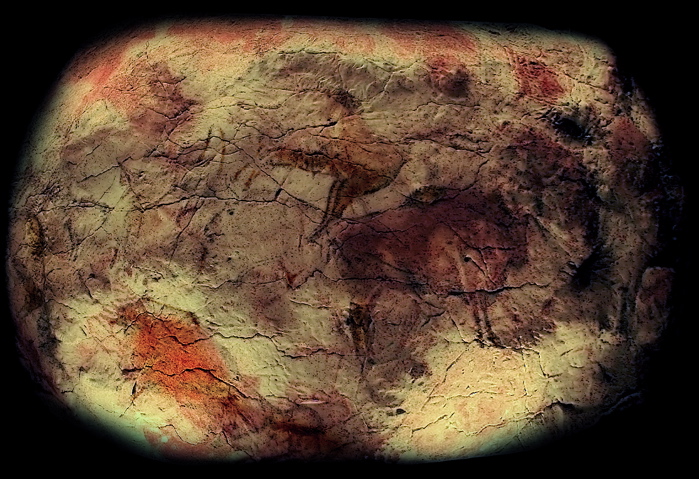
So what exactly is on that famous ceiling? The bison are the stars. Some stand, some seem to lie folded or curled. The artists used red ochre, an iron-rich earth pigment, and black from charcoal or manganese. And here is the detail most visitors miss. The painters chose natural bulges in the rock and placed the animals on them. When you see the ceiling, the bodies of the bison seem to swell outward, almost three-dimensional.
The art was not made all at once. Researchers think people used and decorated the cave over a very long span of time. In 2012, scientists dated thin mineral crusts that had formed over some painted signs in Altamira and other caves in the region. Some of those markings turned out to be more than thirty-five thousand years old — much older than the great bison ceiling. The cave is less a single painting than a long conversation across generations.
Then, many thousands of years ago, a rockfall sealed the entrance. That collapse was a lucky accident. With no wind, no animals, and no people moving in and out, the cave kept its stable climate. The pigments stayed on the walls. In a sense, the mountain closed its own door and kept the art safe until the nineteenth century.
Opening that door again brought new problems. In the twentieth century, huge numbers of visitors came to Altamira. Their breath, body heat, and light changed the air inside. In 1977 the cave closed to the public. It reopened later with strict limits, then closed again in 2002 after microorganisms appeared on the walls. Today, only a tiny number of people may enter, chosen by lottery, as part of an ongoing scientific study.
For almost everyone else, there is the replica. Beside the original cave stands the National Museum and Research Centre of Altamira. Inside, a detailed reproduction, often called the Neocave, rebuilds the main chamber and its painted ceiling. Specialists reproduced the shapes of the rock and the colours of the pigments. It may sound like a compromise. In fact, standing under it, you can study the bison in a calm, well-lit space that the real cave can no longer offer.
Here in Asturias, the same Ice Age tradition continues underground. Near the coastal town of Ribadesella is Tito Bustillo cave, found in 1968 by a group of young cavers. They named it after one of their friends, who died soon after the discovery. Inland, the cave of Candamo holds a large wall covered with engraved and painted animals. Farther east, close to the sea cliffs, El Pindal cave includes animal figures and red signs.
These Asturian caves are part of the same UNESCO listing as Altamira. Some can be visited in small, guided groups, and places are limited to protect the art. That limit is part of the experience. You walk slowly, with a guide, in low light. You hear your own footsteps and the drip of water. And when a painted animal appears on the rock, it arrives the way it once did for the people who made it — out of darkness, by a small light.
Why does this art still matter so much? Partly because it is old beyond easy imagination. But mostly because it feels close. The hand that drew a bison on a curved rock knew how an animal moved, how it lowered its head, how its weight shifted. A quote often credited to Picasso says that after Altamira, everything else is decline. Whether or not he said it, you can understand the feeling.
As you leave, look at the land around you. The same limestone hills, the same river valleys, the same rain that soaks the meadows. People hunted and gathered here when glaciers covered much of Europe. Then they went underground and left their pictures behind. Somewhere beneath your feet, water is still dripping in the dark — slowly, patiently, as it always has.
Key facts
What to look for
Practical tips
Common questions
Is there a free audio guide to Cave of Altamira and Paleolithic Cave Art of Northern Spain?
Yes — the Lokali app narrates Cave of Altamira and Paleolithic Cave Art of Northern Spain free of charge in 50+ languages. The guide runs about 7 minutes, covers the history, what to look for on site and practical tips, and works offline once downloaded.
Where is Cave of Altamira and Paleolithic Cave Art of Northern Spain?
Cave of Altamira and Paleolithic Cave Art of Northern Spain is near Asturias, Spain, at 43.3825, -4.1161. Tap the map link on this page for directions from where you are.
What is Cave of Altamira and Paleolithic Cave Art of Northern Spain known for?
Altamira was first studied by Marcelino Sanz de Sautuola. Sautuola published his Altamira findings in 1880.
What should you look for at Cave of Altamira and Paleolithic Cave Art of Northern Spain?
Bison painted over natural bulges in the ceiling rock. Red ochre and black pigment used side by side. Curled or folded bison shapes on the replica ceiling.
What should you know before visiting Cave of Altamira and Paleolithic Cave Art of Northern Spain?
Visit the Altamira museum replica for the full ceiling view. Book Asturian cave tours ahead; group sizes are strictly limited.
On the map
Opens directions to Cave of Altamira and Paleolithic Cave Art of Northern Spain from your location.
More to see near Cave of Altamira and Paleolithic Cave Art of Northern Spain


Hear Cave of Altamira and Paleolithic Cave Art of Northern Spain in your language
The full story, narrated, in 50+ languages. Download it before you go and it plays offline, at your own pace, with no ticket and no tour group.