
Acropolis of Athens
37.9717° N · 23.7261° E · Archaeological Site
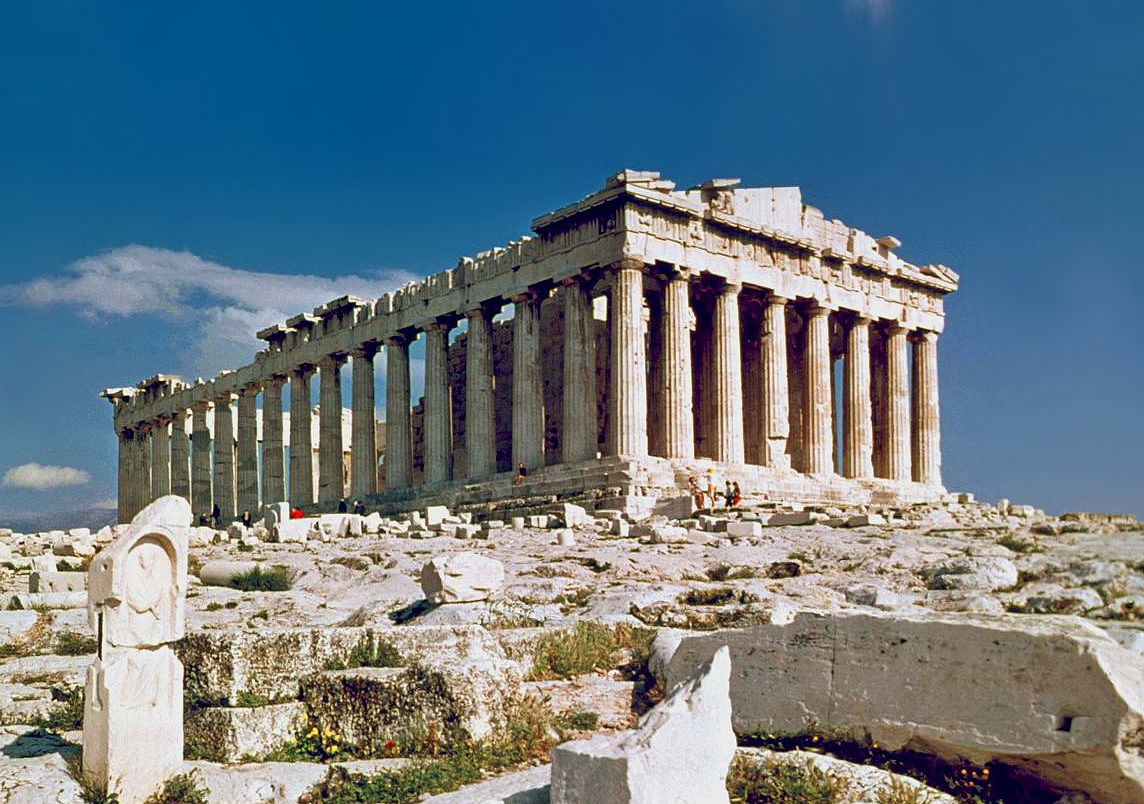
Photo: A.Savin · CC BY-SA 3.0 · Wikimedia Commons
Acropolis of Athens is an ancient citadel above the city of Athens. Built between four hundred and forty-seven and four hundred and thirty-two before Christ. The free Lokali audio guide runs 7 minutes.
✓ Published October 2026 · how we write these guides
Visitor facts
| Lokali audio guide | 7 min · free |
|---|---|
| Type | Archaeological Site |
| Location | Athens, Greece |
| Coordinates | 37.9717, 23.7261 |
| Languages | 50+, in the Lokali app |
The story
The light hits differently up here. Stand still for a moment and feel the marble underfoot — worn smooth by millions of footsteps, warm even through your shoes on a summer afternoon. The stone glows honey-gold in morning sun, bone-white at noon, rose at dusk. That glow is not paint or polish. It is Pentelic marble, quarried from Mount Pentelikon twenty kilometres northeast of where you stand, the same seam the ancient Athenians opened in the fifth century before Christ.
You are standing on a natural limestone outcrop that rises a hundred and fifty metres above the modern city. People have lived on and around this rock for more than seven thousand years. The name Acropolis simply means high city — akros for high, polis for city — and nearly every Greek town had one. But this plateau, roughly three hundred metres long and a hundred and fifty metres wide, became the soul of classical Athens, the stage on which democracy, philosophy, and theatre were born.
The Parthenon, the temple that dominates the summit, was built between four hundred and forty-seven and four hundred and thirty-two before Christ. It was not the first temple here. An earlier structure, now called the Older Parthenon, was under construction when the Persians sacked Athens in four hundred and eighty before Christ and burned everything on the Acropolis to ash. When the Athenians returned, they buried the broken statues and column drums as a kind of mass grave and vowed to rebuild. Thirty years later, under the statesman Pericles, they began again.
The Parthenon you see now is that second temple, dedicated to Athena Parthenos — Athena the Virgin. It held a twelve-metre-tall statue of the goddess, sheathed in gold and ivory, designed by the sculptor Pheidias. The statue vanished in antiquity, probably looted or melted down. What remains is the shell, and even that shell rewrites the rules. The columns lean inward slightly. The floor curves upward at the centre. The corner columns are thicker than the others. Every line that looks straight is actually curved, every vertical slightly tilted. These refinements, invisible to the casual eye, correct for optical illusions and give the building a sense of breath, as if the stone were alive.
Walk toward the smaller temple to your north — the Erechtheion, finished around four hundred and five before Christ. Look for the six draped female figures holding up the porch roof on the south side. These are the Caryatids, columns carved as women. The ones you see here are copies. Five of the originals are in the Acropolis Museum at the base of the hill. The sixth was removed by Lord Elgin in the early eighteen-hundreds and is now in the British Museum in London, a sore point in Greek cultural memory that has not healed.
The Erechtheion marks the spot where, according to myth, Athena and Poseidon competed for the patronage of the city. Poseidon struck the rock with his trident and produced a spring of salt water. Athena planted an olive tree. The citizens chose the olive, and the city took her name. An olive tree still grows in the precinct, a descendant or symbolic replacement of that mythical original.
Between the Parthenon and the Erechtheion, the ground is scattered with column bases, wall footings, and fragments of sculpture. This is not ruin by neglect. The Acropolis has been fortress, church, mosque, and ammunition dump. In 1687, Venetian artillery struck the Parthenon, which the Ottoman Turks were using as a gunpowder magazine. The explosion tore out the centre of the building and left it the roofless colonnade you see today.
Restoration work has been continuous since the nineteen-seventies. The cranes and scaffolding you see are not temporary eyesores — they are part of a decades-long project to stabilize the monuments, replace corroded iron clamps with titanium, and return displaced blocks to their original positions. Archaeologists number each stone, photograph it, and slot it back like a three-dimensional jigsaw puzzle. The work moves slowly because the stakes are absolute. There is no second draft.
On the western edge of the plateau, near where you entered, notice the small temple perched on a bastion of rock. That is the Temple of Athena Nike, built around four hundred and twenty before Christ to commemorate Athenian victories over the Persians. Nike means victory. The temple is tiny, barely eight metres on a side, but its position is commanding. It watches over the approach to the Acropolis like a sentinel.
Beyond the monuments, look at the city spreading below. Modern Athens is a sprawl of white apartment blocks, dense and low, pressed against the hills. But from up here the geometry of antiquity still shows through. To the southeast you can see the columns of the Temple of Olympian Zeus, the largest temple ever completed in Greece, finished by the Roman emperor Hadrian in the second century after Christ. To the west, the Hill of the Pnyx, where the Athenian assembly met and voted, where democracy was practiced in its rawest, loudest form.
The Acropolis was never just a religious precinct. It was a treasury, a fortress, a symbol of Athenian power and identity. During the Panathenaic Festival, held every four years, a procession wound up the Sacred Way from the city below, carrying a new robe for the statue of Athena. The procession is carved into the marble frieze that once ran around the inside of the Parthenon. Much of that frieze is now in London, but fragments remain in Athens, and the procession lives on in the museum galleries.
As you leave, turn back once more. The Parthenon looks different from every angle, and the light changes by the hour. Photographers camp here at dawn and dusk, chasing that brief window when the marble seems to glow from within. But even at midday, under hard sun, the building holds its power. It is a ruin, yes — but a ruin that defined what architecture could be, what a city could mean, what a civilization could leave behind.
Key facts
What to look for
Practical tips
Common questions
Is there a free audio guide to Acropolis of Athens?
Yes — the Lokali app narrates Acropolis of Athens free of charge in 50+ languages. The guide runs about 7 minutes, covers the history, what to look for on site and practical tips, and works offline once downloaded.
Where is Acropolis of Athens?
Acropolis of Athens is in Athens, Greece, at 37.9717, 23.7261. Tap the map link on this page for directions from where you are.
What is Acropolis of Athens known for?
Built between four hundred and forty-seven and four hundred and thirty-two before Christ. Pentelic marble from Mount Pentelikon twenty kilometres northeast.
What should you look for at Acropolis of Athens?
Curved floor line rising toward the centre of the Parthenon. Six Caryatid columns on the south porch of the Erechtheion. Olive tree growing in the Erechtheion precinct.
What should you know before visiting Acropolis of Athens?
Arrive at opening time or near sunset for softer light and thinner crowds. Wear shoes with good grip — marble is slippery when polished or wet.
When is the best time to visit Acropolis of Athens?
Arrive at opening time or near sunset for softer light and thinner crowds.
On the map
Opens directions to Acropolis of Athens from your location.
More to see in Athens


Hear Acropolis of Athens in your language
The full story, narrated, in 50+ languages. Download it before you go and it plays offline, at your own pace, with no ticket and no tour group.