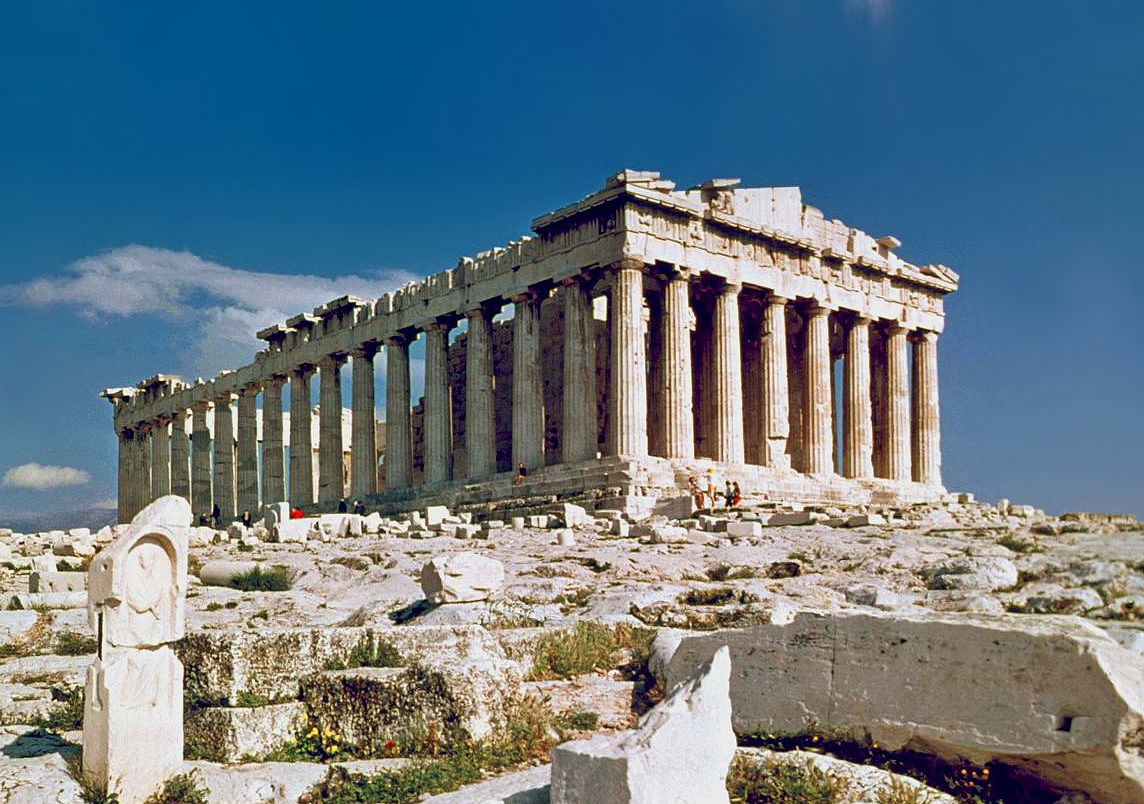
Photo: Steve Swayne · CC BY 2.0 · Wikimedia Commons
Parthenon is a former temple of Athena on the Athenian Acropolis, Greece. It is in Athens, Greece. Built 447-432 BC under Pericles, architects Ictinus and Callicrates. The free Lokali audio guide runs 9 minutes.
✓ Published October 2026 · how we write these guides
Visitor facts
| Lokali audio guide | 9 min · free |
|---|---|
| Type | Archaeological Site |
| Location | Athens, Greece |
| Coordinates | 37.9715, 23.7266 |
| Languages | 50+, in the Lokali app |
The story
Stand still for a moment and look up. The marble catches the light differently depending on the hour — honey-gold at sunrise, bone-white at noon, almost rose-coloured as the sun drops toward the Saronic Gulf. The stone itself is Pentelic marble, quarried from Mount Pentelikon twenty kilometres northeast of here. It weathers to a warm amber patina because of trace iron in the stone. Every surface you see was once painted in vivid reds, blues, and golds, though centuries of rain and sun have stripped it back to this luminous monochrome.
The Parthenon was built between 447 and 432 BC, during the height of Athenian power under the statesman Pericles. Athens had just led the Greek alliance to victory against Persia, and Pericles poured the treasury of the Delian League — supposedly a mutual defence fund — into rebuilding the Acropolis. It was a statement of dominance as much as devotion. The architects were Ictinus and Callicrates. The sculptor Phidias oversaw the decorative program and created the colossal statue of Athena that once stood inside, nearly twelve metres tall, clad in gold and ivory.
The temple was dedicated to Athena Parthenos — Athena the Virgin — the patron goddess of Athens. She was goddess of wisdom, war, and civic order, and the Athenians credited her with their survival and prosperity. The statue inside showed her in full armour, holding a shield in one hand and a small winged Nike — victory — in the other. The gold alone weighed over a thousand kilograms. It was designed so the gold panels could be removed and weighed in times of crisis, proving the city had not embezzled the sacred treasury. The statue vanished in late antiquity, probably melted down or carried off. We know it only from ancient descriptions and small Roman copies.
The building measures roughly seventy metres long by thirty metres wide. It is a Doric temple, which means the columns have no base, just a simple capital, and the entablature above follows a strict rhythm of alternating triglyphs and metopes. But the Parthenon bends the rules. It has eight columns across the short ends instead of the usual six, giving it a longer, more imposing profile. And every line you think is straight is actually curved. The platform rises slightly in the centre to prevent the illusion of sagging. The columns lean inward by a few centimetres and bulge slightly in the middle — a trick called entasis — so they appear perfectly vertical and even from a distance. The corner columns are thicker and set closer to their neighbours, compensating for the bright sky behind them. These refinements are invisible unless you measure, but your eye registers the harmony.
The sculptural program was unprecedented in scale and ambition. The east pediment showed the birth of Athena, springing fully armed from the head of Zeus. The west pediment depicted her contest with Poseidon for patronage of the city — she won by offering the olive tree. Ninety-two metopes ran around the exterior, carved in high relief, showing battles between gods and giants, Greeks and Amazons, Lapiths and centaurs — all metaphors for Greek civilization defeating chaos. Inside the colonnade, a continuous frieze wrapped around the inner chamber, showing the Panathenaic procession, the great festival held every four years in Athena's honour. You can still see fragments of it in museums around the world, but the largest collection is in the British Museum in London, taken by Lord Elgin in the early nineteenth century. Their return has been debated for two hundred years.
The Parthenon has lived many lives. For nearly a thousand years it remained a temple to Athena. In the sixth century it was converted into a Christian church dedicated to the Virgin Mary — the frame fit the new creed remarkably well. The Ottomans turned it into a mosque in the fifteenth century and added a minaret at the southwest corner. Then in 1687, during a Venetian siege, the Ottomans used the temple as a gunpowder magazine. A Venetian mortar round hit the roof. The explosion tore out the centre of the building, killing three hundred people sheltering inside and destroying most of the interior structure. The scars you see — the missing roof, the broken walls, the columns standing alone — date from that single night.
Restoration has been continuous since Greek independence in the nineteenth century, and a major project has been underway since the 1970s. Workers are dismantling sections, cataloguing every block, removing the iron clamps inserted by earlier restorers that have rusted and cracked the marble, and reassembling the structure with titanium supports. Blocks scattered across the site are being fitted back into place like a three-dimensional puzzle. White patches of new marble are deliberately left lighter than the weathered stone so you can distinguish original from restoration. The work is expected to continue for at least another decade.
Look at the columns as you walk around them. You will notice that no two drums — the stacked cylindrical sections — are identical. Each was carved to fit its neighbour, with shallow concave centres and slightly convex edges, locked together without mortar. Wooden pegs and later iron dowels held them in place vertically. The precision is such that even after twenty-five centuries and an explosion, many drums still sit exactly as they were placed. The masons did not use plans in the modern sense — they worked from scale models and proportional systems, adjusting each piece on site. The temple was not designed on paper, it was thought in marble.
The Acropolis plateau is living limestone bedrock, and it rings slightly underfoot when the crowds thin. In ancient times, the Panathenaic procession climbed the Sacred Way, passed through the Propylaea — the monumental gateway at the west end — and approached the Parthenon from the side, seeing it at an angle rather than head-on. The route was choreographed for maximum drama. Today the modern entrance brings you up the north slope on a concrete path, but the spatial experience still holds. The temple does not sit square to the viewer. It reveals itself in layers.
The light changes fast up here. Early morning, before the tour groups arrive, the marble glows softly and the shadows are long and cool. By midday the stone is almost blinding, and there is little shade. Late afternoon, as the sun drops behind the hill of the Pnyx to the west, the whole plateau turns golden and the city below fills with haze. Swifts and kestrels circle the cliffs. If you come in spring, wildflowers grow in the cracks of the bedrock — tiny purple irises, white rock roses, yellow broom.
The city below has sprawled far beyond anything the ancient Athenians would recognize, but the bones of the landscape remain. To the south you can see the Theatre of Dionysus at the foot of the Acropolis, where the plays of Aeschylus, Sophocles, and Euripides were first performed. To the east lies the ancient Agora, the civic heart of the city, now an archaeological park. To the northeast, Lykavittos Hill rises above the modern neighbourhoods, capped with a small white chapel. On clear days you can see the mountains of the Peloponnese across the gulf.
When you leave, walk slowly around the north side of the temple before heading back down. Look for the vertical striations on the column drums — those are the marks left by the claw chisels used to rough out the shape before the final polishing. Look at the floor of the platform where fragments of the original marble tiles remain, worn smooth by millions of footsteps. Look west toward the Propylaea and notice how the Parthenon anchors the whole plateau, not by sitting at the centre but by holding the eastern edge, balanced against the gateway at the west. It is a composition in stone and space, and it still works exactly as it was meant to.
Key facts
What to look for
Practical tips
Common questions
Is there a free audio guide to Parthenon?
Yes — the Lokali app narrates Parthenon free of charge in 50+ languages. The guide runs about 9 minutes, covers the history, what to look for on site and practical tips, and works offline once downloaded.
Where is Parthenon?
Parthenon is in Athens, Greece, at 37.9715, 23.7266. Tap the map link on this page for directions from where you are.
What is Parthenon known for?
Built 447-432 BC under Pericles, architects Ictinus and Callicrates. Pentelic marble weathers to amber because of trace iron.
What should you look for at Parthenon?
Honey-gold patina on the marble in morning light. White restoration patches deliberately left lighter than old stone. Column drums stacked without mortar, locked by shallow joints.
What should you know before visiting Parthenon?
Come early morning before crowds for softer light and space. Walk the north side to see ancient chisel marks on columns.
When is the best time to visit Parthenon?
Spring brings wildflowers in the bedrock cracks.
On the map
Opens directions to Parthenon from your location.
More to see in Athens


Hear Parthenon in your language
The full story, narrated, in 50+ languages. Download it before you go and it plays offline, at your own pace, with no ticket and no tour group.