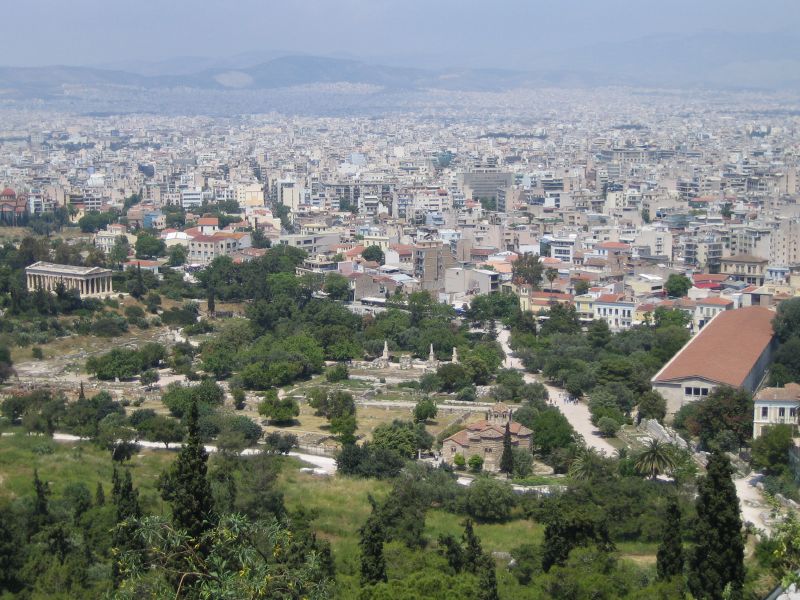
Ancient Agora of Athens
37.9750° N · 23.7225° E · Archaeological Site
Photo: https://www.flickr.com/people/jonezes/ · CC BY-SA 2.0 · Wikimedia Commons
Ancient Agora of Athens is a major archaeological site of Athens. Temple of Hephaestus dates to the fifth century BCE. The free Lokali audio guide runs 7 minutes.
✓ Published October 2026 · how we write these guides
Visitor facts
| Lokali audio guide | 7 min · free |
|---|---|
| Type | Archaeological Site |
| Location | Athens, Greece |
| Coordinates | 37.9750, 23.7225 |
| Languages | 50+, in the Lokali app |
The story
Listen for a moment. Under the olive trees, the cicadas keep up their dry, steady buzz. Gravel shifts under your shoes. Somewhere beyond the fence, a train rattles past, and above you, on its rock, the Acropolis catches the light. You are standing in the old heart of Athens. Not the sacred hill up there, but the working ground below it, where people bought fish, argued about laws, and listened to strangers talk about how to live.
The word agora is often translated as marketplace. That is only half the story. It means a gathering place, and that is what this was. For centuries, this open ground held shops and law courts, offices and altars, all side by side. A citizen could buy olive oil in the morning, serve on a jury at midday, and debate philosophy in the shade by evening. Civic life here was not tucked away in a palace. It happened in the open, in the dust and the noise.
Look for the broad path that cuts diagonally across the site toward the Acropolis. This is the Panathenaic Way. Every few years, a great procession moved along this route, climbing toward the goddess Athena. People carried offerings, led animals, and paraded a new woven robe for her statue. Today the path is quiet, lined with low walls and wild grass. But if you walk it, you are following the same line that festival crowds followed more than two thousand years ago.
Now turn toward the low hill on the western edge. On top stands the Temple of Hephaestus, the god of metalworking and craft. It dates to the fifth century before Christ, and it is one of the most complete ancient Greek temples anywhere. Its roof, its columns, its proportions — most of it is still there. It survived largely because it was later used as a church. Here is the first surprise: many visitors climb the Acropolis to see the Parthenon, yet this smaller temple shows far better what a whole Greek temple once looked like.
The temple sat above a district of workshops. Archaeologists have found traces of bronze casting and pottery making on the slopes nearby. So the choice of god made sense. The people who hammered metal and fired clay could look up from their furnaces and see the house of their patron. Walk around its columns. They follow the Doric style, the plainest of the Greek orders, with simple cushion-like tops and no base at the bottom.
On the opposite side of the site, a long two-storey colonnade runs along the eastern edge. This is the Stoa of Attalos. A stoa is a covered walkway, open on one side, where people could shop, meet, or shelter from the sun. The original was a gift from Attalos the Second, a king of Pergamon in what is now Turkey, in the second century before Christ. The building you see is a reconstruction. It was rebuilt in the 1950s, carefully following the ancient plan.
That reconstruction is the second surprise. Walk inside the lower colonnade and notice the cool air, the long rhythm of columns, the deep shade. This is one of the few places where you can feel how an ancient stoa actually worked as a space. Ruins show you foundations. This building shows you shadow, echo, and scale. Today it houses the Agora Museum, which holds many of the objects found in the excavations around you.
Inside the museum, look for the small, everyday things. There are pieces of broken pottery scratched with names. These are ostraka. In a practice called ostracism, Athenian citizens could vote to send a powerful man into exile for ten years by writing his name on a potsherd. You may also see a fragment of a kleroterion, a stone slab with rows of slots. It helped choose jurors and officials at random, so that no one could easily fix the result.
That idea of chance and rotation was central to Athenian democracy. Near the western side of the site, you can find the foundations of a round building called the Tholos. Members of the city council took turns staying here, eating together, so that some officials were always on duty, day and night. Nearby stood the council house, the Bouleuterion. Little remains above ground now. But this small corner was, in a real sense, the government of Athens.
Philosophy lived here too. Socrates spent much of his life walking these spaces, asking questions of anyone who would answer. Later, a thinker named Zeno taught in a building called the Painted Stoa, decorated with famous paintings of battles. His followers became known as Stoics — the name comes from the stoa itself. So every time someone today calls a calm person stoic, they are pointing, without knowing it, to a colonnade on the edge of this square.
The Agora did not stay the same for long. Over the centuries, Romans added buildings, including a large concert hall near the centre. Raids and fires damaged the area, and later Athens grew over the ruins. Near the southern edge, a small Byzantine church dedicated to the Holy Apostles still stands, roughly a thousand years old. Its brick and stone walls and small domes show how the site kept being used, long after the ancient city faded.
For centuries, all of this lay under houses and streets. In the 1930s, the American School of Classical Studies began large-scale excavations here. Hundreds of later buildings were removed so the ancient ground could be uncovered. That is why the site feels like an open park in the middle of the city. Even now, the railway line runs along the northern edge, and part of the Painted Stoa lies beyond it, still being studied.
As you walk, take your time with the ground itself. Notice the worn marble thresholds, the drainage channels cut into stone, the scattered column drums resting in the grass. Many visitors rush between the temple and the museum. But the spaces in between, the empty squares of foundation, are the places where ordinary Athenians stood and talked. The olive trees and shrubs here were planted after the excavations, giving shade where an open square once baked in the sun.
Before you leave, stand still for a moment on the Panathenaic Way. Look up at the Acropolis, then back across the ruins toward the temple on its hill. Listen again to the cicadas, the distant train, the voices of other visitors in many languages. People are still gathering here, still walking, still talking. In that small, ordinary sense, the Agora is still doing its old job.
Key facts
What to look for
Practical tips
Common questions
Is there a free audio guide to Ancient Agora of Athens?
Yes — the Lokali app narrates Ancient Agora of Athens free of charge in 50+ languages. The guide runs about 7 minutes, covers the history, what to look for on site and practical tips, and works offline once downloaded.
Where is Ancient Agora of Athens?
Ancient Agora of Athens is in Athens, Greece, at 37.9750, 23.7225. Tap the map link on this page for directions from where you are.
What is Ancient Agora of Athens known for?
Temple of Hephaestus dates to the fifth century BCE. Stoa of Attalos was rebuilt in the 1950s.
What should you look for at Ancient Agora of Athens?
Pottery shards scratched with names in the museum. The slotted stone slab used to pick jurors. Round foundations of the Tholos near the western edge.
What should you know before visiting Ancient Agora of Athens?
Arrive early to walk the site before the midday heat. Bring water and a hat — shade is limited.
When is the best time to visit Ancient Agora of Athens?
Arrive early to walk the site before the midday heat.
On the map
Opens directions to Ancient Agora of Athens from your location.
More to see in Athens


Hear Ancient Agora of Athens in your language
The full story, narrated, in 50+ languages. Download it before you go and it plays offline, at your own pace, with no ticket and no tour group.