
Church of the Holy Apostles, Athens
37.9741° N · 23.7239° E · Church
Photo: A.Savin · CC BY-SA 3.0 · Wikimedia Commons
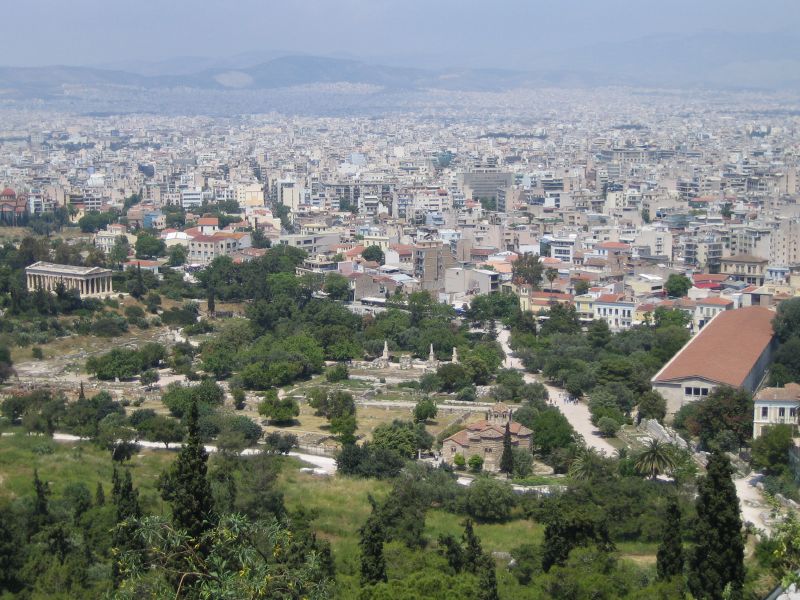
Church of the Holy Apostles, Athens is a restored medieval church in Agora excavations, Athens. Generally dated to around the late tenth or early eleventh century. The free Lokali audio guide runs 7 minutes.
✓ Published October 2026 · how we write these guides
Visitor facts
| Lokali audio guide | 7 min · free |
|---|---|
| Type | Church |
| Location | Athens, Greece |
| Coordinates | 37.9741, 23.7239 |
| Languages | 50+, in the Lokali app |
The story
Listen for a moment. Gravel shifts under your shoes. Cicadas buzz in the olive trees. Somewhere behind you, a guide's voice drifts across open ground scattered with broken marble. In front of you stands a small church of honey-coloured stone and red brick, with a dome that looks almost too neat for its surroundings. This is the Church of the Holy Apostles. It sits inside the Ancient Agora of Athens, the old marketplace and civic heart of the classical city.
That setting is the first surprise. Most visitors come to the Agora for temples, columns, and the long stoa rebuilt across the site. They do not expect a working Byzantine church among the ruins. Yet here it is, standing almost complete, while the classical buildings around it survive mostly as foundations. The church is one of the oldest in Athens that still stands. Scholars generally date it to around the late tenth or early eleventh century, roughly a thousand years ago.
To understand why a church appeared here, picture the Agora long after its classical peak. By the Byzantine period, Athens was a modest provincial town. The great public buildings had fallen or been stripped for stone. People built homes, workshops, and churches among the remains. The Byzantine world, for listeners less familiar with it, was the eastern Roman Empire, centred on Constantinople. It was Greek-speaking and deeply Christian, and churches like this one were the centres of local life.
The dedication carries meaning. The church honours the Holy Apostles, the first followers of Jesus. Tradition links this ground with Saint Paul, who visited Athens and, according to the Book of Acts, spoke with people in the marketplace. Nobody can point to the exact spot where he stood. Still, many people believe the dedication was chosen with that story in mind. A church for the apostles, built in the very marketplace where an apostle once argued with Athenians.
Now look at the shape of the building. Walk slowly around the outside if you can. You will notice the walls do not form a simple box. They bulge outward in rounded curves. These curved projections are called apses. Here there are four main ones, one on each side, which gives the plan the shape of a four-leaf clover. Smaller curved niches sit between them. Architects call this a tetraconch, which simply means a plan with four rounded lobes.
This plan is unusual in Athens, and that is the second thing many visitors miss. Above the clover shape rises the dome. It sits on a drum, a short cylinder with arched windows that let light fall into the centre of the church. Inside, four columns carry the weight of that dome. The result is a compact space that feels taller than it looks from outside. Light comes down from above, rather than in from the sides.
Come closer to the walls themselves. The masonry follows a style common in Byzantine Greece. Blocks of stone are framed by thin red bricks, laid around each block like a picture frame. Look higher, near the roofline and around the windows. In places, the bricks form decorative patterns. Some of these shapes imitate Arabic script. Historians call this pseudo-Kufic decoration, after the angular Kufic style of Arabic lettering. Byzantine builders used it as ornament, not as readable text.
There is one more layer under your feet. The church was built over the remains of an earlier Roman structure, generally identified as a fountain house or nymphaeum. A nymphaeum was a monumental fountain, often decorated and dedicated to water nymphs. So this one spot holds a Roman water building, a Byzantine church, and an excavation site, stacked one on top of another. The Agora is full of layers like this, but here you can see them in a single building.
The church did not always look this clean. Over the centuries it was altered many times. Later additions covered or changed parts of the original structure. In the 1950s, the American School of Classical Studies at Athens, which excavates the Agora, carried out a major restoration. The team removed many of the later additions. Their aim was to return the church to something close to its Byzantine form. Much of what you see today is the result of that work.
If the door is open, step inside. The light changes immediately. After the white glare of the Agora, the interior feels cool and dim. Your eyes need a moment. Then the wall paintings appear. Saints, scenes, and painted figures cover parts of the walls and vaults. These paintings are much later than the building. Some came from another Athenian church and were placed here, so do not read them as original eleventh-century work. Look at them as a later chapter.
Stand under the dome and look up. This is where the design makes sense. The four lobes around you, the columns, the drum with its windows, and the curve above all point the eye to one centre. Byzantine churches were built to lift attention upward. Even in a building this small, the effect works. Notice how quiet it is in here compared to the ground outside. The thick walls hold back the noise of the site.
Back outside, take a step away and look at the church against its background. Behind you, or off to one side depending on where you stand, rise the long columns of the rebuilt Stoa of Attalos. Above the Agora, the Acropolis rock sits against the sky. From certain angles, you can frame the small dome against those far older shapes. It is a useful picture of Athens itself. The city is not one era. It is many, built side by side.
Before you leave, give the walls one more slow look. Find a single stone block and the thin bricks around it. Some hand set those bricks about a thousand years ago, in a town that was poor and far from the empire's capital. They still made something careful and balanced. As you walk back along the gravel paths, past the marble fragments and the olive trees, listen again for the cicadas. The church will stay behind you, small and steady, as it has for centuries.
Key facts
What to look for
Practical tips
Common questions
Is there a free audio guide to Church of the Holy Apostles, Athens?
Yes — the Lokali app narrates Church of the Holy Apostles, Athens free of charge in 50+ languages. The guide runs about 7 minutes, covers the history, what to look for on site and practical tips, and works offline once downloaded.
Where is Church of the Holy Apostles, Athens?
Church of the Holy Apostles, Athens is in Athens, Greece, at 37.9741, 23.7239. Tap the map link on this page for directions from where you are.
What is Church of the Holy Apostles, Athens known for?
Generally dated to around the late tenth or early eleventh century. Among the oldest surviving churches in Athens.
What should you look for at Church of the Holy Apostles, Athens?
Stone blocks framed by thin red bricks. Brick patterns imitating angular Arabic lettering. Arched windows around the drum below the dome.
What should you know before visiting Church of the Holy Apostles, Athens?
Entry requires a ticket to the Ancient Agora site. Visit early morning to avoid heat and tour groups.
When is the best time to visit Church of the Holy Apostles, Athens?
Visit early morning to avoid heat and tour groups.
On the map
Opens directions to Church of the Holy Apostles, Athens from your location.
More to see in Athens


Hear Church of the Holy Apostles, Athens in your language
The full story, narrated, in 50+ languages. Download it before you go and it plays offline, at your own pace, with no ticket and no tour group.