
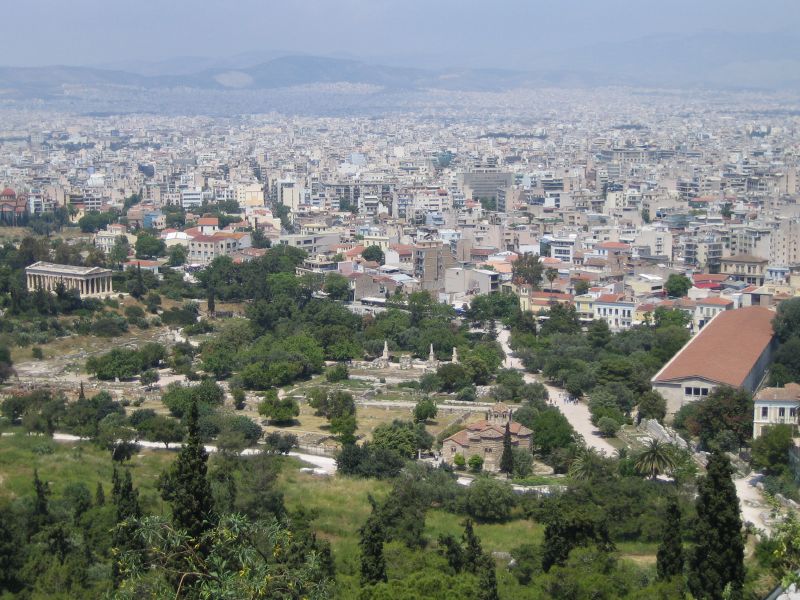
Temple of Hephaestus
37.9756° N · 23.7214° E · Archaeological Site
Photo: Dennis G. Jarvis · CC BY-SA 2.0 · Wikimedia Commons
Temple of Hephaestus is an ancient Greek temple in Athens. Begun in the mid-fifth century before Christ. The free Lokali audio guide runs 7 minutes.
✓ Published October 2026 · how we write these guides
Visitor facts
| Lokali audio guide | 7 min · free |
|---|---|
| Type | Archaeological Site |
| Location | Athens, Greece |
| Coordinates | 37.9756, 23.7214 |
| Languages | 50+, in the Lokali app |
The story
Listen for a moment. Gravel crunches under your shoes, and somewhere below, a train rattles past the edge of the old marketplace. The air smells of dry pine and warm stone. Then you look up, and there it is — a temple of honey-coloured marble, its columns standing in a full ring, its roof line still unbroken against the sky. Most ancient temples you will see in Greece are fragments. This one is almost whole. That is the first surprise of the Temple of Hephaestus.
You are standing on a low rise called Agoraios Kolonos, the market hill. It sits on the western edge of the Ancient Agora, which was the civic heart of Athens. Here, citizens argued about laws, bought olive oil, settled debts, and listened to philosophers. Socrates walked these paths. The temple was placed on high ground so that it looked down over all of that noise and trade. From its steps, the Acropolis rises across the valley to the southeast.
Work on the temple began in the middle of the fifth century before Christ. That is roughly the same generation that built the Parthenon, during the years when Athens was at the height of its power. Construction was slow, however. Scholars believe the building was not fully finished for several decades, partly because money and workers were pulled toward the larger projects on the Acropolis. So this temple is a close cousin of the Parthenon — smaller, quieter, but from the same moment.
The style is Doric, the plainest and sturdiest of the classical Greek orders. Look at the columns. Each one rises straight from the platform with no separate base. The shafts are carved with shallow vertical grooves, called flutes. At the top, each column ends in a simple cushion-shaped capital. There are six columns across each short end and thirteen along each long side. The proportions are calm and balanced. Nothing here tries to shout.
The main material is marble from Mount Pentelikon, the quarry northeast of Athens that also supplied the Parthenon. Pentelic marble contains traces of iron. Over many centuries, that iron has slowly turned the surface a warm golden brown, sometimes almost orange in late afternoon light. Up close, you can see weathering, small chips, and patches where the stone has worn smooth. Some sculptural details were carved from a finer white marble brought from the island of Paros.
Now, a question many visitors never ask. Why would Athens dedicate such a fine temple to Hephaestus, the god of fire, forge, and metalwork? The answer lies in the ground around you. Excavations on and near this hill found the remains of foundries and workshops — places where bronze was cast and pottery was fired. This was a neighbourhood of craftsmen. The temple honoured their god, and it also honoured Athena in her role as patron of crafts and skilled work.
Ancient writers tell us that bronze statues of both gods once stood inside, in the inner chamber. The sculptor is traditionally named as Alkamenes, a pupil of the great Pheidias, who designed the sculptures of the Parthenon. Those statues are long gone. Bronze was valuable, and most ancient bronzes were melted down over the centuries. What remains is the empty room that held them, and the idea of two divine artisans standing side by side.
Here is the second surprise. For a very long time, almost nobody called this building the Temple of Hephaestus. People called it the Theseion, the temple of Theseus, the legendary hero-king of Athens. The reason is carved in stone above the columns. Several of the square sculpted panels, called metopes, show the adventures of Theseus. Later Athenians assumed the temple belonged to him. That old name survives today in the surrounding district, Thiseio, and in the name of the nearby metro station.
The temple survived when so many others fell for a practical reason — it stayed in use. Around the seventh century, it was converted into a Christian church dedicated to Saint George. Builders changed the interior and added a curved, vaulted roof. That vault is one reason the top of the building still holds together. Services continued here for many centuries. In the nineteenth century, the building was also used as a burial place for some Protestant Europeans who died in Athens, before it finally became a monument and museum.
Walk slowly around the outside now, and tilt your head back. On the east front, facing the Agora, the metopes show the labours of Herakles, the strongest of the Greek heroes. On the long sides, the panels nearest that front show Theseus. Inside the colonnade, above the porches, carved friezes show crowded scenes of fighting. The figures are worn, and many faces are lost. But you can still read the twist of a body, the lift of a raised arm.
Look down at the ground around the base, too. In the 1930s, archaeologists from the American School of Classical Studies found rows of cuttings in the rock here. They were planting pits from the ancient world — evidence that a formal garden once surrounded the temple. The excavators replanted the area with species suited to the site, such as myrtle and pomegranate. So the greenery you see today is a modern reconstruction, but it follows an ancient plan.
The interior is closed to visitors, and a low barrier keeps you a few steps back. That distance actually helps. From here, you can take in the whole building at once, which is impossible at the Parthenon. Step back toward the edge of the hill and turn around. Below, you will see the long two-storey colonnade of the Stoa of Attalos, rebuilt in the twentieth century. It now houses the Agora Museum. Beyond it rises the Acropolis.
Before you go, find a patch of shade and simply look. Notice how the light moves across the columns as clouds pass, how the stone shifts from pale gold to deep amber. Listen to the cicadas in the trees, the voices drifting up from the paths below. For about two and a half thousand years, people have stood on this hill and looked at these same columns. As you walk back down, glance over your shoulder once more. The temple will still be there, steady and quiet, watching over the old marketplace.
Key facts
What to look for
Practical tips
Common questions
Is there a free audio guide to Temple of Hephaestus?
Yes — the Lokali app narrates Temple of Hephaestus free of charge in 50+ languages. The guide runs about 7 minutes, covers the history, what to look for on site and practical tips, and works offline once downloaded.
Where is Temple of Hephaestus?
Temple of Hephaestus is in Athens, Greece, at 37.9756, 23.7214. Tap the map link on this page for directions from where you are.
What is Temple of Hephaestus known for?
Begun in the mid-fifth century before Christ. Among the best-preserved ancient Greek temples anywhere.
What should you look for at Temple of Hephaestus?
Worn Herakles panels above the east-facing columns. Theseus scenes on metopes nearest the east corners. Golden-orange patina caused by iron in the marble.
What should you know before visiting Temple of Hephaestus?
Visit in late afternoon when the marble glows warm gold. Entry is included with the Ancient Agora site ticket.
When is the best time to visit Temple of Hephaestus?
Visit in late afternoon when the marble glows warm gold.
On the map
Opens directions to Temple of Hephaestus from your location.
More to see in Athens


Hear Temple of Hephaestus in your language
The full story, narrated, in 50+ languages. Download it before you go and it plays offline, at your own pace, with no ticket and no tour group.