
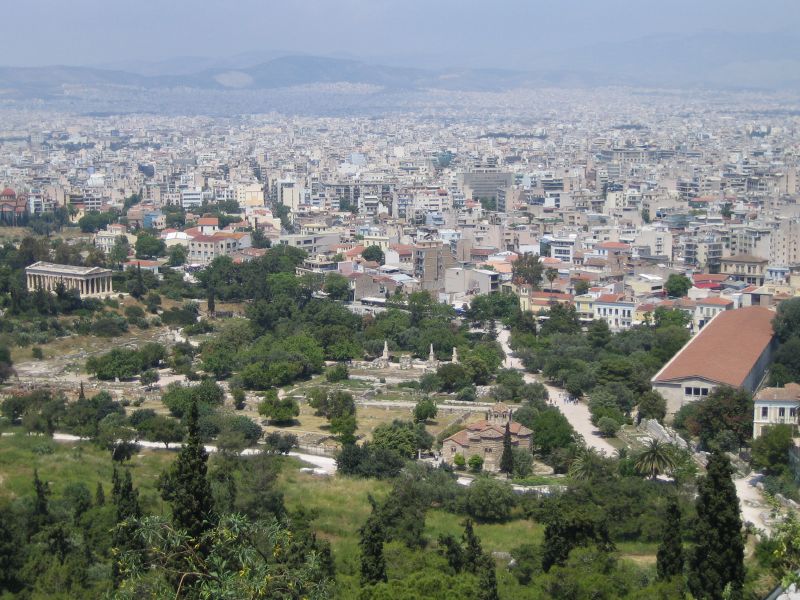
Photo: Wikimedia Commons contributor · CC BY-SA 3.0 · Wikimedia Commons
Pnyx is a hill and archaeological site in Athens. Pnyx hosted the Athenian citizens' assembly, the Ekklesia. The free Lokali audio guide runs 7 minutes.
✓ Published October 2026 · how we write these guides
Visitor facts
| Lokali audio guide | 7 min · free |
|---|---|
| Type | Archaeological Site |
| Location | Athens, Greece |
| Coordinates | 37.9717, 23.7194 |
| Languages | 50+, in the Lokali app |
The story
Feel the ground under your shoes first. It is bare limestone here, worn smooth in places, rough and pitted in others. Dry grass grows in the cracks. Pine needles collect along the edges. On a warm afternoon the rock holds the heat, and you can smell resin from the trees on the slope. Across the valley, the Acropolis sits in full view. And yet this quiet, open hillside may matter even more to the modern world than the temples over there.
You are standing on the Pnyx. This low hill rises just west of the Acropolis. For a long stretch of the classical age, it was where the citizens of Athens gathered to govern themselves. They did not send representatives. They came in person. They sat or stood on this slope, they listened to the arguments, and then they voted. When people call Athens the birthplace of democracy, this hillside is one of the most literal places that phrase can point to.
The body that met here was called the Ekklesia, which simply means the assembly. Its meetings on this hill are usually linked to the reforms of a statesman named Cleisthenes, at the end of the sixth century before Christ. His changes gave ordinary citizens a direct voice in public decisions. Over the following generations, the assembly decided questions of war and peace, alliances, public building, and the fate of individual politicians. All of it was argued out here, in the open air.
Now the first surprise. The rock face in front of you is not a natural cliff. Much of it was cut by hand. Look for a stepped platform carved from the living stone. This was the bema, the speakers' platform. A citizen who wanted to address the crowd climbed up onto it. There was no microphone, and there was no roof. A speaker had only his voice, the shape of the hill, and the patience of thousands of listeners.
Archaeologists have identified several building phases on this site. The meeting place was reshaped more than once over the centuries. In the later phases, builders raised the ground with earth and held it in place with a massive curved retaining wall. Some of its huge, squared blocks still stand. Walk along the lower edge of the site and you can see them. Each one was cut and set without mortar. The scale tells you something important. This was a public project, and the assembly was worth the effort.
Think for a moment about who stood here, and who did not. The assembly was open to adult male citizens. Women had no vote. Enslaved people had no vote. Foreign residents had no vote, even if their families had lived in Athens for generations. So this was democracy in a very limited form. Still, for its time it was a radical idea. A farmer and an aristocrat each had one vote, and either of them could stand up and speak.
Some of the most famous voices of ancient Greece were heard on this slope. Themistocles, Pericles, and later Demosthenes all addressed the assembly. Pericles argued here for the policies that shaped the city's golden age. Demosthenes warned Athenians here about the growing power of Macedon in the north. Their speeches were not polished lectures for a quiet hall. They faced a crowd that could heckle, shout, and turn against them in a single afternoon.
Here is the second surprise, and it comes from the comic playwright Aristophanes. In one of his plays, public slaves sweep through the market with a rope dyed red. Citizens who were slow to come to the assembly got marked with the dye, and they faced a penalty. It is a joke on stage, so treat it with some caution. But it suggests a real problem. Even in the first democracy, getting people to turn up and take part was not always easy.
Some decisions needed a large crowd to be valid. The best known example is ostracism. Once a year, citizens could vote to send one powerful man into exile for ten years. Each voter scratched a name onto a piece of broken pottery, called an ostrakon. That is where our word ostracism comes from. Thousands of these inscribed fragments have survived, and some carry the names of very famous Athenians. The vote itself took place in the Agora below, but debate in the assembly led to it.
The name Pnyx itself is often explained as meaning something like tightly packed, or crowded together. That would fit. Picture this slope filled with thousands of men, shoulder to shoulder, under the sun. Picture the noise before a speech, and then the silence when a speaker began. Then picture the show of raised hands at the vote. Today you may share the whole hill with a few walkers, a dog, and the wind.
In later centuries, the assembly did not meet here as often. Some meetings moved to the Theatre of Dionysus on the southern slope of the Acropolis. After that, the hill slowly went quiet. Grass and trees took back the ground. In modern times, this site found new uses. It became part of the green belt of hills around the ancient centre, and it became a favourite walking spot for Athenians.
Take a moment to look around you. To the east, the Acropolis and the Parthenon fill the skyline. Below, the ancient Agora spreads out. That was the marketplace and civic heart of the city. Nearby rise the Hill of the Nymphs, with the domes of the old observatory, and Philopappos Hill, with its monument on the summit. Beyond them, the modern city stretches toward the sea. Ancient Athens and modern Athens sit together in a single view.
This is also one of the calmer places in central Athens. The tour groups gather on the Acropolis. Here, many visitors simply walk past. Listen and you may hear cicadas in summer, church bells from the neighbourhoods below, and traffic far away. Late in the day, the light turns warm on the Parthenon across the valley. It is a good place to sit on the stone, to rest, and to think about what happened on this spot.
Before you leave, put your hand on the carved rock of the speakers' platform. People argued here about how to live together, how to share power, and how to be wrong in public and change their minds. Those questions have not gone away. As you walk back down the path, look at the city below, and remember that its first citizens climbed this same hill to decide their future together.
Key facts
What to look for
Practical tips
Common questions
Is there a free audio guide to Pnyx?
Yes — the Lokali app narrates Pnyx free of charge in 50+ languages. The guide runs about 7 minutes, covers the history, what to look for on site and practical tips, and works offline once downloaded.
Where is Pnyx?
Pnyx is in Athens, Greece, at 37.9717, 23.7194. Tap the map link on this page for directions from where you are.
What is Pnyx known for?
Pnyx hosted the Athenian citizens' assembly, the Ekklesia. Assembly meetings here are linked to Cleisthenes' reforms.
What should you look for at Pnyx?
The stepped speakers' platform cut into the rock face. Huge squared blocks of the curved retaining wall. Tool marks and cuttings in the levelled bedrock.
What should you know before visiting Pnyx?
Come in late afternoon for warm light on the Acropolis. Wear shoes with good grip on the smooth limestone.
When is the best time to visit Pnyx?
Sit on the upper slope to imagine the assembly crowd.
On the map
Opens directions to Pnyx from your location.
More to see in Athens



Hear Pnyx in your language
The full story, narrated, in 50+ languages. Download it before you go and it plays offline, at your own pace, with no ticket and no tour group.