
Stoa of Eumenes
37.9706° N · 23.7261° E · Archaeological Site
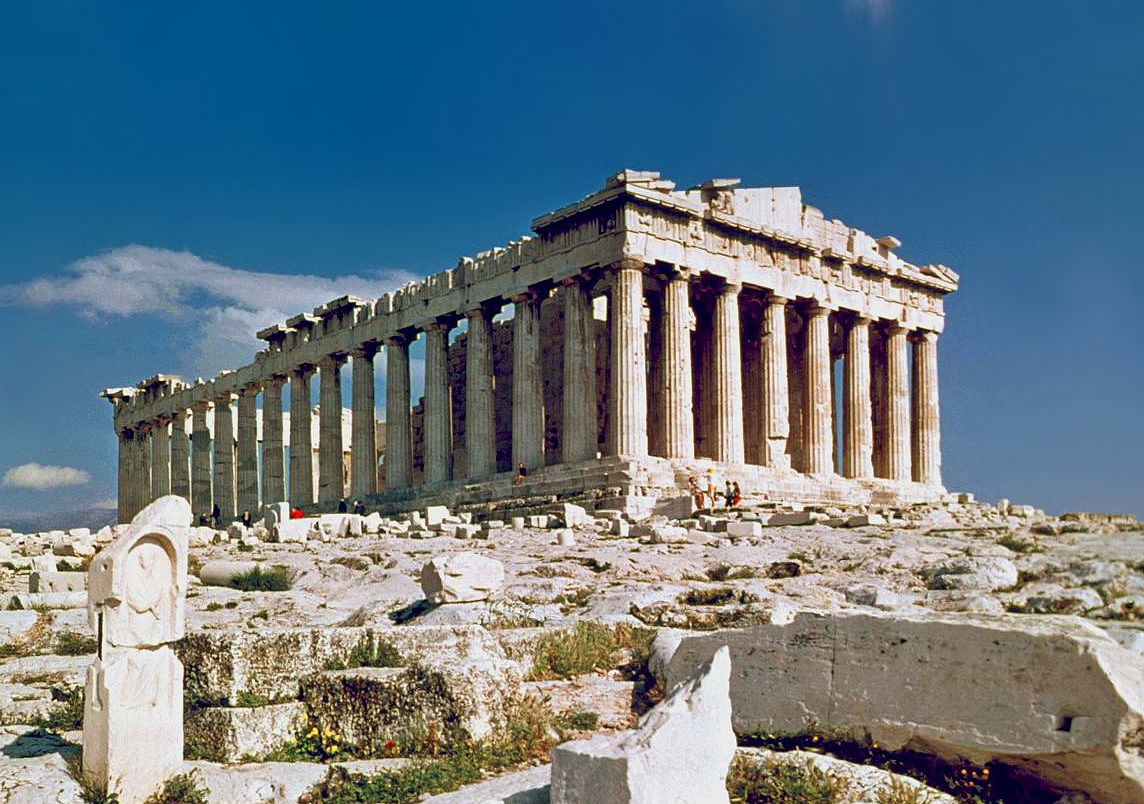
Photo: George E. Koronaios · CC BY-SA 2.0 · Wikimedia Commons
Stoa of Eumenes is an ancient stoa in Athens Acropolis. Funded by King Eumenes the Second of Pergamon. The free Lokali audio guide runs 7 minutes.
✓ Published October 2026 · how we write these guides
Visitor facts
| Lokali audio guide | 7 min · free |
|---|---|
| Type | Archaeological Site |
| Location | Athens, Greece |
| Coordinates | 37.9706, 23.7261 |
| Languages | 50+, in the Lokali app |
The story
Stand on the path below the south slope of the Acropolis and look up. A long row of tall stone arches runs along the hillside. The stones are pale and worn, and many are streaked grey and gold. In summer the cicadas in the pines grow loud around you. This long wall of arches is the most visible part of what remains of the Stoa of Eumenes. It was once one of the largest covered walkways in Athens.
First, a short explanation. A stoa is a covered colonnade, a long building with a solid back wall and a row of columns along the front. The ancient Greeks used stoas the way we use arcades or covered markets. People walked in them, met in them, and sheltered in them from the sun and the rain. Athens had many of them. This one stood in a special place, between two of the city's great stages.
To your east is the Theatre of Dionysus, where Greek drama grew up. To your west is the Odeon of Herodes Atticus, the steep stone theatre still used for summer concerts. The stoa ran along the slope between them, like a long covered corridor. Imagine a crowd leaving a play on a hot afternoon. They could walk here in deep shade, or wait here when a sudden storm broke over the hill.
Now for the first surprise. This building was not a gift from an Athenian. It was a gift from a foreign king. Eumenes the Second ruled Pergamon, a powerful Greek kingdom in what is now western Turkey. He reigned in the early second century before Christ. Hellenistic kings, meaning the Greek-speaking rulers who came after Alexander the Great, often paid for fine buildings in Athens. They wanted to be seen as friends of the city that had shaped Greek culture.
Eumenes was not the only member of his family to do this. His brother, Attalus the Second, later paid for another long stoa in the Athenian Agora, the old marketplace on the other side of the Acropolis. That second building was rebuilt in the 1950s and now holds the Agora Museum. If you visit it, you can walk inside a full-size stoa. It is the best way to picture how this ruined one once looked, with its columns, its shade, and its long, echoing floor.
The stoa here was built on two levels, with a row of columns along the front of each floor. Scholars believe the design followed the architecture of Pergamon. Some even suggest that parts of the building were prepared in Asia Minor and shipped across the Aegean Sea. That idea is still debated, so treat it as a strong theory, not a settled fact. Either way, this was a royal project with royal ambition.
Look again at those arches, because here is the second surprise. They were never meant to be seen. The arches belong to a strong retaining wall at the back of the stoa. The wall held back the earth and rock of the steep Acropolis slope. In front of it stood the columns and the open walkway. Today the front of the stoa is gone, and only its hidden structure remains. You are looking at the skeleton of the building, not its face.
The building did not go unnoticed in the ancient world. Vitruvius, a Roman writer on architecture, named the porticoes of Eumenes when he explained why theatres needed covered walks nearby. He wrote that audiences needed a place to shelter from rain and to stroll between performances. So the stoa became an example in a famous textbook. Its builders in Pergamon could not have known that architects would still read about it two thousand years later.
About three centuries after Eumenes, Athens changed the scene again. In the second century after Christ, the wealthy Athenian Herodes Atticus built his Odeon at the western end of the stoa. The two buildings came to meet each other. As you walk west, notice how the old colonnade line leads you directly towards the Odeon's high stone wall. Two donors, separated by centuries, shaped the same stretch of hillside.
The stoa's later life was harder. In late antiquity, Athens suffered raids and decline, and its people needed defences. The strong back wall of the stoa was useful. It was later built into a fortification line on the south slope. Old public buildings across the Mediterranean often met this fate. Their stone was reused, and their walls became parts of new defences. The stoa survived partly because it was useful in a time of danger.
As you stand here, take a moment for the wider view. Above the arches, the rock rises towards the Parthenon, though you may not see its columns from every point on the path. Below you, the modern city spreads out towards the sea, with its pale apartment blocks and green hills. The path itself is old, too. Ancient Athenians walked a route around the slopes of the Acropolis, and this area has carried foot traffic for more than two thousand years.
The ground here holds the remains of many centuries at once. Look down and you will see foundations, fallen blocks, and pieces of column scattered among dry grass and wildflowers. Some stones carry neat, square cuts where metal clamps once held them together. Others are smooth from weather and from centuries of feet. Archaeologists have studied this slope for a long time, but the site still feels quiet and unfinished, more like a page with missing lines than a museum display.
This is also a good place to slow down. Most visitors hurry past on their way to the Acropolis summit. The arches stand in the background of their photographs, and few people ask what they are. But now you know. This was a royal gift, a shelter for theatre crowds, an example in a Roman textbook, and later a wall of defence. It is a single building with several lives.
Before you walk on, look one more time at the line of arches against the rock. Notice how the light changes on the stone as you move along the path. Listen for the voices drifting from the Theatre of Dionysus and the Odeon. For more than two thousand years, people have walked along this slope between performances, looking for shade. Today, for a few minutes, you are one of them.
Key facts
What to look for
Practical tips
Common questions
Is there a free audio guide to Stoa of Eumenes?
Yes — the Lokali app narrates Stoa of Eumenes free of charge in 50+ languages. The guide runs about 7 minutes, covers the history, what to look for on site and practical tips, and works offline once downloaded.
Where is Stoa of Eumenes?
Stoa of Eumenes is in Athens, Greece, at 37.9706, 23.7261. Tap the map link on this page for directions from where you are.
What is Stoa of Eumenes known for?
Funded by King Eumenes the Second of Pergamon. Built in the early second century before Christ.
What should you look for at Stoa of Eumenes?
The long row of arches set against the rock. Square clamp cuttings on the fallen marble blocks. Scattered column pieces lying among the dry grass.
What should you know before visiting Stoa of Eumenes?
Combine this walk with the Theatre of Dionysus nearby. Visit the rebuilt Stoa of Attalos to picture this one.
When is the best time to visit Stoa of Eumenes?
Walk the slope early, before the Acropolis crowds arrive.
On the map
Opens directions to Stoa of Eumenes from your location.
More to see in Athens


Hear Stoa of Eumenes in your language
The full story, narrated, in 50+ languages. Download it before you go and it plays offline, at your own pace, with no ticket and no tour group.