
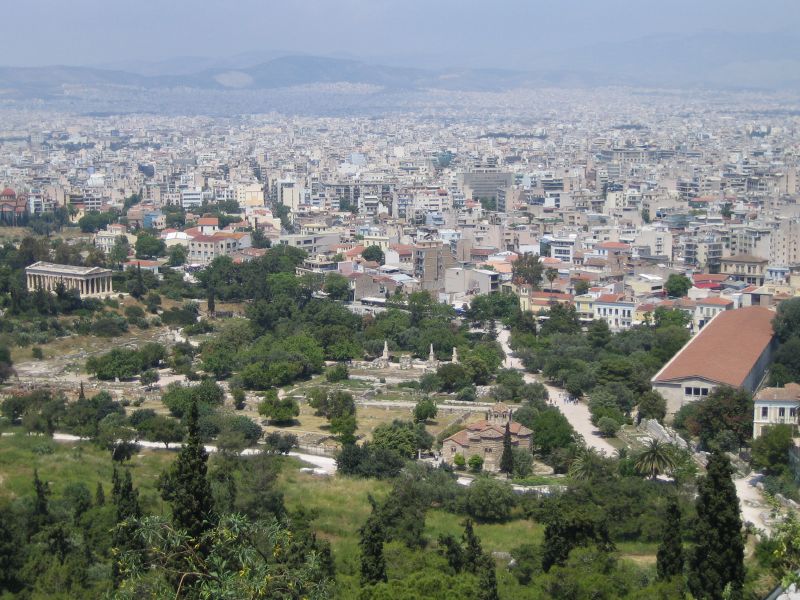
Photo: Tomisti · CC BY-SA 4.0 · Wikimedia Commons
Stoa Poikile is an ancient stoa in Athens. Built in the early fifth century before Christ. The free Lokali audio guide runs 6 minutes.
✓ Published October 2026 · how we write these guides
Visitor facts
| Lokali audio guide | 6 min · free |
|---|---|
| Type | Memorial |
| Location | Athens, Greece |
| Coordinates | 37.9763, 23.7230 |
| Languages | 50+, in the Lokali app |
The story
Stand still for a moment and listen. Behind you, café chairs scrape on the pavement of Adrianou Street. A train rumbles past in its open cutting. Below the fence, in a sunken pit of pale earth, lie a few long blocks of worn stone. They look modest, almost forgettable. But this patch of ground gave a name to one of the most influential ways of thinking in the Western world.
This is the Stoa Poikile, the Painted Stoa. A stoa is a long, covered walkway. It has a solid back wall and an open row of columns along the front. Ancient Greek cities built them as shelters from sun and rain, and as places to meet, trade, argue, and wait. This one stood on the northern edge of the Agora, the great public square of ancient Athens.
It was built in the early fifth century before Christ, in the years after the Persian Wars. Athens was confident and rebuilding. At first the building had another name, the Stoa of Peisianax, after the man who paid for it. Ancient writers link him to the family of Kimon, a leading Athenian general and politician of that time. But the people of Athens soon gave it a simpler name, and that name stayed for centuries.
The new name came from what hung inside. Along the back wall, the stoa held large paintings on wooden panels. Some of the most respected painters of the age worked on them. Ancient sources name Polygnotos, Mikon, and Panainos, who was a relative of the sculptor Pheidias. Painting was one of the great arts of classical Greece. Today almost none of it survives. These panels were among the most admired works in the whole Greek world.
What did they show? We know because a traveller described them. Pausanias, a Greek writer of the second century after Christ, walked through Athens and wrote down what he saw. He lists a battle between Athenians and Amazons, the warrior women of myth. He describes the Greeks after the fall of Troy. And he describes the Battle of Marathon, where Athenians and their allies defeated a Persian army in 490 BC.
The Marathon painting mattered most to Athenians. It placed heroes and gods beside real soldiers who had fought that day. Pausanias says it showed the Persians fleeing and pushing each other into the marshes. Ancient tradition says the general Miltiades appeared in the front line. Imagine a citizen standing where you stand, pointing at the painted figure of his own grandfather. History, myth, and family memory hung on the same wall.
Here is a detail many visitors miss. The stoa also displayed real trophies of war. Pausanias mentions bronze shields taken from Spartan soldiers captured at Pylos in 425 BC. Archaeologists excavating the Agora later found a bronze shield with an inscription. It says the Athenians took it from the Spartans at Pylos. That shield is now in the museum inside the Agora site, just across the railway line from here.
Now the second surprise. Around 300 BC, a man from Cyprus called Zeno began to teach here. He had no school building of his own. He simply walked up and down under the painted colonnade and spoke with anyone who came. His followers became known as the people of the stoa, the Stoics. Stoicism, the philosophy of calm, duty, and self-control, takes its name from this building.
Think about that for a moment. Marcus Aurelius, the Roman emperor, wrote his private notes in the Stoic tradition. Modern readers still buy books on Stoic thinking for help with stress and work. Every one of those ideas traces back to conversations in a public walkway, open to the street. Philosophy here was not hidden away. It happened in front of shoppers, officials, and passing travellers.
The stoa had other uses too. Ancient texts suggest it hosted some legal hearings and public business. Many scholars also connect it with the opening announcement of the Eleusinian Mysteries, the secret religious rites held at nearby Eleusis. It was a true civic space. People came to look at art, to settle disputes, to hear news, and simply to stand in the shade.
The famous paintings did not last forever. By around the year 400 AD, ancient letters report that the panels had been taken away. A Roman official is said to have removed them. Over the following centuries the building fell into ruin. Later houses and streets covered the site. For a long time, nobody knew exactly where the Painted Stoa had stood.
The answer came from excavation. Archaeologists of the American School of Classical Studies, who have dug the Agora for decades, found the western end of the building in 1981. That is the part you see now. Much of the rest still lies under Adrianou Street and the buildings beside it. Look closely at the blocks below. You can see the line of the foundations, and the bases where columns once stood in a long row.
The remains are not tall. You need some imagination here. Picture a long roof above you, a deep shadow, and a row of columns facing south toward the open square. Picture the bright colours of the painted panels along the back wall. Picture the low voices of people arguing about how to live a good life, while traders called out nearby.
Before you walk on, look once more at the ordinary life around you. People sit at tables, talk, check their phones, and watch the street. In a sense, nothing has changed. This corner of Athens has always been a place to pause and talk. As you turn toward the Agora or the busy lanes of Monastiraki, you are walking the same route that Zeno's listeners once took.
Key facts
What to look for
Practical tips
Common questions
Is there a free audio guide to Stoa Poikile?
Yes — the Lokali app narrates Stoa Poikile free of charge in 50+ languages. The guide runs about 6 minutes, covers the history, what to look for on site and practical tips, and works offline once downloaded.
Where is Stoa Poikile?
Stoa Poikile is in Athens, Greece, at 37.9763, 23.7230. Tap the map link on this page for directions from where you are.
What is Stoa Poikile known for?
Built in the early fifth century before Christ. Originally named the Stoa of Peisianax after its donor.
What should you look for at Stoa Poikile?
Long line of foundation blocks in the sunken pit. Column bases set in a row along the front. Railway cutting separating the stoa from the Agora.
What should you know before visiting Stoa Poikile?
View the remains from the fence on Adrianou Street. Pair this stop with a visit to the Ancient Agora.
When is the best time to visit Stoa Poikile?
Visit in the morning before the café crowds arrive.
On the map
Opens directions to Stoa Poikile from your location.
More to see in Athens



Hear Stoa Poikile in your language
The full story, narrated, in 50+ languages. Download it before you go and it plays offline, at your own pace, with no ticket and no tour group.