
Harmodius and Aristogeiton, the Tyrannicides
37.9751° N · 23.7234° E · Monument
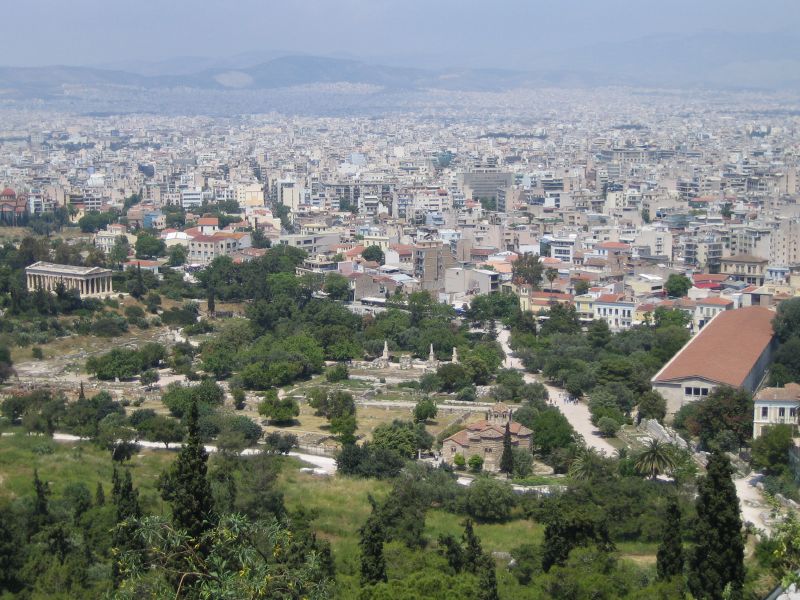
Photo: Elliott Brown · CC BY 2.0 · Wikimedia Commons
Harmodius and Aristogeiton, the Tyrannicides is a classical Greek sculpture. It is in Athens, Greece. Hipparchus was killed during the Panathenaic festival in 514 BCE. The free Lokali audio guide runs 6 minutes.
✓ Published October 2026 · how we write these guides
Visitor facts
| Lokali audio guide | 6 min · free |
|---|---|
| Type | Monument |
| Location | Athens, Greece |
| Coordinates | 37.9751, 23.7234 |
| Languages | 50+, in the Lokali app |
The story
Feel the gravel under your feet. It crunches softly, dry and pale, the way it has under countless sandals before yours. Somewhere in the olive trees, cicadas are buzzing. The light here is sharp and white, and it bounces off broken marble in every direction. You are in the heart of ancient Athens, close to the old public square called the Agora. Two bronze men once stood near here. They held swords, and they were caught in the middle of a killing.
Their names were Harmodius and Aristogeiton. To the Athenians, they became the Tyrannicides, which simply means the tyrant-slayers. For centuries, Athenians told their story as the moment the city chose freedom. Their statues were among the first public monuments in Greece made to honour real, living citizens. Gods and heroes had statues. Ordinary men usually did not. These two were the exception, and that alone tells you how much their deed meant to the city.
Let us go back to the late sixth century before Christ. Athens was ruled by a family of tyrants. In ancient Greek, a tyrant was not always cruel. The word meant a ruler who took power outside the normal rules. The head of the family was Hippias. His younger brother was Hipparchus. Together they shaped the city's politics, its festivals, and its building projects. Many Athenians accepted their rule. Some quietly resented it.
In 514 BC, during the great summer festival called the Panathenaia, the two friends made their move. This festival honoured Athena, the city's goddess, with a grand procession through the Agora. Crowds filled the streets. Weapons could be carried openly in the parade. The conspirators had planned to strike at Hippias himself. But in the confusion of that morning, they attacked his brother Hipparchus instead, and they killed him.
The ending was brutal. Harmodius was cut down on the spot by the guards. Aristogeiton escaped for a short time, but he was captured, tortured, and put to death. And here is the first surprise... the plot did not end the tyranny. Hippias stayed in power for about four more years. He became harsher and more suspicious. He was finally driven out in 510 BC, and Spartan soldiers played a major role in his fall.
So why did Athens celebrate these two men as liberators? Partly because memory is selective. Soon after the tyrants fell, Athens began building its early democracy. The young democracy needed heroes of its own, and it did not want to give the credit to Sparta. Two Athenian citizens, who had given their lives in the middle of a sacred festival, made a far better founding story.
The historian Thucydides, writing decades later, was not convinced by the heroic version. He describes a much more personal motive. According to his account, Harmodius and Aristogeiton were a couple. Hipparchus made advances toward Harmodius and was rejected. In revenge, he insulted Harmodius's sister by turning her away from an honoured role in the festival procession. In this telling, the killing came from private anger, not from political principle.
Both versions survived side by side. At drinking parties, Athenians sang short songs in honour of the pair. One well-known verse speaks of carrying a sword hidden in a branch of myrtle, a fragrant evergreen shrub. The city also gave lasting honours to the families of the two men. Ancient writers mention privileges for their descendants, such as meals at public expense. A legend became an official institution.
Now to the statues themselves, and to the second surprise. The first bronze group was made by a sculptor named Antenor, not long after the tyrants were expelled. In 480 BC, the Persian army of King Xerxes captured and burned Athens. The Persians carried the statues away as war trophies. They took the symbol of Athenian freedom, and that choice says a great deal about its power.
The Athenians did not wait for their return. A few years later, two sculptors named Kritios and Nesiotes made a new pair. Ancient sources say the original group was later sent back from Persia, after Alexander the Great's conquests in the East. Accounts differ on exactly who returned it. If they are right, Athenians could eventually stand here and see both versions of the same two heroes, the first pair and its replacement.
None of these bronzes survive. What we know of their appearance comes mainly from later Roman copies in marble. The best known pair is now in the National Archaeological Museum in Naples, in Italy. The figures stride forward together. The younger Harmodius is beardless and raises his sword high above his head. The older, bearded Aristogeiton pushes forward with one arm extended, a cloak hanging from it. Art historians call this the Severe Style, an early classical manner that is calm, strong, and serious.
That pose had a long life. Artists in Athens copied it on painted vases, on coins, and in other sculptures. It became a kind of visual shorthand for striking down a tyrant. Many centuries later, the story still appears in debates about freedom and violence. Were they selfless liberators, or two men settling a personal score? The honest answer may be that they were both, and the city chose the part it needed.
Look around you now. The great bronzes are gone, and so is the noise of the procession. But the shape of the place is still here. The broad open ground, the line of the old festival route, and the Acropolis rising above all of it. As you walk on, picture two figures striding through the crowd, swords raised... and remember how quickly a messy moment can become a city's founding story.
Key facts
What to look for
Practical tips
Common questions
Is there a free audio guide to Harmodius and Aristogeiton, the Tyrannicides?
Yes — the Lokali app narrates Harmodius and Aristogeiton, the Tyrannicides free of charge in 50+ languages. The guide runs about 6 minutes, covers the history, what to look for on site and practical tips, and works offline once downloaded.
Where is Harmodius and Aristogeiton, the Tyrannicides?
Harmodius and Aristogeiton, the Tyrannicides is in Athens, Greece, at 37.9751, 23.7234. Tap the map link on this page for directions from where you are.
What is Harmodius and Aristogeiton, the Tyrannicides known for?
Hipparchus was killed during the Panathenaic festival in 514 BCE. Hippias, the ruling tyrant, was finally expelled in 510 BCE.
What should you look for at Harmodius and Aristogeiton, the Tyrannicides?
The Acropolis rising directly above the old festival route. Worn marble blocks lining the open ground of the Agora. Olive trees shading the paths through the ancient square.
What should you know before visiting Harmodius and Aristogeiton, the Tyrannicides?
Visit early morning to walk the Agora in softer light. Bring water and a hat for the exposed Agora grounds.
When is the best time to visit Harmodius and Aristogeiton, the Tyrannicides?
Visit early morning to walk the Agora in softer light.
On the map
Opens directions to Harmodius and Aristogeiton, the Tyrannicides from your location.
More to see in Athens


Hear Harmodius and Aristogeiton, the Tyrannicides in your language
The full story, narrated, in 50+ languages. Download it before you go and it plays offline, at your own pace, with no ticket and no tour group.