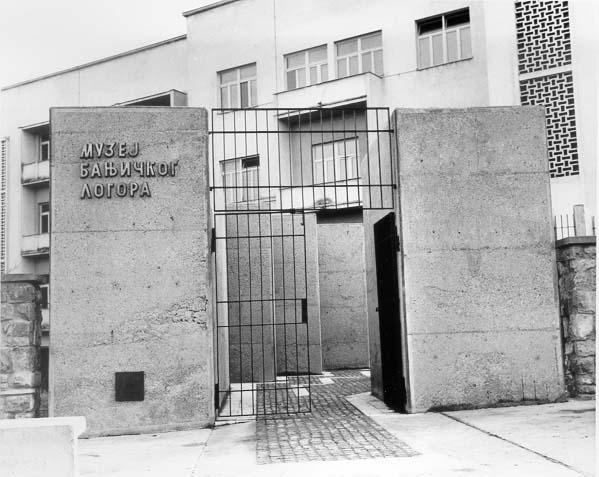
Banjica Concentration Camp
44.7703° N · 20.4683° E · Museum
Photo: Unknown authorUnknown author · CC0 · Wikimedia Commons
Banjica Concentration Camp is a Nazi German concentration camp in the Territory of the Military Commander in Serbia. Camp opened in summer 1941 under German occupation. The free Lokali audio guide runs 6 minutes.
✓ Published October 2026 · how we write these guides
Visitor facts
| Lokali audio guide | 6 min · free |
|---|---|
| Type | Museum |
| Location | Belgrade, Serbia |
| Coordinates | 44.7703, 20.4683 |
| Official website | mgb.org.rs |
| Languages | 50+, in the Lokali app |
The story
Stand still for a moment and listen. Traffic hums along the wide roads of this southern Belgrade neighbourhood. Apartment blocks rise nearby, and somewhere a dog barks. The building in front of you looks plain, almost ordinary: a long, low military structure with rows of windows. That ordinariness is part of what makes this place so heavy. During the Second World War, this was one of the largest concentration camps in occupied Serbia.
Before the war, the site served a very different purpose. These were barracks of the Royal Yugoslav Army, built to house soldiers of an infantry regiment. Long corridors, dormitories, a parade ground... a practical layout for keeping many men in one place. After Germany invaded and occupied Yugoslavia in April 1941, the occupiers saw that same layout differently. A building designed to hold soldiers could just as easily hold prisoners.
The camp opened in the summer of 1941. It was set up under German occupation authority, but it was not run by Germans alone. Serbian collaborationist forces, especially the Special Police of Belgrade, played a central role in arrests, interrogations and daily administration. This is an uncomfortable truth, and the museum here does not hide it. Occupation depended on local hands as well as foreign orders.
Who was brought here? The answer is long. Communists and suspected supporters of the Partisan resistance. Jews and Roma, who were targeted for who they were. Royalist Chetnik sympathisers. Students, workers, priests, peasants, and ordinary citizens taken as hostages. Men, women, and even children passed through these gates. Records show that more than twenty thousand prisoners were registered here over the course of the war.
Those records matter. The camp administration kept registers of prisoners, with names, dates and notes on what happened to each person. Many of these books survived the war. Today they are one of the most important sources for understanding the camp. They also do something quieter. They turn a vast, abstract number back into individual people — a name, an age, a hometown, a date of arrival.
One of the darkest tools of the occupation was the hostage system. In occupied Serbia, German command ordered mass reprisals for attacks on German soldiers. For every soldier killed, one hundred civilians were to be shot. For every soldier wounded, fifty. Banjica became a holding place for people who could be selected for these executions. A prisoner here might be killed not for anything they had done, but for an attack somewhere else entirely.
Many executions took place outside the camp, at Jajinci, a few kilometres to the south. Prisoners were taken there by truck and shot in large groups. In the later years of the war, as German forces prepared to retreat, they tried to hide what had happened. Bodies were dug up and burned to destroy the evidence. Today Jajinci is a memorial park, quiet and green, with a large monument to the victims.
The camp also served as a transit point. Some prisoners were not killed here, but sent onward to other camps across occupied Europe, including camps in Germany, Austria and Norway. For many families in Belgrade, the name Banjica meant the last known place a relative was seen. The camp continued to operate until the autumn of 1944, shortly before Partisan and Soviet forces liberated Belgrade in October that year.
Here is something many visitors do not expect. Banjica was not hidden in a remote forest. It stood on the edge of a capital city, close to homes and roads. People in Belgrade knew it existed. Relatives sometimes came to the area hoping to learn news, or to pass a parcel of food or clothing to someone inside. The camp was part of the city's daily fear, not a distant secret.
After the war, part of the old barracks was preserved as a museum. It now belongs to the Museum of the City of Belgrade. Inside, the exhibition uses photographs, documents, personal belongings and reconstructed spaces to tell the story. Look closely at the smaller objects. Letters written by prisoners, handmade items, and simple possessions carry a weight that large wall texts cannot.
The second surprise is in the scale of the place compared with the scale of its story. The surviving building is modest. You can walk its length in a minute or two. Yet it held thousands of people over three years. Standing in a single room, it helps to imagine it crowded, with prisoners sleeping close together on the floor or on simple bunks, waiting each day to hear whether their name would be called.
As you move through the museum, take your time. There is no need to read every caption. Some visitors choose one name from the walls or the displays and carry it with them for the rest of the visit. Others simply sit for a moment. This is a place of memory for Serbian, Jewish and Roma families, and for many others. A quiet, respectful pace is the right one here.
When you step back outside, notice how life continues around this building. Cars pass. People walk to the shops or wait for a bus. Children may be playing somewhere close by. The ordinary city has grown up around this site, and it carries on. As you leave, look back once at the plain walls and the rows of windows... and remember that every one of those windows once looked out on people who hoped, against everything, to go home.
Key facts
What to look for
Practical tips
Common questions
Is there a free audio guide to Banjica Concentration Camp?
Yes — the Lokali app narrates Banjica Concentration Camp free of charge in 50+ languages. The guide runs about 6 minutes, covers the history, what to look for on site and practical tips, and works offline once downloaded.
Where is Banjica Concentration Camp?
Banjica Concentration Camp is near Belgrade, Serbia, at 44.7703, 20.4683. Tap the map link on this page for directions from where you are.
What is Banjica Concentration Camp known for?
Camp opened in summer 1941 under German occupation. Housed in former Royal Yugoslav Army infantry barracks.
What should you look for at Banjica Concentration Camp?
The long, plain facade of the original barracks building. Handwritten prisoner letters displayed in the exhibition cases. Pages from the surviving camp prisoner registers.
What should you know before visiting Banjica Concentration Camp?
Check museum status in advance, as schedules can change. Combine your visit with the Jajinci memorial park nearby.
On the map
Opens directions to Banjica Concentration Camp from your location.
More to see in Belgrade


Hear Banjica Concentration Camp in your language
The full story, narrated, in 50+ languages. Download it before you go and it plays offline, at your own pace, with no ticket and no tour group.