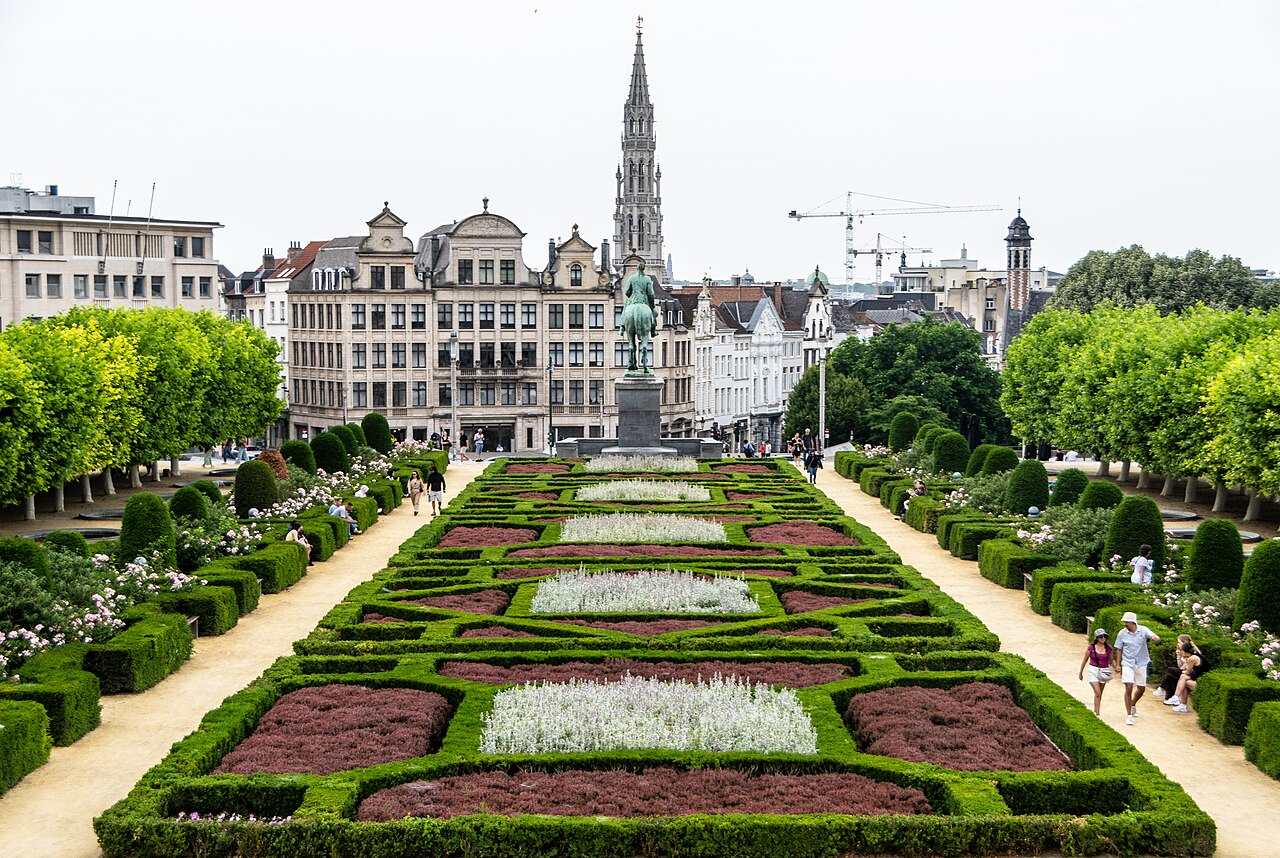
Mont des Arts is a terraced public garden rising between the Old Town and the European Quarter, with walking paths, sculptures, and viewpoints overlooking Brussels. It is in Brussels, Belgium. Most visitors spend 30–45 min here. The free Lokali audio guide runs 5 minutes.
✓ Verified August 2026 · how we write these guides
Visitor facts
| Time needed | 30–45 min |
|---|---|
| Lokali audio guide | 5 min · free |
| Type | Park |
| Best for | Photography |
| Location | Brussels, Belgium |
| Coordinates | 50.8400, 4.3720 |
| Languages | 45, in the Lokali app |
The story
Climb the wide stone steps and stop at the top. Below you, the city falls away in a long open view. Rooftops stretch toward the horizon. In the distance, a single thin tower points up from the old square. Behind you sits a neat green garden, cut into clean shapes. This place is called the Mont des Arts, the Mount of the Arts.
The name fits the spot. This slope links the lower town, down by the old market streets, with the upper town, where the royal square and the grand houses stand. For a long time, this was just a steep hill in the way. Today it is a calm set of gardens, stairs, and stone, joining the two halves of the city.
The garden in front of you is laid out with care. Straight paths cross neat beds of grass and flowers. Low hedges form clean lines and corners. In the warm months, the colors shift as the planting changes. People sit on the edges of the beds, eat their lunch, and look out over the view you just found.
This calm did not come easily. More than a hundred years ago, a poor neighborhood stood on this hill. Its narrow streets and old houses were pulled down. The king at the time, Leopold the Second, wanted a grand approach to the upper town. The homes were cleared away, and for a while the hill stood bare and open.
In 1910, the city held a great fair, and a temporary garden was planted here to welcome guests. People liked it. But the space stayed unsettled for years, changing plans more than once. The hill waited through two wars and many long arguments before it found the shape you see today.
The lasting design came in the 1950s. The city was preparing for a huge world fair, held in 1958, which drew visitors from across the globe. The Mont des Arts was rebuilt as part of that effort. New stone buildings rose along the slope, framing the garden and the climbing stairs in clean modern lines.
One of those buildings holds the Royal Library of Belgium. Behind its walls rest millions of books, maps, and old handwritten pages. Scholars come here to read works that are hundreds of years old. As you stand in the garden, a vast store of writing and memory sits quietly just steps away from where you are.
Turn and face the view again. From this height you can see the thin tower of the Town Hall, far down in the lower town. On a clear day, the eye travels across spires, domes, and long rows of roofs. This is one of the finest open views in the city, and it costs nothing at all to enjoy.
Look for the clock set into one of the walls nearby. Above it stand small figures, each linked to a moment or a craft from the country's past. At certain hours, the clock marks the time, and the figures take their turn. Children often wait in front of it, watching for the small movement to begin.
The slope is a meeting point in more ways than one. People crossing from the train station to the museums above pass through here. Visitors rest on the steps. Friends agree to meet by the garden. The place works as a kind of open room, shared by everyone who happens to be passing through it.
As the light changes through the day, the mood of the hill changes with it. In the morning, the garden is fresh and quiet. At midday, it fills with people and talk. In the evening, the low sun turns the stone warm and gold, and the long view softens into a gentle haze. Couples pause to take photographs, and the whole hill seems to slow down with the fading light.
Around you stand the museums, the library, and the grand square above. The Mont des Arts ties them all together, a green knot in the middle of the city's most serious buildings. It asks nothing of you but a few minutes and a pause to look out at the view it offers so freely.
Before you move on, sit for a moment on the warm stone. Think of the homes that once stood here, the fairs that came and went, and the long wait before this calm took hold. The hill has held many shapes. Right now it holds you, the garden, and a quiet view across an old city.
Key facts
What to look for
Practical tips
Common questions
How long do you need at Mont des Arts?
Plan 30–45 min. That is the time most visitors spend at Mont des Arts. The free Lokali audio guide adds about 5 minutes of narration you can listen to as you walk, so it fits inside your visit rather than adding to it.
Is there a free audio guide to Mont des Arts?
Yes — the Lokali app narrates Mont des Arts free of charge in 50+ languages. It covers the history, what to look for on site and practical tips, and it works offline once downloaded.
Where is Mont des Arts?
Mont des Arts is in Brussels, Belgium, at 50.8400, 4.3720. Tap the map link on this page for directions from where you are.
What should you know before visiting Mont des Arts?
Come at sunset for the warmest light.
What is Mont des Arts known for?
Mont des Arts means Mount of the Arts.
What is the best time to visit Mont des Arts?
Climb to the upper terrace for an unobstructed view of the Cathedral and the Old Town roofline.
On the map
Opens directions to Mont des Arts from your location.
More to see in Brussels


Hear Mont des Arts in your language
The full story, narrated, in 50+ languages. Download it before you go and it plays offline, at your own pace, with no ticket and no tour group.