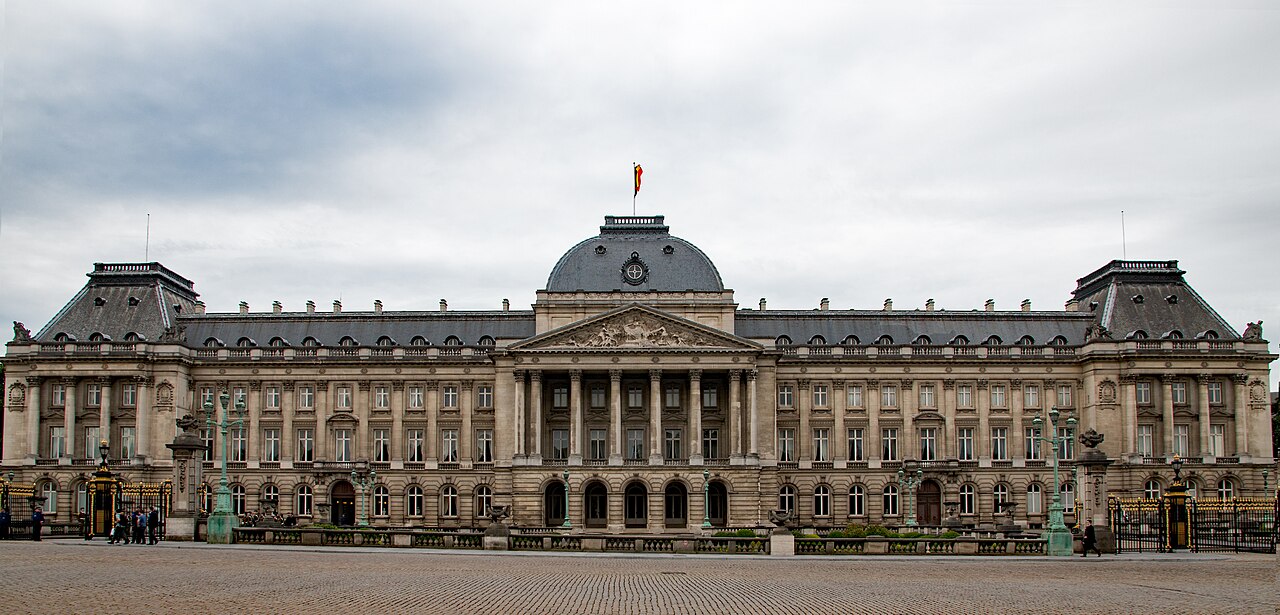
Royal Palace of Brussels
50.8407° N · 4.3717° E · Palace
Royal Palace of Brussels is the official Brussels residence of the Belgian monarch, a neoclassical palace on the Place Royale. It is in Brussels, Belgium. Most visitors spend 1–1.5 hours here. The free Lokali audio guide runs 5 minutes.
✓ Verified August 2026 · how we write these guides
Visitor facts
| Time needed | 1–1.5 hours |
|---|---|
| Lokali audio guide | 5 min · free |
| Type | Palace |
| Best for | History |
| Location | Brussels, Belgium |
| Coordinates | 50.8407, 4.3717 |
| Languages | 45, in the Lokali app |
The story
Stand on the wide square and look up. The facade runs long and pale before you, the color of cream and old ivory. Flags lift and fall in the wind above the central doors. Behind you, cars slide past in a low hum. In front, a green park reaches away in straight, careful lines. This is the Royal Palace of Brussels, the working home of the Belgian crown, set at the heart of the city.
The word official carries weight here. The King and Queen of the Belgians do not sleep inside these walls. They live a few kilometers to the north, at the Palace of Laeken, among glass houses and gardens. This building is a place of work. Here the King receives heads of state, holds audiences, signs papers, and hosts the ceremonies of the nation. Picture a grand office, dressed in marble, mirrors, and gold.
The palace faces Brussels Park across a broad avenue. Two centuries ago, this whole quarter was drawn up as a single design. The park, the square, and the proud buildings around it were planned together, like one large stage. Across the lawns stands the Belgian Parliament. So the King and the elected lawmakers sit face to face, divided only by a long row of trees.
The front you see is younger than it first appears. Much of this long facade was completed in the early twentieth century, around 1904. King Leopold the Second wanted a palace to rival the great courts of Europe. He pressed for something wider, taller, and more formal. The architect Henri Maquet gave shape to the design that now stretches the length of the square, pale stone upon pale stone.
Beneath your feet lies a far older story. Long ago, the dukes who ruled this region lived on this same hill, in a castle called the Coudenberg. That palace was lost to a great fire in 1731. Its broken walls were buried and built over. Today you can walk through the cold cellars of that vanished court, deep below the modern street, in an underground museum close by.
Each summer, the palace opens its doors to everyone. When the royal family leaves the city for the warmer weeks, the gates swing wide, and anyone may step inside, with no ticket and no fee. For a short season, the great rooms of the state belong to ordinary visitors. Quiet lines form along the square in the morning, families waiting in the sun.
Inside waits the room that stops people in their tracks. It is the Mirror Room, a long hall with tall windows along one side. Lift your eyes to the ceiling. It glows in deep shades of green and blue, catching the light. The artist Jan Fabre covered the whole surface with the hard wing cases of more than a million small beetles, each one placed by hand.
The work is called Heaven of Delight. It was finished in 2002, at the request of the Queen. Every tiny shell throws back the light at its own slight angle. As you walk beneath it, the ceiling seems to ripple and shift, like water seen from below. It is ancient handcraft and modern art joined together, beauty made from the bodies of insects.
Other rooms hold heavy crystal and long curtains. The Throne Room runs bright and wide, lit by rows of warm lamps, its walls climbing with gilded frames. Servants once moved through these halls in near silence, footsteps soft on the polished floor. The sheer scale is meant to impress visiting leaders, and even now, it quietly does its work.
Step outside again and watch the roofline. A single flag keeps a small secret. When the King is inside the country, a special royal banner flies above the palace. When he travels abroad, the banner comes down. Those who know the code can tell, from the pavement below, whether the head of state is home that very day.
Stand back and take in the full width of the front. This palace is not the tallest building in Brussels, nor nearly the oldest. Its strength lies in its calm. It sits low and long and certain, holding one edge of the park, keeping a steady watch over the city it helps to govern. Nothing about it hurries.
When you leave, walk a slow path through the park before it. Then turn, just once, and look back. The pale stone. The moving flags. The straight green lawns running toward the gates. For a few centuries now, in fire and in peace, this gentle hill has held the quiet center of a small and tangled kingdom.
Key facts
What to look for
Practical tips
Common questions
How long do you need at Royal Palace of Brussels?
Plan 1–1.5 hours. That is the time most visitors spend at Royal Palace of Brussels. The free Lokali audio guide adds about 5 minutes of narration you can listen to as you walk, so it fits inside your visit rather than adding to it.
Is there a free audio guide to Royal Palace of Brussels?
Yes — the Lokali app narrates Royal Palace of Brussels free of charge in 50+ languages. It covers the history, what to look for on site and practical tips, and it works offline once downloaded.
Where is Royal Palace of Brussels?
Royal Palace of Brussels is in Brussels, Belgium, at 50.8407, 4.3717. Tap the map link on this page for directions from where you are.
What should you know before visiting Royal Palace of Brussels?
Arrive early; queues build along the square by midmorning.
What is Royal Palace of Brussels known for?
Main facade completed around 1904 under architect Henri Maquet.
What is the best time to visit Royal Palace of Brussels?
The palace's interior is surprisingly intimate—not as vast as Versailles.
On the map
Opens directions to Royal Palace of Brussels from your location.
More to see in Brussels


Hear Royal Palace of Brussels in your language
The full story, narrated, in 50+ languages. Download it before you go and it plays offline, at your own pace, with no ticket and no tour group.