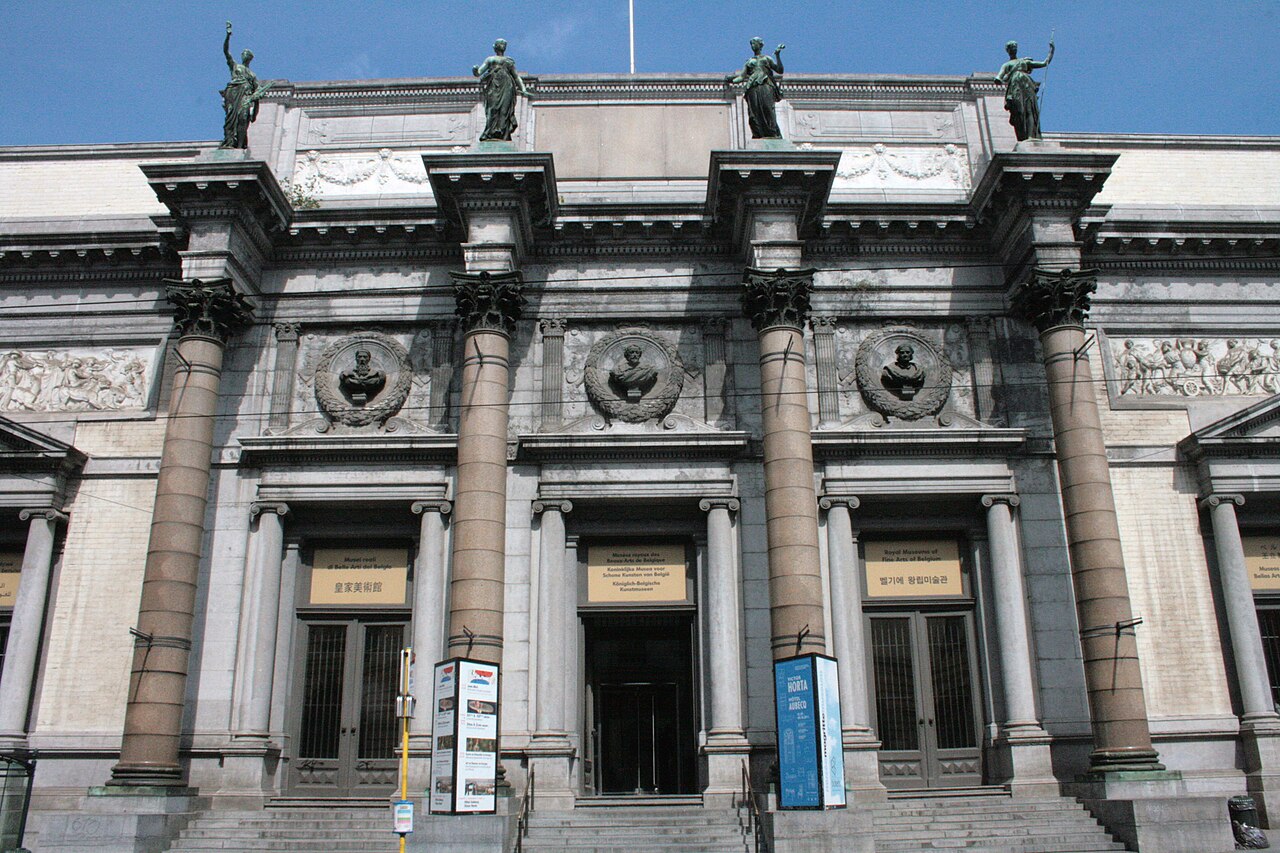
Musées Royaux des Beaux-Arts
50.8383° N · 4.3754° E · Museum
Musées Royaux des Beaux-Arts is a museum in Brussels, Belgium. Complex of interconnected art museums housing Belgian and European paintings from the 15th century onward. Most visitors spend 2–3 hours here. The free Lokali audio guide runs 5 minutes.
✓ Verified August 2026 · how we write these guides
Visitor facts
| Time needed | 2–3 hours |
|---|---|
| Lokali audio guide | 5 min · free |
| Type | Museum |
| Best for | Editors' pick |
| Location | Brussels, Belgium |
| Coordinates | 50.8383, 4.3754 |
| Languages | 45, in the Lokali app |
The story
Push through the doors and let the noise of the street fall away. The air turns cool and still. Your footsteps echo on stone floors. Ahead, high walls rise, hung from top to bottom with paintings in heavy gold frames. The building is calm, almost hushed, a world held apart from the trams outside. This is the Royal Museums of Fine Arts of Belgium, in the heart of Brussels, where six centuries of European painting wait in quiet rooms.
This is not one museum but several, gathered under a single name. There is the Old Masters Museum, full of work from long ago. There is the Magritte Museum, devoted to one strange and famous mind. There is the Fin-de-Siecle Museum, holding the art of the late nineteenth century. A single ticket carries you through all of them, room flowing into room. Together they form one of the largest collections in the country.
The main building has stood here since 1887. Its grand neoclassical front, with tall columns, was designed by the architect Alphonse Balat. He was a teacher to the young Victor Horta, who would later fill Brussels with curving glass and iron. So in these stones you can sense the moment just before a new style was born. Walk slowly here and the building itself becomes part of the collection.
Begin with the Old Masters, on the upper floors. Here hang the great names of the Low Countries. Rubens fills whole walls with warm bodies and rolling cloud. Van Dyck paints faces sharp with feeling. Jordaens crowds his canvases with laughter and food. The rooms are calm, but the paintings are loud with life. There is more on these walls than any single visit can hold.
Look for the works of Pieter Bruegel the Elder. He painted ordinary people, four hundred years ago, with rare honesty. In The Census at Bethlehem, a holy story unfolds in a frozen Flemish village. Children slide on the ice. Workers carry bundles through the snow. The sacred hides quietly inside the everyday. Look closely and you find a small joke or sorrow in every corner.
One small room holds a painting that changed art. It is The Death of Marat, by Jacques-Louis David, finished in 1793. A man lies dead in his bath, a letter still in his hand. The French Revolution killed him, and David turned his body into a kind of saint. The image is simple, calm, and deeply sad. Visitors gather before it in silence, drawn to its strange stillness.
Now follow the signs down toward the Magritte Museum. The mood shifts at once. Rene Magritte was a Belgian painter who made the ordinary feel like a dream. Men in bowler hats. Apples that fill a room. Skies that hang inside a window frame. Nothing here is quite what it claims to be. Here you will find the largest gathering of his work anywhere on earth.
The Magritte Museum opened in 2009. Its rooms trace his whole life, from early sketches to his last quiet pictures. He asked simple, troubling questions. Is a painting of a pipe really a pipe? What is real, and what is only an image? His questions stay with you long after you leave. You walk out looking twice at the world outside.
Do not rush past the sculpture along the way. Bronze and marble figures stand in the open halls and on the stairs. Some reach upward. Some curl inward. In the changing light from the high windows, they seem to pause between one movement and the next, caught and held in cool metal. Walk a slow circle around one and watch how its shadow turns with you.
The museum sits on the Coudenberg hill, near the Royal Palace and the old heart of power. For centuries, art and rule have lived side by side on this rise of ground. Kings collected. Painters served. What now hangs freely on these walls once decorated the halls of dukes and the chapels of the rich. The hill remembers all of it, layer upon layer.
Take your time. No one should try to see all of it in a single visit. Choose one or two rooms and stay with them. Let your eyes adjust to the dark varnish, the small cracks, the brushstrokes laid down by hands long gone. Each painting is a window someone opened on purpose. Sit on a bench if you can, and simply look.
When you step back outside, the light will seem brighter than before. The trams, the people, the moving sky. After hours among painted centuries, the living city looks almost like another canvas, still wet, still being made. Carry that second look with you down the hill.
Key facts
What to look for
Practical tips
Common questions
How long do you need at Musées Royaux des Beaux-Arts?
Plan 2–3 hours. That is the time most visitors spend at Musées Royaux des Beaux-Arts. The free Lokali audio guide adds about 5 minutes of narration you can listen to as you walk, so it fits inside your visit rather than adding to it.
Is there a free audio guide to Musées Royaux des Beaux-Arts?
Yes — the Lokali app narrates Musées Royaux des Beaux-Arts free of charge in 50+ languages. It covers the history, what to look for on site and practical tips, and it works offline once downloaded.
Where is Musées Royaux des Beaux-Arts?
Musées Royaux des Beaux-Arts is in Brussels, Belgium, at 50.8383, 4.3754. Tap the map link on this page for directions from where you are.
What should you know before visiting Musées Royaux des Beaux-Arts?
Pick one or two rooms rather than rushing everything.
What is Musées Royaux des Beaux-Arts known for?
Main neoclassical building opened in 1887, architect Alphonse Balat.
What is the best time to visit Musées Royaux des Beaux-Arts?
The Magritte Museum occupies its own building within the complex.
On the map
Opens directions to Musées Royaux des Beaux-Arts from your location.
More to see in Brussels


Hear Musées Royaux des Beaux-Arts in your language
The full story, narrated, in 50+ languages. Download it before you go and it plays offline, at your own pace, with no ticket and no tour group.