
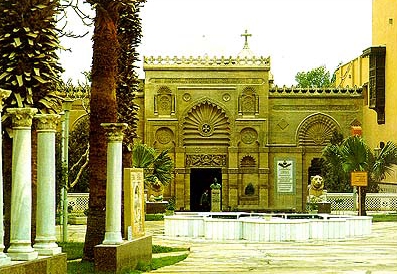
Photo: Zerida at English Wikipedia (Original text: — Zerida) · CC BY-SA 3.0 · Wikimedia Commons
Ben Ezra Synagogue is a building in Egypt. The site has held a synagogue for roughly a thousand years. The free Lokali audio guide runs 6 minutes.
✓ Published October 2026 · how we write these guides
Visitor facts
| Lokali audio guide | 6 min · free |
|---|---|
| Type | Synagogue |
| Location | Cairo, Egypt |
| Coordinates | 30.0058, 31.2310 |
| Languages | 50+, in the Lokali app |
The story
Listen for a moment. The noise of Cairo fades here, behind high walls and narrow lanes. Your footsteps sound on worn stone, and the air smells of dust and old wood. Somewhere nearby, a church bell may ring, or a call to prayer may drift over the rooftops. You are standing in one of the oldest corners of the city, and inside this modest building is a story that changed how we understand medieval life.
This is the Ben Ezra Synagogue, in the district many visitors call Coptic Cairo. The area sits within the old Roman fortress of Babylon, near the first Arab settlement of Fustat. Christians, Jews, and Muslims have lived and worshipped within a few hundred metres of each other here for many centuries. The Hanging Church and the Church of Saint Sergius are just steps away. The neighbourhood is small, but it holds a remarkable layering of faiths.
The synagogue was once known as the Synagogue of the Levantines. That name came from Jews whose families had roots in the lands of the eastern Mediterranean, in what is now Israel, Palestine, Lebanon, and Syria. According to a popular tradition, the site was a Christian church before it was sold to the Jewish community in the early Islamic period. Historians debate the details of that sale. What is clear is that a synagogue has stood here for roughly a thousand years.
Local tradition also attaches older legends to this ground. Some say this is near the place where the infant Moses was found among the reeds of the Nile. Others connect the site with the prophet Jeremiah. The name Ben Ezra is often linked with Ezra the Scribe, a figure from the Hebrew Bible. These stories are faith and folklore, not documented history. But they show how deeply this spot mattered to the people who prayed here.
Now, here is the surprise most visitors miss. The building you see is not medieval. The earlier structure was taken down and rebuilt in the late nineteenth century. Later, in the late twentieth century, it went through a careful restoration. So the walls around you are fairly recent. The real treasure of this place was never the building itself. It was something hidden inside it — a room full of paper.
That room was called a geniza. In Jewish tradition, writings that may contain the name of God should not be thrown away. Instead, worn-out texts are stored and later buried. Here in Cairo, they were stored, and stored, and stored. For centuries, people placed old pages into a chamber in the building. And in the dry Egyptian air, almost nothing rotted. The pages simply waited.
By the late nineteenth century, scholars and dealers began to hear about this hoard. Fragments started to appear on the antiquities market. Then, in the 1890s, a scholar named Solomon Schechter came from Cambridge University. He arranged to take a huge portion of the material back to England. Today the largest collection of these fragments is held at Cambridge. Other pieces are scattered across libraries in Europe, the United States, and beyond.
The numbers are hard to picture. The Cairo Geniza contains hundreds of thousands of fragments. Some are religious texts, prayers, and poems. But many are ordinary documents — letters, marriage contracts, shopping lists, court records, and business accounts. They were written over many centuries. Together, they give a rare, street-level view of daily life across the medieval Mediterranean world. Merchants, widows, doctors, and children all appear in these papers.
One famous resident of old Fustat was Moses Maimonides, the great Jewish philosopher and physician of the twelfth century. He lived and worked in this area while serving at the court of the sultan. Pages connected to Maimonides, including writing in his own hand, have been identified among the geniza fragments. Imagine that. A thinker still studied around the world today once walked these same lanes, and scraps of his work survived in a storeroom.
As you step inside, let your eyes adjust. The interior is light and calm. Look for carved and inlaid woodwork, painted details, and Hebrew inscriptions. In the centre of the hall stands a raised platform, where the Torah was read aloud. At the eastern end is the ark, the cabinet that once held the Torah scrolls. Above, a gallery runs along the side. In traditional practice, women sat in that upper space during prayer.
The geniza chamber itself was placed high in the building, reached from the upper level. Visitors usually cannot enter it today. Still, it is worth finding its location with your eyes. Think of the generations who climbed up there with a bundle of worn pages. They were not saving history. They were simply showing respect for written words. Their quiet habit became one of the great archives of the medieval world.
Today there is no regular congregation here. Egypt's Jewish community was once large and active, but it shrank sharply during the twentieth century. Very few Jewish people remain in the country now. The synagogue is cared for as a heritage site. That gives the space a certain stillness. It feels less like a busy house of worship and more like a place that remembers one. Photography rules can be strict inside, so follow any signs or guards.
Before you leave, stand for a moment in the doorway. Behind you is a room of wood, stone, and light. In front of you are the lanes of Old Cairo, with church domes and the sounds of the modern city beyond the walls. As you walk on toward the churches nearby, notice how close everything is. For centuries, neighbours of different faiths shared these few streets — and some of their everyday words survived, against all odds, in the room above.
Key facts
What to look for
Practical tips
Common questions
Is there a free audio guide to Ben Ezra Synagogue?
Yes — the Lokali app narrates Ben Ezra Synagogue free of charge in 50+ languages. The guide runs about 6 minutes, covers the history, what to look for on site and practical tips, and works offline once downloaded.
Where is Ben Ezra Synagogue?
Ben Ezra Synagogue is near Cairo, Egypt, at 30.0058, 31.2310. Tap the map link on this page for directions from where you are.
What is Ben Ezra Synagogue known for?
The site has held a synagogue for roughly a thousand years. Current building was rebuilt in the late nineteenth century.
What should you look for at Ben Ezra Synagogue?
Raised reading platform standing in the centre of the hall. The ark cabinet set into the eastern wall. Hebrew inscriptions painted and carved into the woodwork.
What should you know before visiting Ben Ezra Synagogue?
Bring a passport for security checkpoints around Coptic Cairo. Dress modestly with shoulders and knees covered.
On the map
Opens directions to Ben Ezra Synagogue from your location.
More to see in Cairo



Hear Ben Ezra Synagogue in your language
The full story, narrated, in 50+ languages. Download it before you go and it plays offline, at your own pace, with no ticket and no tour group.