
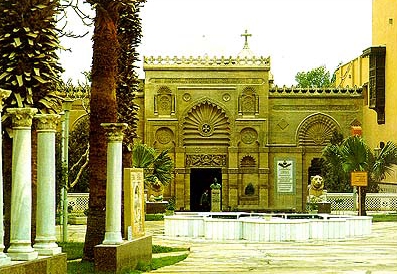
Photo: Berthold Werner · CC BY-SA 3.0 · Wikimedia Commons
The Hanging Church is a church in Cairo, Egypt. Built on top of a Roman fortress gatehouse. The free Lokali audio guide runs 7 minutes.
✓ Published October 2026 · how we write these guides
Visitor facts
| Lokali audio guide | 7 min · free |
|---|---|
| Type | Church |
| Location | Old Cairo, Egypt |
| Coordinates | 30.0054, 31.2301 |
| Languages | 50+, in the Lokali app |
The story
Start at the bottom of the stairs. The street noise of Old Cairo is behind you: car horns, a vendor calling out, the hiss of a coffee pot somewhere nearby. In front of you, a steep flight of stone steps climbs toward a pale façade with twin bell towers. As you go up, the air cools and the sound drops away. By the top, the city feels much further off than a few metres.
This is the Church of the Virgin Mary, known to almost everyone as the Hanging Church. In Arabic it is called al-Muallaqa, which means "the suspended one." It belongs to the Coptic Orthodox Church. Copts are Egypt's native Christians, and their community is one of the oldest Christian communities in the world. For many Egyptians, this building is one of the most important churches in the country.
So why "hanging"? The answer is under your feet. The church was not built on solid ground. It was built on top of a gatehouse of an old Roman fortress known as Babylon. The Romans held this stretch of the Nile for centuries. Their fortress guarded the river crossing and the road south. When Christians later built a church here, they placed it across the tops of the old gate towers, so part of the nave sits above an open passage.
Keep that picture in your mind as you walk inside. Below the church floor there is empty space, with Roman stone walls rising up from the old ground level. Look out for a section of glass set into the floor. If it is open to view, you can look straight down into the gap beneath the church. Most visitors walk right past it. It is a strange feeling to stand on a holy floor and see air under your shoes.
No one is sure exactly when the first church stood on this spot. Some traditions place a church here very early in Egyptian Christianity. The building you see today is the product of many centuries. It was damaged, repaired, rebuilt, and extended again and again. Historians agree on one point. In the Middle Ages, this church gained great status. For a time it served as the seat of the Coptic patriarch, the head of the whole church, after the patriarchs moved here from Alexandria.
Now look up. The ceiling is made of wood, and its shape is worth a slow look. The curved timber roof is often compared to the hull of a ship turned upside down. Many guides link it to Noah's Ark, a common image of salvation in Christian thought. The wood is dark and warm, and it softens the light. On a quiet day, every footstep and whisper seems to stay inside it.
In front of you is the sanctuary screen. In Coptic churches, this screen separates the altar area from the main hall where people stand and pray. Here the screens are made of dark wood with very fine inlay. Small pieces of pale ivory are set into the wood in crosses, stars, and geometric shapes. Move closer and you will see how tiny some of the pieces are. Each pattern was set by hand, piece by piece.
Above and around the screens hang rows of icons. Icons are painted images of saints and holy figures, used in prayer. Many in this church are old, and their colours have gone deep and dark with age and candle smoke. One icon of the Virgin Mary is especially loved. Locals sometimes say her eyes seem to follow you around the room. Test it yourself. Walk slowly from one side to the other and keep watching her face.
Near the centre of the church stands a marble pulpit, the raised platform used for readings and sermons. It rests on a set of slender columns. Here is a detail many people miss. Tradition says the columns stand for Christ and his apostles. According to this popular reading, one column is darker than the rest and stands for Judas, who betrayed Christ. Another is greyer and stands for Thomas, the apostle who doubted. Count them, and look at their colours.
The church also carries one of the most famous stories in Coptic tradition. According to this tale, a medieval ruler of Egypt challenged the Christians to prove a line from the Gospels: that faith can move a mountain. The patriarch is said to have prayed here for days. Then, the story goes, a vision of the Virgin sent him to a humble shoemaker, and the Mokattam hill east of Cairo moved. Treat it as legend. For Copts, it remains a central story of courage under pressure.
The Hanging Church is a working church, not a museum. Families come here to light candles, to pray, and to mark weddings and baptisms. If you are lucky, you may hear part of a service. Some prayers are still sung in Coptic, the last stage of the language of ancient Egypt, written mostly with Greek letters. The melodies are slow and repeat, often with cymbals and a triangle keeping time. It is one of the few places where this old language is still heard aloud.
When you step back outside, remember you are in the heart of a very old neighbourhood. This walled area is often called Coptic Cairo. Within a short walk are other old churches, the Coptic Museum, and the Ben Ezra Synagogue. For centuries, Christians, Jews, and Muslims lived side by side on these narrow lanes. The whole quarter grew up inside and around the Roman fortress walls, which you can still see in places.
Before you go, pause in the courtyard and look back at the steps you climbed. Notice the light on the pale stone, and the soft noise of visitors and worshippers. Then think again about what lies under this building. Roman soldiers once marched through the gate below. Today, people walk up those steps to pray. As you head back into the lanes of Old Cairo, listen for how quickly the city sound returns... and how quiet it was just a few steps above it.
Key facts
What to look for
Practical tips
Common questions
Is there a free audio guide to The Hanging Church?
Yes — the Lokali app narrates The Hanging Church free of charge in 50+ languages. The guide runs about 7 minutes, covers the history, what to look for on site and practical tips, and works offline once downloaded.
Where is The Hanging Church?
The Hanging Church is near Old Cairo, Egypt, at 30.0054, 31.2301. Tap the map link on this page for directions from where you are.
What is The Hanging Church known for?
Built on top of a Roman fortress gatehouse. Arabic name al-Muallaqa means "the suspended one".
What should you look for at The Hanging Church?
Glass floor panel showing the void beneath. Ivory inlay crosses set into dark wooden screens. Curved timber ceiling shaped like an upturned hull.
What should you know before visiting The Hanging Church?
Dress modestly and cover shoulders and knees inside. Climb the entrance steps slowly and use the handrail.
On the map
Opens directions to The Hanging Church from your location.
More to see in Cairo


Hear The Hanging Church in your language
The full story, narrated, in 50+ languages. Download it before you go and it plays offline, at your own pace, with no ticket and no tour group.