
Photo: Daniel Mayer · CC BY-SA 4.0 · Wikimedia Commons
Babylon Fortress is a fortification located in Coptic Cairo, Egypt. Roman fortress linked to Emperor Trajan, early second century. The free Lokali audio guide runs 7 minutes.
✓ Published October 2026 · how we write these guides
Visitor facts
| Lokali audio guide | 7 min · free |
|---|---|
| Type | Fortification |
| Location | Cairo, Egypt |
| Coordinates | 30.0061, 31.2297 |
| Languages | 50+, in the Lokali app |
The story
Start with your hand on the wall, if you can reach it. The surface is rough and slightly warm. Pale bands of cut stone alternate with thin layers of flat red brick, stacked like the pages of a closed book. Behind you, a metro train hisses into the station. In front of you stand walls that Roman soldiers once guarded, along a river that is no longer there.
This is Babylon Fortress, in the heart of what Cairenes call Old Cairo or Coptic Cairo. It is one of the oldest standing structures in the city. It is also one of the easiest to walk past without noticing. The fortress does not rise above the skyline. Instead, much of it sits low, partly below the level of the modern street, with churches, lanes and houses built directly on top of it.
The name surprises almost everyone. Why would a Roman fort in Egypt be called Babylon? Nobody knows for certain. One popular tale says that captives from Mesopotamian Babylon were settled here long ago and gave the place their homeland's name. Some scholars instead suggest that a much older Egyptian place name was heard by Greek ears as Babylon. Both ideas have supporters. What is clear is that the name was already in use in the classical period, long before the walls you see now were built.
The fortress that survives today is Roman work. It is generally linked to the Emperor Trajan in the early second century, and it was strengthened later, around the end of the third century, under the Emperor Diocletian. Its position was strategic. The fort guarded the point where the Nile valley opens into the Delta. It also watched over the start of an old canal that connected the Nile with the Red Sea — a route for grain, goods and soldiers across the empire.
Now for the first surprise. When the Romans built here, the Nile flowed right beside these walls. Boats could come up almost to the gates. Over the centuries, the river slowly shifted west, and the land between filled with silt and city. Today the Nile is several hundred metres away, out of sight. The walls stayed where they were. It was the river that moved.
Look again at that striped masonry. Courses of stone separated by bands of fired brick were a common Roman building method. The brick layers helped to level the wall and spread the weight evenly. You will see the same pattern in Roman walls around the Mediterranean. Here, it is one of the clearest signs that you are looking at original ancient fabric, not a later rebuilding.
The second surprise sits just a short walk away. The Hanging Church, known in Arabic as al-Muallaqa, was built on top of the fortress's southern gatehouse. Its nave stands over the old gate passage, between two Roman towers. That is where the name comes from. The church appears to hang in the air above the gateway. Visitors climb a flight of steps to reach it, and in places you can look down through glass panels into the Roman structure below.
On the other side of the main entrance, a round domed church rises above another of the fortress towers. This is the Church of Saint George, which belongs to the Greek Orthodox community. The circular shape of the building follows the curve of the Roman tower beneath it. It is a simple idea. Builders used the strongest foundations they could find, and these walls were very strong indeed.
Inside the old fortified area, a small maze of lanes holds some of the oldest Christian sites in Egypt. Among them is the Church of Saints Sergius and Bacchus, often called Abu Serga. According to a cherished tradition, the Holy Family rested in a cave here during their flight into Egypt. Its crypt is honoured as that spot. This is a matter of faith and long local memory rather than archaeology, but it has drawn pilgrims for many centuries.
The lanes also lead to the Ben Ezra Synagogue. In the late nineteenth century, scholars studied a vast collection of old documents that had been stored in a room of this synagogue, known as the Cairo Geniza. A geniza is a storeroom where worn texts containing the name of God are kept rather than thrown away. The papers included letters, contracts and shopping lists. They gave historians an extraordinary picture of daily life in medieval Cairo and across the Mediterranean.
The fortress also marks a turning point in Egypt's history. In the seventh century, an Arab army led by the general Amr ibn al-As besieged Babylon. The Byzantine garrison held out for months, but the fortress finally fell in 641. Soon afterwards, the new rulers founded a settlement called Fustat just to the north. Fustat grew into Egypt's capital, and in time the city of Cairo grew out of it. So, in a sense, much of modern Cairo began beside these walls.
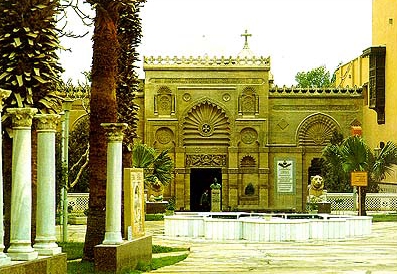
Right beside the entrance stands the Coptic Museum. It holds textiles, carved wood, icons and manuscripts from Egypt's Christian centuries. The word Coptic refers to Egypt's native Christians and their church. The museum is a natural next stop. Its galleries help explain the communities that lived and worshipped inside the fortress walls after Roman rule ended. Many visitors combine the fortress, the churches and the museum into one slow morning.
As you walk these lanes, notice the sounds. Church bells, the murmur of prayer, a shopkeeper calling out, the rumble of trains underground. Notice the changing ground level, too. In some places you step down to reach older doorways. Every step down is a step closer to the Roman street. Before you leave, stand still for a moment near the gate towers. Look at the stripes of stone and brick once more. Soldiers, merchants, monks, rabbis and pilgrims have all passed this spot. The river has gone, and the empire has gone. But the wall is still here, under your hand, holding up a church, a city and nearly two thousand years of daily life.
Key facts
What to look for
Practical tips
Common questions
Is there a free audio guide to Babylon Fortress?
Yes — the Lokali app narrates Babylon Fortress free of charge in 50+ languages. The guide runs about 7 minutes, covers the history, what to look for on site and practical tips, and works offline once downloaded.
Where is Babylon Fortress?
Babylon Fortress is in Cairo, Egypt, at 30.0061, 31.2297. Tap the map link on this page for directions from where you are.
What is Babylon Fortress known for?
Roman fortress linked to Emperor Trajan, early second century. Strengthened later under the Emperor Diocletian.
What should you look for at Babylon Fortress?
Alternating bands of pale stone and red brick. Round Church of Saint George built over a tower. Glass panels showing Roman stonework under the Hanging Church.
What should you know before visiting Babylon Fortress?
Take the metro to Mar Girgis station, beside the fortress. Dress modestly for the active churches and synagogue.
When is the best time to visit Babylon Fortress?
Come early morning when the lanes are quieter.
On the map
Opens directions to Babylon Fortress from your location.
More to see in Cairo



Hear Babylon Fortress in your language
The full story, narrated, in 50+ languages. Download it before you go and it plays offline, at your own pace, with no ticket and no tour group.