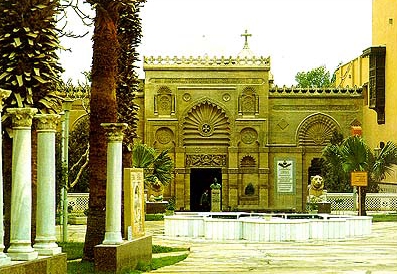
Photo: The original uploader was Néfermaât at French Wikipedia. · CC BY-SA 2.0 fr · Wikimedia Commons
Coptic Museum is a museum in Coptic Cairo, Egypt. Marcus Simaika founded the museum in 1910. The free Lokali audio guide runs 6 minutes.
✓ Published October 2026 · how we write these guides
Visitor facts
| Lokali audio guide | 6 min · free |
|---|---|
| Type | Museum |
| Location | Cairo, Egypt |
| Coordinates | 30.0059, 31.2307 |
| Official website | egymonuments.gov.eg |
| Languages | 50+, in the Lokali app |
The story
Step through the gate and the noise of Cairo drops away. Underfoot, the paving is cool and uneven. Above you, dark wooden screens filter the sunlight into small, scattered squares of gold. The air carries the dry smell of old timber and stone. You are standing in one of the quietest corners of Old Cairo, and also one of its oldest.
This is the Coptic Museum. It holds the largest collection of Coptic Christian art in the world. To understand what that means, it helps to know the word. Coptic refers to the Christians of Egypt, and to the final stage of the ancient Egyptian language. That language was written in Greek letters, with a few extra signs borrowed from older Egyptian script. In a sense, the Copts carried the voice of the pharaohs' Egypt into the Christian age.
Look around at the setting before you look at the objects. The museum sits inside the grounds of the Babylon Fortress. This was a Roman stronghold on the edge of the Nile, long before Cairo itself existed. The river once ran much closer to these walls than it does today. Over the centuries it shifted west, and the city grew into the space it left behind. The heavy round towers you can see nearby are part of that Roman fortress.
The museum exists largely because of one man. Marcus Simaika, a Coptic community leader and scholar, founded it in 1910. In his time, carvings, manuscripts and woodwork from old churches and houses were being lost, sold abroad or simply thrown away. Simaika gathered what he could. He wanted the Coptic chapter of Egyptian history to have a home of its own, alongside the pharaonic and Islamic collections elsewhere in the city.
Here is the first surprise. The building itself is part of the collection. Many of the wooden ceilings, doors and window screens came from old Cairo houses that were being demolished. Those screens are called mashrabiya. They are made of small pieces of turned wood, fitted together into a lattice. They let air and light pass through, while hiding the people inside. So as you walk the galleries, you are moving through fragments of homes that once stood in these streets.
The museum has two main parts, an older wing and a newer one added in the mid twentieth century. Both were renovated in recent decades, after damage from an earthquake in the 1990s. The galleries are arranged largely by material: stone, wood, textiles, metal, manuscripts and icons. This makes it easy to follow one craft through many centuries, and to see how styles slowly changed.
Start with the stone. Many of the carved pieces come from early monasteries, including sites at Saqqara and Bawit, further south along the Nile. Look closely at the capitals of the columns and the friezes. You will see grapevines, acanthus leaves, birds and baskets of fruit. Some of these motifs come straight from Greek and Roman decoration. Others look older and more Egyptian. Christian meaning was layered onto familiar forms.
This leads to the second surprise. Watch for the ankh, the ancient Egyptian sign of life, shaped like a cross with a loop at the top. Early Egyptian Christians kept using it. For them, it became a form of the cross, a sign of eternal life. Standing in front of one of these carvings, you can see two religions meeting in a single shape. Nothing about it feels like a clean break with the past.
The textile rooms are easy to rush through, but they reward patience. Egypt's dry climate preserved woven fabric that would have rotted almost anywhere else. These pieces of linen and wool once formed tunics, cushions and burial cloths. Some show dancers, hunters and sea creatures. Others show saints and crosses. The colours have softened over time... yet the purples, reds and greens still hold. Look at how fine the threads are. These were made by hand, on simple looms.
Upstairs, you reach some of the most important objects in the building. The museum holds the Nag Hammadi codices. These are early books, bound in leather, found buried in a jar in Upper Egypt in 1945. They contain religious texts written in Coptic, many of them unknown before the discovery. Scholars still study and debate them. It is remarkable to think that they survived for so long under the desert sand.
The icon galleries offer a different mood. Here, the figures look straight out at you, with large, calm eyes. Gold backgrounds catch the light from the windows. Many of these icons were painted for local churches, and some are much later than the stone carvings downstairs. They show that this tradition did not end in the distant past. It continued through the medieval period and into modern times, and it continues in the churches just outside.
When you leave, you are still inside a living Christian quarter. The Hanging Church stands nearby, built above the gatehouse of the old fortress. Other ancient churches and the Ben Ezra Synagogue are a short walk away through narrow lanes. Local tradition says the Holy Family sheltered in this area during their flight into Egypt. Whether or not you take that story literally, it shows how deeply people here feel connected to this ground.
Before you go, pause for a moment in the garden or courtyard. Listen for the birds in the trees and the faint sound of traffic beyond the walls. Look up once more at the wooden screens and the pale stone towers. You are standing where Roman soldiers, Egyptian monks and Cairo families all left their mark. As you walk back toward the street, notice the old doorways and worn steps around you. The story in these galleries does not stop at the gate.
Key facts
What to look for
Practical tips
Common questions
Is there a free audio guide to Coptic Museum?
Yes — the Lokali app narrates Coptic Museum free of charge in 50+ languages. The guide runs about 6 minutes, covers the history, what to look for on site and practical tips, and works offline once downloaded.
Where is Coptic Museum?
Coptic Museum is in Cairo, Egypt, at 30.0059, 31.2307. Tap the map link on this page for directions from where you are.
What is Coptic Museum known for?
Marcus Simaika founded the museum in 1910. Built within the grounds of the Roman Babylon Fortress.
What should you look for at Coptic Museum?
Wooden mashrabiya screens rescued from old Cairo houses. Ankh-shaped crosses carved into early Christian stonework. Grapevine and acanthus friezes on monastery column capitals.
What should you know before visiting Coptic Museum?
Take the metro to Mar Girgis station, right outside. Allow time for the Hanging Church next door.
When is the best time to visit Coptic Museum?
Visit early to enjoy the quieter courtyard and galleries.
On the map
Opens directions to Coptic Museum from your location.
More to see in Cairo


Hear Coptic Museum in your language
The full story, narrated, in 50+ languages. Download it before you go and it plays offline, at your own pace, with no ticket and no tour group.