
Saints Sergius and Bacchus Church
30.0063° N · 31.2306° E · Church
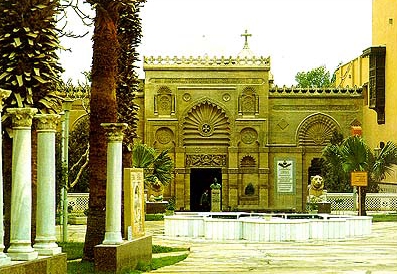
Photo: Sailko · CC BY 3.0 · Wikimedia Commons
Saints Sergius and Bacchus Church is a church in Coptic Cairo, Egypt. Egyptians often call this church Abu Serga. The free Lokali audio guide runs 7 minutes.
✓ Published October 2026 · how we write these guides
Visitor facts
| Lokali audio guide | 7 min · free |
|---|---|
| Type | Church |
| Location | Old Cairo, Egypt |
| Coordinates | 30.0063, 31.2306 |
| Official website | coptic-cairo.com |
| Languages | 50+, in the Lokali app |
The story
Listen for a moment. The traffic of modern Cairo fades behind you, and the lane under your feet turns to worn stone. The air here is cooler, and it smells of dust, old wood, and a little incense. Ahead, a narrow passage leads you down, not up. Many visitors miss this detail at first. This church sits lower than the streets around it, because the city has slowly risen around it over many centuries.
You are standing in the heart of Coptic Cairo, inside the old walls of the Roman fortress known as Babylon. This quarter is one of the oldest parts of the city. Several churches, a synagogue, and a museum share these few narrow lanes. Among them, this small church holds a special place. Egyptians often call it Abu Serga, which is the Arabic form of the name Sergius. Its fame does not come from its size. It comes from a story about a family on the run.
According to Coptic tradition, the Holy Family came to Egypt to escape King Herod. Mary, Joseph, and the infant Jesus travelled through the Nile Valley for some time. Tradition says they rested here, in a cave beneath the place where the church now stands. This story is a matter of faith and long memory, not of archaeological proof. But for many centuries, pilgrims have come to this spot because of it. For Egyptian Christians, it is one of the most important stops on the route of the Holy Family.
The church takes its name from two other figures — Sergius and Bacchus. They were Roman soldiers who lived in Syria. According to Christian tradition, they were officers in the Roman army who refused to make offerings to the Roman gods. For this, they were put to death, probably in the early fourth century. Their story spread widely across the eastern Mediterranean. Churches in many lands carry their names. So a Syrian story and an Egyptian story meet here, under one roof.
Now step inside, and let your eyes adjust to the soft light. The building follows the shape of a basilica. That is an old Roman hall plan, adopted early by Christians: a long central space called the nave, with a narrower aisle on each side. Rows of columns divide these spaces. Look at them closely as you walk. They do not all match. Some are smooth white marble. Many of these columns were probably taken from older buildings, which was a common practice in the ancient world.
Here is a detail most visitors walk past. Among the pale marble columns, one stands out because of its darker, reddish stone. It is the only one of its kind in the row. Some people say the different column has a symbolic meaning. Others believe it was simply the stone that was available. Either way, it shows how this church was assembled over time, piece by piece, from the materials of the city around it.
Look up at the ceiling. The roof is made of wood, and its shape recalls the hull of a boat turned upside down. This form is found in many old Coptic churches. Some explain it with an image from the Bible: the church as a kind of ark, a ship that carries believers to safety. Whether you see a boat or just old timber, the warm brown wood gives the whole space a calm and closed feeling.
At the far end of the nave, a wooden screen separates the main space from the altar area. In Coptic churches, this screen is called the iconostasis, which means a wall that holds icons. Walk close and look at the panels. They are decorated with fine geometric patterns. Small pieces of ivory and dark wood are set into the surface, forming crosses and stars. This kind of inlay was a skill of Cairo craftsmen for many centuries, and you can see it in mosques and churches across the old city.
The church that you see today is not the original building. Tradition places the first church here in the early Christian centuries. But the structure was damaged by fire in the medieval period, and it was rebuilt and repaired many times after that. So the walls around you carry layers of different ages. Older foundations sit beneath later restorations. This is true of much of Coptic Cairo. The buildings survived because generations of people kept repairing them.
Now to the heart of the story — the crypt. Below the altar area lies the cave where, according to tradition, the Holy Family sheltered. Steps lead down into this low, vaulted space. But there is a second surprise here. The water table in this part of Cairo has risen over the years. Groundwater has often flooded the crypt, and for this reason it is frequently closed to visitors. If you cannot go down, you can still stand near the entrance and imagine the small, quiet room beneath your feet.
This church also played a role in the life of the Coptic Church as a whole. The Copts are the native Christians of Egypt, and their church has its own patriarch, a leader similar to a pope. In earlier centuries, this small building was an important place for the community, and several patriarchs were chosen here. It is easy to forget, standing in such a modest room, that decisions made inside these walls once shaped the life of a whole people.
As you leave, notice how close everything is. A short walk away stands the Hanging Church, built on top of the old Roman gate. Nearby is the Ben Ezra Synagogue, and the Church of Saint Barbara. Christians, Jews, and Muslims have lived beside each other in this district for a very long time. The narrow lanes, the shared walls, and the quiet courtyards all carry that long history of neighbours.
Before you go, pause once more in the doorway. Listen to the soft footsteps on the stone floor and the low voices of other visitors. Look back at the columns, the dark wooden roof, the pale ivory stars on the screen. Then climb the steps toward the street, and notice the moment when the sound of the city returns. You are rising, step by step, through centuries of earth that the city has laid down around this small, patient church.
Key facts
What to look for
Practical tips
Common questions
Is there a free audio guide to Saints Sergius and Bacchus Church?
Yes — the Lokali app narrates Saints Sergius and Bacchus Church free of charge in 50+ languages. The guide runs about 7 minutes, covers the history, what to look for on site and practical tips, and works offline once downloaded.
Where is Saints Sergius and Bacchus Church?
Saints Sergius and Bacchus Church is near Old Cairo, Egypt, at 30.0063, 31.2306. Tap the map link on this page for directions from where you are.
What is Saints Sergius and Bacchus Church known for?
Egyptians often call this church Abu Serga. Tradition says the Holy Family sheltered in its crypt.
What should you look for at Saints Sergius and Bacchus Church?
The single reddish column among pale marble ones. Ivory and dark wood inlay on the altar screen. The boat-shaped wooden ceiling above the nave.
What should you know before visiting Saints Sergius and Bacchus Church?
Dress modestly with covered shoulders and knees. Keep your voice low if a service is taking place.
On the map
Opens directions to Saints Sergius and Bacchus Church from your location.
More to see in Cairo


Hear Saints Sergius and Bacchus Church in your language
The full story, narrated, in 50+ languages. Download it before you go and it plays offline, at your own pace, with no ticket and no tour group.