Photo: Wikimedia Commons contributor · CC BY-SA 3.0 · Wikimedia Commons
Abydos is an ancient city of Mysia in modern-day Turkey. It is in Canakkale, Türkiye. Abydos was founded as a colony of Miletus. The free Lokali audio guide runs 6 minutes.
✓ Published October 2026 · how we write these guides
Visitor facts
| Lokali audio guide | 6 min · free |
|---|---|
| Type | Archaeological Site |
| Location | Canakkale, Türkiye |
| Coordinates | 40.1953, 26.4050 |
| Languages | 50+, in the Lokali app |
The story
Stand still for a moment and listen. Water slaps against a low shore. A ferry horn sounds somewhere to the south. Wind comes down the strait and pushes at your jacket. Across the water, the hills of Europe sit close, close enough to see their fields and roads. This is the Asian shore of the Dardanelles, and somewhere beneath this headland lies the ancient city of Abydos.
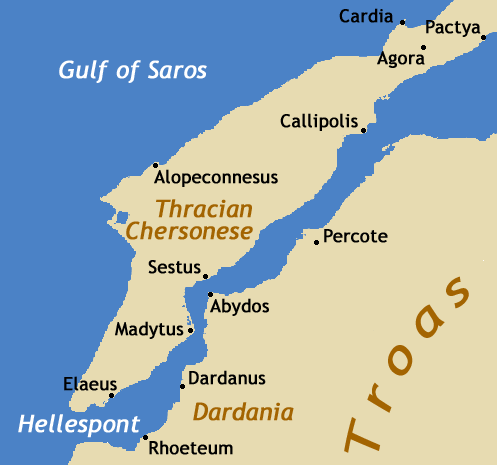
The strait in front of you had an older name. The Greeks called it the Hellespont. It is a long, narrow channel of water that links the Aegean Sea to the Sea of Marmara, and beyond that to the Black Sea. For thousands of years, ships passed here between two worlds. Armies crossed here too. Abydos grew up at one of the points where Asia and Europe come closest together.
The city was a Greek colony. Ancient writers say settlers from Miletus founded it. Miletus was a powerful trading city on the Aegean coast further south, and it planted colonies all around these waters. The reason is easy to see from where you stand. Whoever held this shore could watch every ship and take a share of every cargo. Across the water stood a partner town called Sestos. The two cities faced each other like gatekeepers.
Now for the story that made Abydos famous across the ancient world. In 480 BC, the Persian king Xerxes marched west to invade Greece. His army needed to cross the Hellespont. The Greek historian Herodotus tells us that his engineers built bridges of boats across the strait, from the shore near Abydos to the European side. Ships were lashed together, cables were stretched over them, and a road was laid on top.
Herodotus adds two details that visitors rarely hear. The first bridges broke in a storm. According to his account, Xerxes was so angry that he ordered the water itself to be whipped and punished. The second detail is quieter. Herodotus says the king sat on a throne of white marble on a hill near Abydos to watch his fleet and army. Seeing so many men, he wept, because none of them would be alive in a hundred years.
Here is the first surprise. Very little of Abydos survives above ground. There are no temple columns or theatre seats to walk through. The city was occupied for many centuries, and later builders carried away much of its stone. Today the site is mostly a quiet rise of earth, scattered fragments, and the shape of the land itself. If you came hoping for grand ruins, let the landscape do the work instead. The geography is the monument here.
Abydos also has a darker chapter. In 200 BC, Philip the Fifth of Macedon, a king from northern Greece, besieged the city. The Greek historian Polybius describes what followed. When defeat became certain, the people of Abydos chose to die rather than surrender. According to Polybius, many killed their own families and then themselves. It is a hard story to hold, standing on such a peaceful shore. But it shows how fiercely people fought for this small piece of coast.
The Hellespont carried more armies after that. When Alexander the Great began his invasion of the Persian Empire, ancient writers say most of his army crossed from Sestos to Abydos. Later came Romans, then Byzantine officials who collected tolls from passing ships. The pattern never really changed. Empires rose and fell, but this narrow water stayed the same, and Abydos stayed on guard beside it.
Now turn to the water again, because the most loved story of Abydos is a legend, not history. Locals and poets tell of Leander, a young man from Abydos, and Hero, a priestess of Aphrodite who lived in a tower at Sestos. Every night, Leander swam across the strait to see her. Hero lit a lamp in her window to guide him through the dark water.
One stormy winter night, the legend says, the wind blew out the lamp. Leander lost his way in the waves and drowned. At dawn, Hero saw his body on the shore below her tower. In her grief, she threw herself into the sea. The tale was retold by Greek and Roman poets, and much later by Christopher Marlowe and other writers in England. It turned this strait into a symbol of love that risks everything.
Here is the second surprise. In 1810, the English poet Lord Byron decided to test the legend. He swam the Hellespont between the European shore and the Abydos side, together with a naval officer. Byron was proud of it for the rest of his life and wrote a short, joking poem about the swim. Today, swimmers still cross the Dardanelles in an organised race each summer, following the path of Leander and Byron.
This headland carries more recent history too. The Turkish name for the point is Nara. In 1915, during the First World War, Allied fleets tried to force their way through the Dardanelles toward Istanbul. Forts and minefields on both shores defended the strait. This stretch of water was part of that defence. Parts of the area are still used by the military, so it is wise to respect any fences and signs you see.
Take one last look across the strait. Watch a cargo ship move slowly past, low in the water, heading for the Black Sea or the Aegean. A Persian king once watched this same water from a marble throne. A young man in a story swam it toward a lamp in the dark. Feel the wind on your face, and listen to the small waves on the stones. As you walk away, Europe will still be there across the water — just as close as it always was.
Key facts
What to look for
Practical tips
Common questions
Is there a free audio guide to Abydos?
Yes — the Lokali app narrates Abydos free of charge in 50+ languages. The guide runs about 6 minutes, covers the history, what to look for on site and practical tips, and works offline once downloaded.
Where is Abydos?
Abydos is in Canakkale, Türkiye, at 40.1953, 26.4050. Tap the map link on this page for directions from where you are.
What is Abydos known for?
Abydos was founded as a colony of Miletus. Xerxes bridged the Hellespont near here in 480 BCE.
What should you look for at Abydos?
European hills of the Gallipoli peninsula just across the water. Large cargo ships passing through the narrow channel. Scattered ancient stone fragments in the grass.
What should you know before visiting Abydos?
Bring a windproof layer; strong winds often blow down the strait. Respect fences and signs, as nearby land may be military.
When is the best time to visit Abydos?
Come in late afternoon to watch ships against softer light.
On the map
Opens directions to Abydos from your location.
More to see in Canakkale


Hear Abydos in your language
The full story, narrated, in 50+ languages. Download it before you go and it plays offline, at your own pace, with no ticket and no tour group.