Photo: Wikimedia Commons contributor · CC BY-SA 3.0 · Wikimedia Commons
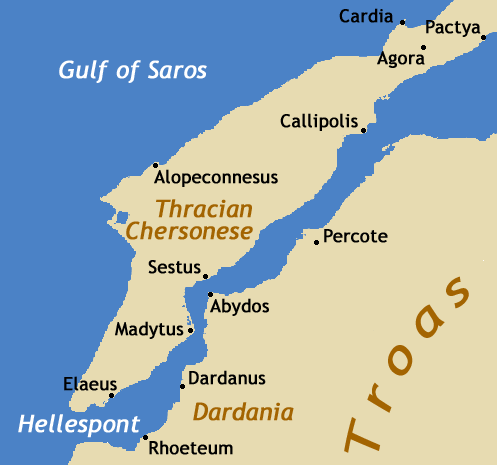
Sestos is an ancient city in Thrace. It is in Canakkale, Türkiye. Sestos stood on the European shore of the Hellespont. The free Lokali audio guide runs 7 minutes.
✓ Published October 2026 · how we write these guides
Visitor facts
| Lokali audio guide | 7 min · free |
|---|---|
| Type | Archaeological Site |
| Location | Canakkale, Türkiye |
| Coordinates | 40.2167, 26.3833 |
| Languages | 50+, in the Lokali app |
The story
Listen first. Water moves below you with a steady, restless sound. This is the Dardanelles, the narrow strait the ancient Greeks called the Hellespont. The current here runs fast and almost always in one direction, from the Sea of Marmara toward the Aegean. Wind comes off the water, and it carries salt and the smell of dry hillside grass. Across the channel, on the Asian shore, the land rises in soft brown folds. You are standing near Sestos, one of the oldest names on this coast.
Sestos was an ancient Greek city on the European side of the strait. It sat on the long, thin peninsula that the Greeks called the Thracian Chersonese. Today most visitors know that peninsula as Gallipoli. Directly opposite, on the Asian shore, stood its sister city, Abydos. For centuries, these two towns faced each other across the water like a pair of gatekeepers. Whoever held them could watch every ship that passed between the Black Sea and the Mediterranean.
Here is the first thing many visitors do not expect. Very little of the ancient city stands above ground today. There is no temple and no theatre to walk through. What remains is mostly the shape of the land itself — a low rise near the shore, scattered stones, and fields that farmers have worked for generations. So this is a place you experience with your imagination. The strait, the slopes, and the view across the water are the real monuments here.
Why did a city grow on this exact spot? Look at the water. The Dardanelles are long and narrow, and the shores come close together along this stretch. For an army, a merchant, or a traveller on foot, this was one of the best places to cross between Europe and Asia. A city here could charge for passage, protect a harbour, and control the grain ships that sailed past. Geography made Sestos important long before any famous name arrived.
Then, in 480 BC, a famous name did arrive. The Persian king Xerxes was marching west to invade Greece. The Greek historian Herodotus describes how his engineers built bridges of boats across the Hellespont, in the area between Abydos and Sestos. Ships were lashed together, and a road was laid on top. According to Herodotus, a storm destroyed the first bridges. The angry king then ordered the water itself to be whipped as punishment. Picture that scene on this calm shore.
The second bridge held, and Herodotus says the Persian army took days to cross. But the invasion failed. After major Greek victories, the war turned. In 479 BC, an Athenian force came to the Hellespont and besieged Sestos, which was then held by the Persians. The city eventually fell to the Athenians. Here is a quiet detail many people miss. The story of that siege comes near the very end of Herodotus's Histories. In a sense, one of the first great works of Western history finishes on this coast.
After the Persian Wars, Sestos became a valuable possession for Athens. Ships carrying grain from the Black Sea passed close by, and Athens depended on that grain. Holding Sestos helped to keep the route open. Over the following centuries, control of the city changed hands many times. Greek powers, then Hellenistic kings, and later the Romans all had an interest in this crossing. The town's fortunes rose and fell with the empires around it.
Now for the story that most people associate with this name. It is not history but legend, and it is one of the best-known love stories of the ancient world. Hero was said to be a priestess of Aphrodite, the goddess of love, who lived in a tower at Sestos. Leander was a young man from Abydos, on the far shore. Every night, according to the tale, he swam across the strait to meet her. Hero lit a lamp in her tower to guide him through the dark.
The legend ends in sorrow. On a stormy winter night, the wind blew out Hero's lamp. Leander lost his way in the waves and drowned. When Hero found his body on the shore at dawn, she threw herself from her tower so that she could die with him. Poets in Greece and Rome told this story, and later writers in Europe retold it again and again. Look across at the opposite shore, and the distance in the legend becomes very real.
Here is the second surprise. Someone tested the legend. In 1810, the English poet Lord Byron swam across the Hellespont, from the European side toward Asia, with a companion. He was proud of it and wrote about it in his letters and in a short, playful poem. He joked that Leander swam for love, while he swam for glory. Since then, many swimmers have followed. Today, an organised Dardanelles swim crosses the strait, though the route and conditions are carefully managed because of the current and the shipping.
And the shipping is worth watching. Turn toward the water and wait a few minutes. Large cargo ships and tankers move slowly through the channel, one after another. They are following the same route that grain ships followed in the time of Athens. The scale has changed, but the logic of the place has not. This strait is still one of the most important sea passages in the world. Sestos was built to watch exactly what you are watching now.
This peninsula also carries much more recent memories. During the First World War, the Gallipoli campaign brought fierce fighting to these hills and shores. Memorials and cemeteries stand across the peninsula, and many visitors combine a stop here with those sites. So, in one view, you can hold several layers of time together — Persian bridges, Athenian ships, a Greek legend, a Romantic poet, and the soldiers of the twentieth century.
Before you leave, stand still for one more moment. Feel the wind and listen to the water moving below. Look across to the Asian shore, where Abydos once stood, and try to judge the distance a swimmer would face in the dark. As you walk back, notice how the land slopes down to the strait. That simple shape — a shore that meets the water at a narrow crossing — is the reason this city existed at all.
Key facts
What to look for
Practical tips
Common questions
Is there a free audio guide to Sestos?
Yes — the Lokali app narrates Sestos free of charge in 50+ languages. The guide runs about 7 minutes, covers the history, what to look for on site and practical tips, and works offline once downloaded.
Where is Sestos?
Sestos is in Canakkale, Türkiye, at 40.2167, 26.3833. Tap the map link on this page for directions from where you are.
What is Sestos known for?
Sestos stood on the European shore of the Hellespont. Its sister city Abydos faced it on the Asian shore.
What should you look for at Sestos?
The Asian shore opposite, where ancient Abydos once stood. The fast surface current running toward the Aegean. Scattered old stones in the fields near the shore.
What should you know before visiting Sestos?
Bring a windproof layer because the strait is often breezy. Combine your visit with nearby Gallipoli memorial sites.
When is the best time to visit Sestos?
Come in late afternoon for softer light across the water.
On the map
Opens directions to Sestos from your location.
More to see in Canakkale


Hear Sestos in your language
The full story, narrated, in 50+ languages. Download it before you go and it plays offline, at your own pace, with no ticket and no tour group.