
Çanakkale Martyrs' Memorial
40.0502° N · 26.2193° E · Monument
Photo: Onder Kokturk · CC BY-SA 4.0 · Wikimedia Commons
Çanakkale Martyrs' Memorial is a World War I memorial in Turkey. Turkish name is Çanakkale Şehitleri Anıtı. The free Lokali audio guide runs 6 minutes.
✓ Published October 2026 · how we write these guides
Visitor facts
| Lokali audio guide | 6 min · free |
|---|---|
| Type | Monument |
| Location | Marmara Region, Türkiye |
| Coordinates | 40.0502, 26.2193 |
| Languages | 50+, in the Lokali app |
The story
Listen first. There is wind here, almost always. It comes off the water and moves through the dry grass of the headland. Under your feet the paving is warm and pale. Ahead of you, four great legs of stone rise from the ground and hold a flat roof high above the cliff. Below that roof, the sea is very still.
You are standing near the southern tip of the Gallipoli Peninsula, in the Marmara region of northwest Turkey. This is the Çanakkale Martyrs' Memorial. In Turkish it is called Çanakkale Şehitleri Anıtı. The word şehit means martyr. Here it means the soldiers who died defending this land. The memorial was built for them, and for the families who never saw them come home.
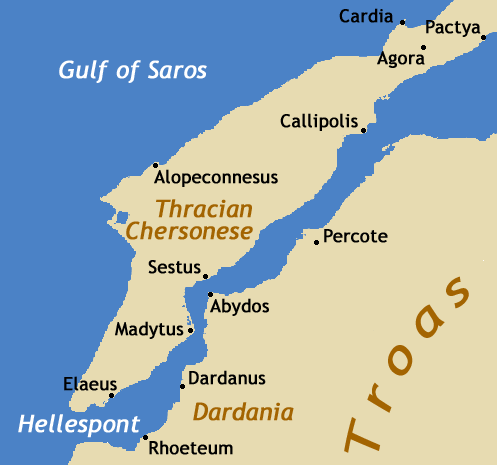
Look out past the edge of the headland. That narrow channel of water is the Dardanelles. It links the Aegean Sea with the Sea of Marmara, and beyond that, the Bosphorus and the Black Sea. For thousands of years, whoever controlled this strait controlled a road between continents. The far shore is Asia. You can see two continents from one viewpoint here — with very few places like it on earth.
In 1915, during the First World War, the Allied powers tried to force their way through this strait. Britain and France wanted to reach Istanbul, the Ottoman capital, and open a sea route to their ally Russia. On the 18th of March 1915, a large Allied fleet moved into the narrows. Ottoman mines and shore guns stopped it. Several warships were sunk or badly damaged. In Turkey, that day is still remembered every year.
After the naval attack failed, the Allies turned to the land. On the 25th of April 1915, troops came ashore on the beaches of this peninsula. Many of the soldiers came from Britain and France. Others came from Australia, New Zealand, India, and other parts of the British and French empires. Some of the landings happened on the shore just below where you stand now.
What followed was eight months of trench warfare. The lines barely moved. Summer brought heat, flies, and disease. Winter brought storms and frostbite. Ottoman soldiers held the high ground, and among their commanders was a young officer named Mustafa Kemal. Years later, he became Atatürk, the founder of the modern Turkish Republic. Here is something many visitors miss. For Turks, this campaign is not only a story of war — it is part of the story of how the nation itself began.
By January 1916, the Allies had withdrawn completely. The withdrawal itself was carried out quietly, mostly at night, with remarkably few losses. But the cost of the whole campaign was enormous on every side. Hundreds of thousands of men were killed or wounded. The Ottoman losses were the heaviest. Many of those soldiers have no known grave. That is part of why a monument of this size stands here.
Now turn back to the structure itself. The memorial was completed around 1960, after years of planning and construction. It is more than forty metres tall. Its design is simple — four square columns joined by a single heavy slab on top. From a distance it looks like a great stone gate, or a table set on the edge of the land. It is visible from ships passing through the strait, and from the hills around it.
Walk underneath it. This is the best way to feel its scale. The columns are broad and plain, and the roof feels very far above you. The space under the slab is open on all four sides. Wind passes straight through. Many visitors stand here in silence for a long moment. Children often go quiet too. The architecture does not tell you what to feel. It simply makes you small, and leaves the rest to you.
Around the memorial, look for the grounds and the symbolic cemetery nearby. Rows of stones carry the names of fallen soldiers. They do not mark individual graves. Instead, they stand for the many men whose bodies were never found or identified. Read a few names slowly. You will notice how many share the same family names, and how many came from small towns across Anatolia — the vast inland region of modern Turkey.
This memorial is part of a much larger landscape of remembrance. The whole peninsula is now a protected historical area. On a clear day you can see other monuments along this coast, including the tall British memorial at Cape Helles, not far to the west. Turkish, British, French, Australian, and New Zealand cemeteries lie scattered across these hills. Former enemies are remembered within sight of one another.
Every year, especially around the 18th of March and the 25th of April, many people travel here. Turkish school groups come in buses, often carrying flags. Families from Australia and New Zealand come to find the names of great-grandfathers. Some visitors leave flowers. Others leave nothing and simply stand at the railing. On quieter days, you may share this headland with only a few people and the sound of the wind.
Before you leave, walk to the edge once more and look at the water. Ships still pass through the Dardanelles — tankers, cargo ships, small fishing boats. The strait is calm and busy, just as it was before 1915. Behind you, the four columns hold their roof against the sky. As you walk back across the warm stone, listen again for the wind in the grass. It is the same wind those soldiers heard, more than a century ago.
Key facts
What to look for
Practical tips
Common questions
Is there a free audio guide to Çanakkale Martyrs' Memorial?
Yes — the Lokali app narrates Çanakkale Martyrs' Memorial free of charge in 50+ languages. The guide runs about 6 minutes, covers the history, what to look for on site and practical tips, and works offline once downloaded.
Where is Çanakkale Martyrs' Memorial?
Çanakkale Martyrs' Memorial is near Marmara Region, Türkiye, at 40.0502, 26.2193. Tap the map link on this page for directions from where you are.
What is Çanakkale Martyrs' Memorial known for?
Turkish name is Çanakkale Şehitleri Anıtı. Allied naval attack failed on 18 March 1915.
What should you look for at Çanakkale Martyrs' Memorial?
Four square columns supporting one flat stone slab. The Dardanelles strait with Asia on the far shore. Name stones in the nearby symbolic cemetery.
What should you know before visiting Çanakkale Martyrs' Memorial?
Visit on a weekday to avoid large school groups. Bring a windproof layer for the exposed headland.
When is the best time to visit Çanakkale Martyrs' Memorial?
Expect big crowds around 18 March and 25 April.
On the map
Opens directions to Çanakkale Martyrs' Memorial from your location.
More to see near Çanakkale Martyrs' Memorial


Hear Çanakkale Martyrs' Memorial in your language
The full story, narrated, in 50+ languages. Download it before you go and it plays offline, at your own pace, with no ticket and no tour group.