Cardia is an ancient city of Thrace in modern-day Turkey. Cardia's name comes from the Greek word for heart. The free Lokali audio guide runs 7 minutes.
✓ Published October 2026 · how we write these guides
Visitor facts
| Lokali audio guide | 7 min · free |
|---|---|
| Type | Archaeological Site |
| Location | Çanakkale, Türkiye |
| Coordinates | 40.5472, 26.7408 |
| Languages | 50+, in the Lokali app |
The story
Listen first. The wind comes in off the Gulf of Saros, steady and salty, and it pushes through low scrub and dry grass. The ground underfoot is pale and crumbly. Somewhere a dog barks from a farmhouse, and the sea makes a soft, constant hiss against the shore. There is no grand gate here and no marble colonnade. Yet this quiet stretch of coast once held a Greek city whose name travelled across the ancient world: Cardia.
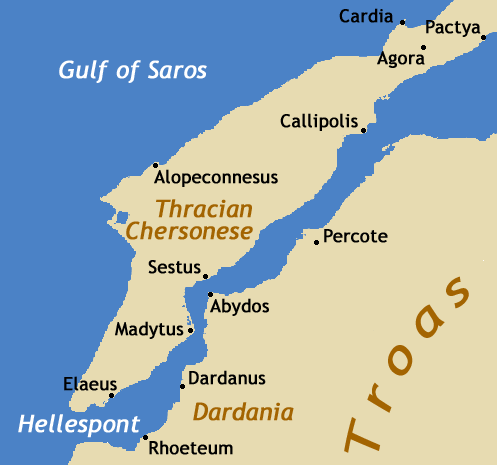
The name comes from the Greek word for heart. Ancient writers offered different explanations for it. One popular idea links the name to the shape of the land around the city. Whatever the true reason, the name fits the position well. Cardia sat close to the narrowest point of the Gallipoli Peninsula, the long arm of land the Greeks called the Thracian Chersonese. Whoever held this neck of land could control movement between Europe's mainland and the whole peninsula behind it.
Look at the geography around you, because geography is the whole story here. To one side lies the Gulf of Saros, which the ancient Greeks called the Black Gulf, or Melas. Only a few kilometres away, on the other side of the isthmus, lies the Sea of Marmara. Between them, the land is thin. A city here could watch both the sea lanes and the land road. That made Cardia useful to friends, and a target for rivals.
Ancient sources say the first settlers were Greek colonists from the cities of Miletus and Clazomenae, on the coast of what is now western Turkey. Later, in the sixth century before Christ, Athenians arrived. They came under Miltiades the Elder, an Athenian aristocrat who became ruler of the Chersonese. This is not the Miltiades who won the battle of Marathon. That famous general was his nephew, who also ruled here for a time before returning to Athens.
Herodotus, the Greek historian, tells us what the elder Miltiades did next. He built a wall across the isthmus, running from Cardia to a settlement called Pactya on the far shore. The purpose was simple. The wall protected the Greek towns of the peninsula from raids by Thracian tribes to the north. Nothing obvious of that wall survives for a casual visitor to see today. But as you stand here, picture a long barrier of stone and earth crossing the land behind you.
Now for a story that most visitors never hear. According to a tale preserved by later ancient writers, the people of Cardia trained their horses to dance to the music of the pipe. It was a party trick, a sign of luxury. Then, the story goes, an enemy learned the secret. During a battle, they played pipes, the Cardian horses began to dance, and the riders lost control. Treat it as a legend. But it tells you how the Greeks saw Cardia: wealthy, clever, and perhaps a little too pleased with itself.
In the fourth century before Christ, Cardia found itself between two powers. Athens wanted control of the Chersonese and its grain route to the Black Sea. Philip the Second of Macedon, father of Alexander the Great, was expanding his kingdom eastward. Cardia chose Philip's side. When an Athenian commander clashed with the Cardians, the dispute became serious news in Athens. The orator Demosthenes discussed these events in his speech known as On the Chersonese. A small city on this shore had become part of a great political argument.
Here is the second surprise. Cardia produced one of the most remarkable men of Alexander's age. Eumenes of Cardia served as secretary to Philip, and then to Alexander himself. He was a Greek among Macedonian generals, a man of records and letters rather than noble birth. After Alexander's death, the empire broke apart into wars between his commanders. Eumenes became a general in those wars, and ancient writers describe him as unusually skilful. His Greek origin, though, always made him an outsider among the Macedonian elite.
Cardia gave the world another important figure: Hieronymus of Cardia, a relative of Eumenes. Hieronymus lived a long life and wrote a history of the years after Alexander. That work is now lost. However, later historians used it heavily, so a great deal of what we know about that violent period comes, indirectly, from a man of this town. In a sense, part of ancient history was written through Cardian eyes.
The city's end came from one of those same successor kings. Lysimachus, who ruled Thrace after Alexander, founded a new city nearby and named it Lysimachia, after himself. Ancient sources report that Cardia was destroyed, and its people were moved into the new foundation. It was a common practice for Hellenistic kings. They emptied old towns to fill new capitals. And so Cardia, after centuries on this coast, lost its independent life.
Today, very little of the ancient city stands above the ground. Do not expect temple columns or a theatre. Scholars still discuss the exact extent of the site, and much of what remains lies under fields or soil. This can feel disappointing at first. But it also makes the place honest. What you have here is the land itself: the same shoreline, the same narrow isthmus, the same wind that the colonists, the Athenians and the Macedonians all knew.
So use your eyes for the landscape. Notice how low the land is, and how quickly the ground falls toward the water. Notice the colour of the Gulf of Saros, often a clear blue-green on calm days. Look along the coast and imagine small Greek ships pulled up on the beach, and merchants unloading pottery, wine and oil. Look inland and think of the Thracian hills beyond, where the tribes that worried Miltiades once lived.
This peninsula has seen many armies since then. Byzantine, Ottoman and modern soldiers all understood the value of this narrow neck of land. The same logic that placed a Greek city here placed later forts and defences nearby. Cardia was simply one of the first to recognise it. History here is layered, and the oldest layer is the quietest.
Before you leave, stand still for a moment and face the sea. Feel the wind on your face, and listen to the water on the shore. Somewhere beneath the grass around you lie the traces of a city that trained dancing horses, argued with Athens, and raised a secretary to Alexander. As you walk back, look at the ground at your feet. A broken piece of old pottery, or a worked stone, may be closer than you think.
Key facts
What to look for
Practical tips
Common questions
Is there a free audio guide to Cardia?
Yes — the Lokali app narrates Cardia free of charge in 50+ languages. The guide runs about 7 minutes, covers the history, what to look for on site and practical tips, and works offline once downloaded.
Where is Cardia?
Cardia is near Çanakkale, Türkiye, at 40.5472, 26.7408. Tap the map link on this page for directions from where you are.
What is Cardia known for?
Cardia's name comes from the Greek word for heart. Founded by colonists from Miletus and Clazomenae.
What should you look for at Cardia?
The narrow isthmus between the Gulf of Saros and Marmara. Clear blue-green water along the Gulf of Saros shore. Pottery fragments scattered in ploughed field soil.
What should you know before visiting Cardia?
Bring water and sun protection; the coast has little shade. Wear sturdy shoes for uneven fields and loose soil.
On the map
Opens directions to Cardia from your location.
More to see in Canakkale


Hear Cardia in your language
The full story, narrated, in 50+ languages. Download it before you go and it plays offline, at your own pace, with no ticket and no tour group.