
Lampsacus
40.3439° N · 26.6836° E · Archaeological Site
Photo: Wikimedia Commons contributor · Public domain · Wikimedia Commons
Lampsacus is an ancient city of Troas in modern-day Turkey. Lampsacus stood where modern Lapseki stands today. The free Lokali audio guide runs 7 minutes.
✓ Published October 2026 · how we write these guides
Visitor facts
| Lokali audio guide | 7 min · free |
|---|---|
| Type | Archaeological Site |
| Location | Gelibolu, Türkiye |
| Coordinates | 40.3439, 26.6836 |
| Languages | 50+, in the Lokali app |
The story
Stand at the water's edge and listen. Small waves slap against the stones, a ferry engine hums somewhere out in the channel, and gulls argue overhead. The air smells of salt and diesel and, on warm days, of dry grass from the hills. Across this narrow stretch of water lies the other shore. On that shore, almost three thousand years ago, a Greek city called Lampsacus looked back at you.
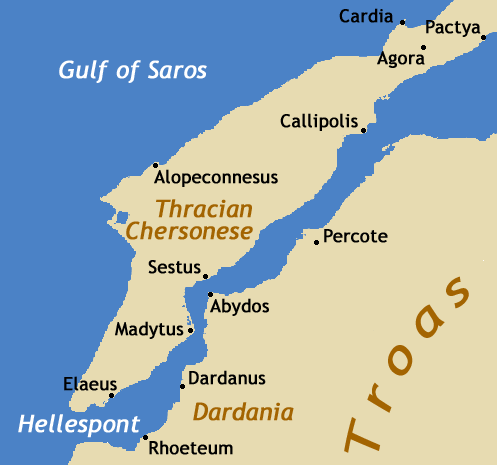
The water in front of you is the Dardanelles. The ancient Greeks called it the Hellespont. It is a long, narrow strait that joins the Aegean Sea to the Sea of Marmara, and it divides Europe from Asia. Gelibolu sits on the European side. Lampsacus stood on the Asian side, where the modern town of Lapseki stands today. The name has survived, worn down over the centuries, like a coin passed through many hands.
The city began as a Greek colony. Ancient writers say settlers came from Phocaea, a seafaring Greek city on the Aegean coast of what is now Turkey. The traditional date for the founding is the middle of the seventh century before Christ. Some sources say the place had an earlier name, Pityusa, which comes from the Greek word for pine. It is easy to imagine why. Even now, the hills behind the shore carry dark green trees.
That pine connection appears in one of the best stories about Lampsacus. The historian Herodotus tells it. In the sixth century before Christ, the people of Lampsacus captured an Athenian leader called Miltiades. The king Croesus of Lydia, a powerful ally of Miltiades, sent a warning. Release him, Croesus said, or I will cut you down like a pine tree. The people of Lampsacus were puzzled. Then an old man explained. A pine, once cut, never grows again from its stump. They released Miltiades.
Why did anyone fight over this place? Look at the water. Every ship moving between the Black Sea and the Mediterranean had to pass through this strait. Grain from the north, wine and oil from the south, soldiers in both directions. A city on this shore could watch the traffic, trade with it, and grow rich. Lampsacus did exactly that. It also had a harbour, fertile land, and good water.
And it had vineyards. In the ancient world, the wine of Lampsacus had a strong reputation. Here is a detail that surprises many visitors. After the Athenian general Themistocles fell from power, he fled to the Persian Empire. The Persian king gave him several cities to support him. According to ancient writers, Lampsacus was given to supply his wine. An exiled Greek hero, living on the wine of the coast across from where you stand.
Lampsacus moved between powerful neighbours. It came under Persian rule. Later, it joined the alliance of Greek cities led by Athens, known as the Delian League. Near the end of the long war between Athens and Sparta, the Spartan commander Lysander took the city. Soon after, in 405 BC, the Athenian fleet was destroyed at Aegospotami, a beach on the European shore, not far from where you are now. That defeat effectively ended the war.
The city was also a place of ideas. The philosopher Anaxagoras, who taught that the sun was a burning mass of stone, was forced to leave Athens. He spent his last years in Lampsacus and died there. Ancient writers say the people honoured him with an annual holiday for schoolchildren. Later, the philosopher Epicurus taught in Lampsacus for a time and gathered friends and students there before he founded his famous school in Athens.
There is a stranger side to the city's fame. Lampsacus was a centre for the worship of Priapus, a minor god of gardens, fields, and fertility. Local tradition claimed he was born here. In ancient art he appears as a rustic figure, often placed in orchards and vineyards to protect the crops. For a city that lived from its land and its wine, a guardian of gardens made practical sense.
Lampsacus also made beautiful money. Its coins often show the front half of a winged horse, wings spread, as if it is rising from the sea. The city struck coins in silver and in gold. Today these coins sit in museum collections around the world. For many people, a small coin is the only physical piece of Lampsacus they will ever hold in their hand.
Now, an honest word about what you can see. Very little of the ancient city stands above ground. There is no great temple or theatre waiting on the far shore. Over many centuries, stone was reused, buildings fell, and the modern town grew over the old one. Lampsacus lives mostly in texts, in coins, and in the shape of the land itself. So the best way to see it is to look at its setting.
From here, look across the strait and follow the line of the opposite coast. Notice how the hills slope down to a gentle shore, good for a harbour and for farming. Watch a ship move through the channel and think of the triremes, the oared warships of the ancient Greeks, rowing the same route. If you take the car ferry from Gelibolu across to Lapseki, you will make the same short crossing that sailors made for thousands of years.
The modern town on that shore is quiet and agricultural. Orchards and fields cover the slopes, and the rhythm of the place follows the seasons. In a way, little has changed in the basic logic of life here. The land still feeds people. The water still carries traffic between two seas. The two shores still look at each other across a narrow strait.
Before you turn away, take one more look at the far side. Somewhere under those streets lies a city where a philosopher died, an exile drank its wine, and a king compared its people to a pine tree. Listen again to the waves on the stones beneath you. They are the same sound the people of Lampsacus heard, every day, as they looked toward this shore.
Key facts
What to look for
Practical tips
Common questions
Is there a free audio guide to Lampsacus?
Yes — the Lokali app narrates Lampsacus free of charge in 50+ languages. The guide runs about 7 minutes, covers the history, what to look for on site and practical tips, and works offline once downloaded.
Where is Lampsacus?
Lampsacus is near Gelibolu, Türkiye, at 40.3439, 26.6836. Tap the map link on this page for directions from where you are.
What is Lampsacus known for?
Lampsacus stood where modern Lapseki stands today. Greek colonists from Phocaea founded it in the seventh century BCE.
What should you look for at Lampsacus?
The gentle sloping shoreline that once held the ancient harbour. Pine trees on the hills, echoing the old name Pityusa. Cargo ships following the same channel as ancient triremes.
What should you know before visiting Lampsacus?
Take the car ferry from Gelibolu across to Lapseki. Bring binoculars to study the opposite coastline in detail.
When is the best time to visit Lampsacus?
Visit on a clear morning for the sharpest view across.
On the map
Opens directions to Lampsacus from your location.
More to see in Gelibolu

Hear Lampsacus in your language
The full story, narrated, in 50+ languages. Download it before you go and it plays offline, at your own pace, with no ticket and no tour group.