
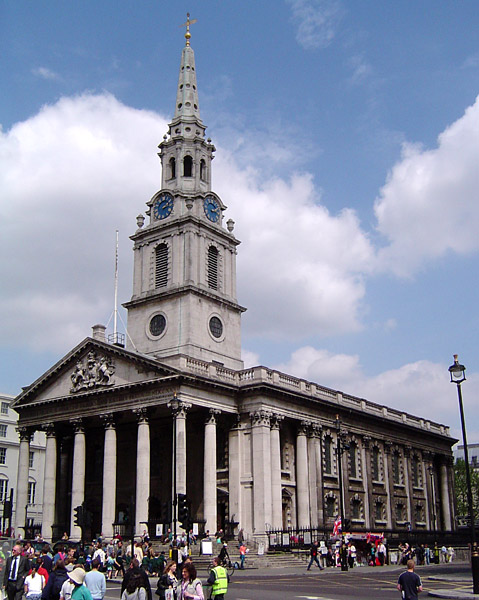
Photo: Beata May · CC BY-SA 3.0 · Wikimedia Commons
Nelson's Column is a victory column in London. It is in Westminster, United Kingdom. Commemorates Admiral Nelson, killed at Trafalgar in 1805. The free Lokali audio guide runs 8 minutes.
✓ Published October 2026 · how we write these guides
Visitor facts
| Lokali audio guide | 8 min · free |
|---|---|
| Type | Monument |
| Location | Westminster, United Kingdom |
| Coordinates | 51.5078, -0.1279 |
| Languages | 50+, in the Lokali app |
The story
Stand still for a moment and listen. Water falls from the fountains behind you. Buses brake and sigh along the edge of the square. Pigeons scatter and settle on warm stone. Then tilt your head back, slowly, and follow the long grey shaft upward until your neck aches. At the very top, small against the sky, a figure in a cocked hat looks out over London. This is Nelson's Column, at the heart of Trafalgar Square.
The man up there is Horatio Nelson, Britain's most celebrated admiral. In 1805, off the coast of Spain near Cape Trafalgar, his fleet met the combined navies of France and Spain. The British won a decisive victory. But Nelson was shot during the battle and died aboard his flagship, HMS Victory, before the fighting ended. The nation was stunned. His victory and his death arrived in London together, and grief and celebration became tangled into one.
It took more than three decades for London to build him a proper monument here. In the late 1830s, a competition was held for the design. The winner was the architect William Railton. Construction began around 1840, and the column and statue were in place by the early 1840s. The square itself was being shaped at the same time, under the architect Charles Barry. So the column and the square grew up together, almost like a stage and its central actor.
Look closely at the shaft. It is a Corinthian column, the most decorative of the classical styles, borrowed from ancient Greece and Rome. You can see the long vertical grooves, called fluting, running up its length. At the top, the capital flares out into bronze leaves, modelled on the acanthus plant. The stone is granite, brought from Dartmoor in the south-west of England. It is hard, grey, and flecked, built to survive centuries of rain and smoke.
Now, the height. For many years, people quoted a figure that turned out to be too generous. When the monument was surveyed during restoration work in the 2000s, it proved to be a little shorter than the books had claimed. Even so, the whole structure stands at roughly fifty metres, statue included. That is about the height of a fifteen-storey building. From the ground, Nelson himself looks modest. In reality, the statue is several times taller than a person.
The statue was carved by the sculptor Edward Hodges Baily, from sandstone rather than bronze. Notice the details, even from down here. Nelson lost his right arm in an earlier battle, and the sculptor shows an empty sleeve pinned to his coat. He also leans lightly on a coil of rope, a reminder of the ship's deck. A popular story says that before the statue was lifted into place, a group of stonemasons held a dinner on top of the column. It is a charming image, though best treated as London lore.
Walk to the base and you will find four large bronze panels, one on each side of the pedestal. Each shows a scene from Nelson's naval career. There is the Battle of Cape Saint Vincent, the Battle of the Nile, and the Battle of Copenhagen. The fourth, facing south toward Whitehall, shows his death at Trafalgar. Here is a detail most visitors miss. The bronze for these panels is said to have come from melted-down cannon captured from the enemy. Nelson's defeated opponents, quite literally, became part of his memorial.
Then there are the lions. Four of them lie at the corners, heavy and calm, guarding the base. They were not part of the original monument. They arrived in 1867, more than twenty years after the column went up. The painter Sir Edwin Landseer designed them, and the bronze casting was carried out by the sculptor Carlo Marochetti. Landseer was famous for painting animals, especially dogs and stags. Some people say his lions have paws that look a little like a house cat's. Look for yourself and decide.
Take a moment to notice where Nelson is facing. He looks south, down Whitehall, toward the Houses of Parliament. Locals like to say he is gazing toward the sea and the naval town of Portsmouth, keeping watch over his fleet. That is a nice idea, and partly true in direction. From his position, he would also see the clock tower of the Palace of Westminster. In a way, the admiral watches over the government itself.
The column has also lived through dangerous times. During the Second World War, London was heavily bombed, yet the monument came through standing. According to one widely repeated tale, Hitler planned to take the column to Berlin as a trophy if Germany invaded Britain. Historians treat this story with some caution. But it shows how deeply this monument is tied to the idea of British resistance. For many people, it is not only about one admiral. It is about the nation holding firm.
For much of its life, the column shared the square with huge flocks of pigeons. Tourists fed them, and the birds became part of the scene. In the early 2000s, the city banned feeding them here, and trained birds of prey were brought in to discourage the flocks. You will still see pigeons today, but far fewer than older visitors remember. The stone of the column and lions is cleaner as a result. Restoration work has also removed decades of grime from the granite.
Now turn slowly and look around the square. To the north, behind the fountains, stands the long facade of the National Gallery. In the corners are plinths with other statues. One of them, the fourth plinth in the north-west corner, stood empty for many years. Today it carries a changing series of modern artworks, often playful, sometimes controversial. So the square mixes old victories with new art. Nelson, high above it all, has watched every one of these debates arrive and depart.
Trafalgar Square is also London's gathering place. People come here to protest, to celebrate, and to mourn. Crowds have filled this space for elections, sporting victories, and New Year's Eve. At Christmas, a large tree stands nearby, sent each year by Norway as a thank-you for British help during the Second World War. The column is the fixed point in all of it. Whatever the crowd is shouting about, Nelson stands in the middle, silent and patient.
Before you move on, look up one more time. Follow the fluted granite from the lions to the bronze leaves, and then to the small grey figure at the top. Feel the stone under your hand if you are close to the base. Listen again to the fountains and the traffic. Two centuries ago, a battle at sea decided the shape of this place. Today, it is simply a square where people sit, talk, and look up — just as you are doing now.
Key facts
What to look for
Practical tips
Common questions
Is there a free audio guide to Nelson's Column?
Yes — the Lokali app narrates Nelson's Column free of charge in 50+ languages. The guide runs about 8 minutes, covers the history, what to look for on site and practical tips, and works offline once downloaded.
Where is Nelson's Column?
Nelson's Column is in Westminster, United Kingdom, at 51.5078, -0.1279. Tap the map link on this page for directions from where you are.
What is Nelson's Column known for?
Commemorates Admiral Nelson, killed at Trafalgar in 1805. Column designed by architect William Railton.
What should you look for at Nelson's Column?
Nelson's empty right sleeve pinned to his coat. Bronze panel showing Nelson's death, facing Whitehall. Acanthus leaves on the bronze capital at the top.
What should you know before visiting Nelson's Column?
Visit early morning for fewer crowds around the base. View the column from the National Gallery's north terrace.
When is the best time to visit Nelson's Column?
Visit early morning for fewer crowds around the base.
On the map
Opens directions to Nelson's Column from your location.
More to see in Westminster


Hear Nelson's Column in your language
The full story, narrated, in 50+ languages. Download it before you go and it plays offline, at your own pace, with no ticket and no tour group.